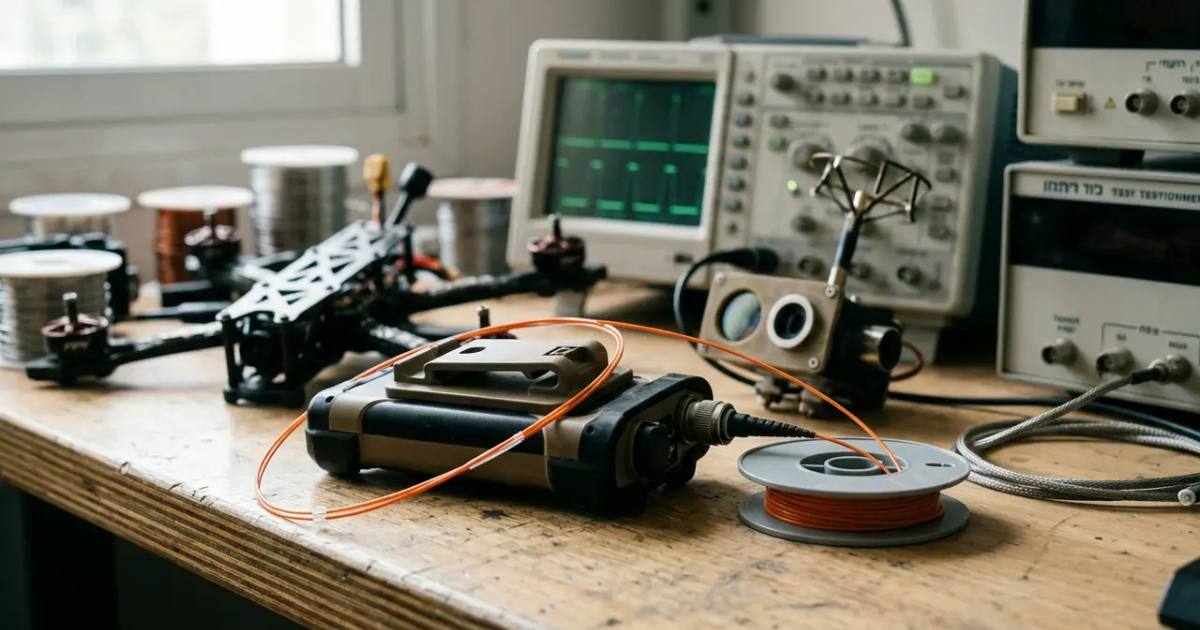

Autonomous Guard is negotiating a controlling stake in an Israeli firm building soldier-worn detection for fiber-optic-guided drones, a threat category current jammers cannot stop.
Autonomous Guard, the Kfar Saba-based parent of counter-drone firms Skylock and BeeSense, has entered advanced negotiations to acquire a controlling stake in an Israeli company that makes a soldier-worn detection system for fiber-optic-guided drones, a threat category that has proven difficult to counter on modern battlefields. Autonomous Guard's shares jumped roughly 7 percent on the Tel Aviv Stock Exchange after the announcement, according to Techtime's April 27, 2026 report.
What does the acquisition target actually do?
The unnamed target company has developed a personal, soldier-carried system for detecting drones that are guided by fiber-optic cable rather than radio-frequency signals, according to Techtime. Fiber-optic-guided drones cannot be jammed using conventional electronic warfare because they do not transmit a wireless control signal, a gap that has made them an increasingly serious problem for infantry units. The U.S. Army's own public materials describe fiber-optic spool-fed drones as a persistent threat that current countermeasures struggle to defeat, noting that adversaries have exploited this blind spot extensively in the Russia-Ukraine war.
The drones themselves are small and difficult to spot by conventional means. They fly tethered to an operator by a thin optical cable that can stretch for miles, which means they throw off almost no radio signal, minimal radar signature, and little thermal profile compared to radio-controlled alternatives. A soldier-worn detector aimed at this threat category would need to rely on acoustic, visual, or other passive sensing rather than the radio-frequency scanning that most existing wearable counter-drone kits use.
Why has this threat become urgent for Israeli forces specifically?
Fiber-optic drones first appeared on the battlefield in Ukraine roughly two years before the technology reached Israel's northern front, according to CNN's June 2026 reporting on Hezbollah's adoption of the tactic. CNN reported that at least 12 Israeli soldiers were killed by Hezbollah drones since fighting resumed in March 2026, accounting for roughly one third of Israeli fatalities in Lebanon during that period, and that the fiber-optic variants are especially difficult to detect because they do not rely on a radio link.
The scale of the problem reportedly reached the highest levels of Israeli government. Breaking Defense reported in May 2026 that Prime Minister Benjamin Netanyahu called an urgent meeting to address the threat after Israeli troops came under sustained attack from first-person-view drones in Lebanon, many of them fiber-optic guided and therefore resistant to jamming. Smart Shooter CEO Michal Mor told Breaking Defense that the drone threat had become one of the most urgent operational challenges facing Israeli forces. Separately, Israel Defense reported in May 2026 that Israel Aerospace Industries, Elbit Systems, and Rafael Advanced Defense Systems were all accelerating development of fiber-optic countermeasures under pressure from the Ministry of Defense's Directorate of Defense Research and Development, though the outlet cited defense sources who said the pace of development still lagged behind warnings submitted over the prior one to two years.
What are the deal terms?
Autonomous Guard has signed a non-binding memorandum of understanding to acquire 17 percent of the target company for 3 million shekels, roughly 800,000 dollars, Techtime reported. A second phase would add approximately 6 million shekels of investment through a new share allocation, bringing Autonomous Guard's total holding to about 51 percent, for a combined investment of roughly 9 million shekels once the deal closes. The companies have entered a 45-day due diligence period, according to the same report.
How does this fit into Autonomous Guard's existing business?
Autonomous Guard operates through two subsidiaries, Skylock and BeeSense Sensor Systems, which merged into a single parent structure in mid-2025 to combine counter-drone jamming with multi-domain sensing, according to Techtime's coverage of the merger. Skylock specializes in detecting and neutralizing hostile drones, while BeeSense focuses on border and perimeter threat detection across land, air, and sea.
The company has been expanding briskly through 2026. The Jerusalem Post reported in February 2026 that Autonomous Guard signed a memorandum of understanding to supply its Bee 3 dual-channel observation system to an Indian security client, marking its first entry into that market. The following month, The Defense Post reported that Israel's own Ministry of Defense awarded Autonomous Guard two new contracts worth a combined 3.5 million dollars for follow-on drone detection and sensor orders.
How big is the broader counter-drone market Autonomous Guard is chasing?
The global counter-drone market is projected to grow from about 6.64 billion dollars in 2025 to 20.31 billion dollars by 2030, a compound annual growth rate of roughly 25.1 percent, according to a Drone Intelligence forecast published in June 2026 citing MarketsandMarkets data. The Middle East and Africa segment of that market is forecast to grow even faster, at roughly 27.7 percent annually, with Gulf states approaching 28.5 percent, the report found. Established Israeli primes including Rafael, Israel Aerospace Industries, and Elbit Systems compete in that space alongside newer entrants such as Autonomous Guard, while U.S. firms like Anduril and Epirus and the UAE's EDGE Group round out the field of major vendors the report identified.
Against that backdrop, a working solution to the fiber-optic detection gap would give Autonomous Guard a product category that few competitors currently offer at the individual-soldier level, since most existing wearable counter-drone kits are built around radio-frequency detection rather than the passive sensing methods needed to catch a tethered, non-transmitting drone.
Sources: Techtime, April 27, 2026 and October 2025 (Hebrew-language, translated and paraphrased by The Olam); CNN; Breaking Defense; Israel Defense; The Jerusalem Post; The Defense Post; Drone Intelligence; U.S. Army official materials on fiber-optic drone threats.