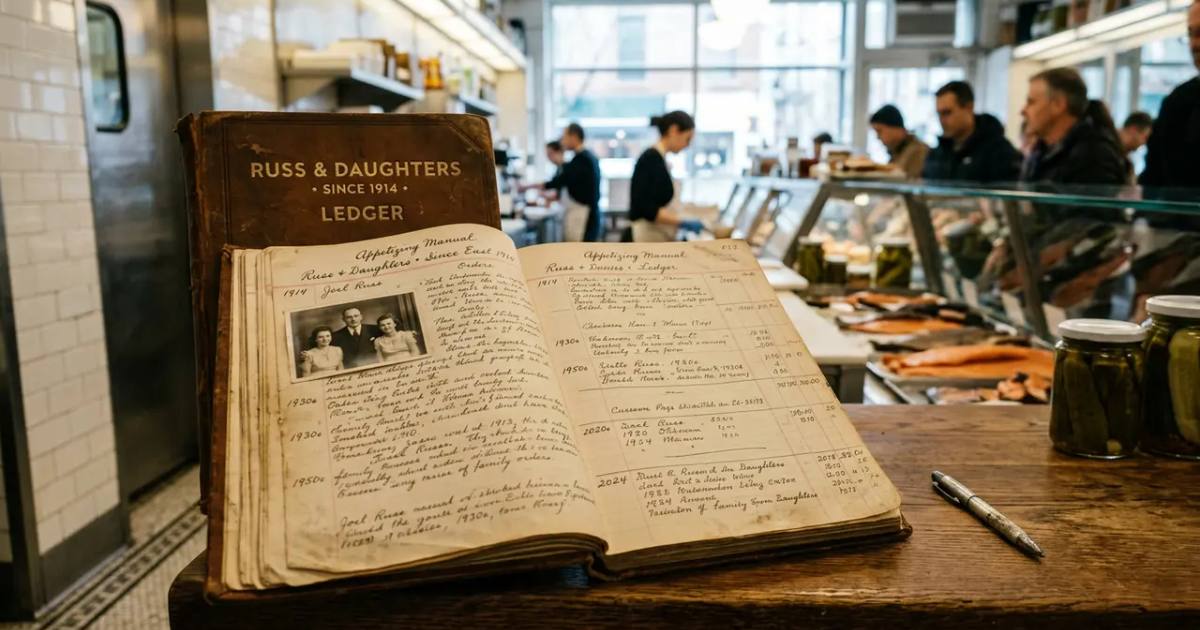

Russ & Daughters, founded in 1914 by Joel Russ on Manhattan's Lower East Side, remains owned by the fourth generation of the same family. It was the first known American business to use "& Daughters" in its name.
Russ & Daughters is a fourth-generation, family-owned appetizing store founded in 1914 by Polish Jewish immigrant Joel Russ on Manhattan's Lower East Side. It became the first known American business to use "& Daughters" in its name after Russ made his three daughters full partners in 1935, and remains owned and operated by the same family across four generations today.
Who founded Russ & Daughters?
Joel Russ immigrated from Strzyzow, in what is now Poland, arriving in Manhattan around 1905, according to Wikipedia's documented company history. He began selling schmaltz herring and Polish mushrooms from a shoulder pack, then a pushcart, before opening his first storefront, J. Russ International Appetizers, around the corner from the current location in 1914.
In 1920, Russ moved the business to 179 East Houston Street, where it remains today. Having no sons, Russ brought his three daughters, Hattie, Ida, and Anne, into the business from their teenage years, according to the company's own history. In 1933, he renamed the business "Russ & Daughters" after formally making them full partners, a move the company describes as the first known use of "& Daughters" in an American business name.
This origin sets Russ & Daughters apart from most Jewish-owned businesses profiled in this series, which typically trace ownership through fathers and sons. The Russ family business instead ran through three sisters for its formative second generation, a structural choice unusual for early 20th-century American retail regardless of religious or ethnic background.
How did ownership pass through four generations?
The daughters ran the store together until 1979, when Anne's son Mark Russ Federman left a legal career to become the third-generation owner, running the business with his wife Maria for three decades, according to the company's documented history. Mark Russ Federman later wrote a memoir about the business titled "Russ & Daughters: The House That Herring Built."
In 2009, cousins Josh Russ Tupper and Niki Russ Federman took over as fourth-generation owners, a milestone the company notes explicitly: fewer than 1 percent of American family businesses survive long enough to reach a fourth generation of ownership. The transition kept operational control inside the family across more than a century, a pattern distinct from Eichler's Judaica, where the original founding family's Boro Park store passed to an outside investor in 2024 while only the separate Flatbush location stayed family-owned.
The generational math is worth stating plainly: Russ & Daughters has now operated under the same family's control for 112 years as of 2026, spanning the Great Depression, multiple recessions, the rise of supermarket chains, and the growth of e-commerce, without a sale to an outside buyer at any point in its history.
How many Russ & Daughters locations exist today?
The original Houston Street shop anchors a footprint that has expanded steadily since the fourth generation took over. Josh Russ Tupper and Niki Russ Federman opened Russ & Daughters Cafe on Orchard Street in 2014, marking the business's 100th anniversary on the same street where Joel Russ once sold herring from a barrel, according to the company's own history.
A takeout counter and restaurant followed at the Jewish Museum in 2016. In 2019, the company opened a Brooklyn location at the Brooklyn Navy Yard that serves as both a retail counter and the company's nationwide shipping hub, complete with an in-house bakery producing bagels, bialys, and babka. A fourth retail location opened at 502 West 34th Street in Manhattan in 2023.
This expansion pattern, adding one new location roughly every four to five years since 2014, contrasts with the single-location model maintained by B&H Photo Video, which has stayed concentrated in one Manhattan superstore despite comparable brand recognition and a similarly long operating history.
| Detail | Figure | Source |
|---|---|---|
| Founded | 1914 | Wikipedia, company history |
| Original founder | Joel Russ | Wikipedia |
| Name changed to Russ & Daughters | 1933 | Wikipedia |
| Current owners (4th generation) | Josh Russ Tupper, Niki Russ Federman (since 2009) | Company history |
| Number of physical locations | 4 (Houston St, Orchard St Cafe, Brooklyn Navy Yard, 34th St) | Company history |
| Employees (Houston St location) | ~18 | Buzzfile |
| Employees (Brooklyn Navy Yard operation) | ~95 | Buzzfile |
| Revenue estimate (flagship location) | ~$3.4 million/year | Buzzfile |
| Revenue estimate (Brooklyn Navy Yard operation) | ~$5.5 million/year | Buzzfile |
What is an appetizing store, and why does the category matter?
"Appetizing" describes a specifically American Jewish food tradition centered on the foods eaten alongside bagels: smoked and cured fish, caviar, and homemade salads and cream cheeses, distinct from a kosher deli's focus on meat, according to the company's own definition of the category. Russ & Daughters is recognized by the Center for Jewish History as the second-oldest surviving appetizing store in New York City.
The category has drawn institutional recognition beyond retail sales figures. Russ & Daughters' contributions have been formally acknowledged by the New York City Mayor's Office, the Manhattan Chamber of Commerce, the Smithsonian Institution, and the Foundation for Jewish Culture, and the New York State Senate unanimously passed a resolution commending the business on its 100th anniversary, according to the company's own account of these honors.
The term "appetizing" itself derives from the Latin "appete," meaning to desire or long for, and the company's own materials describe the category as encompassing everything one eats alongside a bagel rather than a single dish or product line. This distinguishes appetizing stores from delicatessens, which center on cured and smoked meats rather than fish and dairy.
How big is Russ & Daughters as a business today?
Revenue estimates vary by location and data source, reflecting the company's multi-entity structure rather than a single consolidated business. LeadIQ's June 2025 data placed total annual revenue at $2.6 million across roughly 51 employees, while Buzzfile's location-level estimates separately place the original Houston Street shop at approximately $3.4 million in annual revenue with about 18 employees, and the Brooklyn Navy Yard operation, listed under the entity name Russ Ops, at roughly $5.5 million with about 95 employees.
The spread across these estimates points to a business that operates as several legally distinct but commonly branded entities rather than one centralized corporate structure, a common pattern among multi-location family food businesses that expand location by location rather than through a single franchise or corporate parent. Public records reviewed by Tracxn show Russ & Daughters has never raised outside investment capital, financing its four-location expansion entirely through internally generated revenue rather than external funding rounds.
Who are Russ & Daughters' closest competitors?
Within the appetizing and Jewish deli category, Russ & Daughters competes most directly with other Lower East Side and citywide institutions serving smoked fish, bagels, and traditional Jewish comfort food, though few match its combination of century-plus continuous family ownership and documented landmark status. Broader grocery and specialty food retailers such as Sprouts Farmers Market and Safeway appear as competitors in business-database comparisons like Tracxn, though these track general food retail rather than the specific appetizing category Russ & Daughters occupies.
The company's closest direct comparison within Jewish food retail on generational continuity is limited: few Jewish-owned food businesses of comparable age have kept ownership inside the founding family across four full generations without a sale, franchise, or outside investment.
What has Russ & Daughters' 100th anniversary meant for the business?
The 2014 centennial functioned as an inflection point that shifted the business from a single storied storefront into a small multi-location group. Opening the Orchard Street cafe in the same year the company turned 100 was a deliberate choice, according to company materials, situated on the same street where Joel Russ began selling herring from a barrel more than a century earlier.
The documentary "The Sturgeon Queens," which premiered around the store's centennial, further cemented the business's cultural profile beyond its immediate customer base, contributing to broader recognition efforts including the 2008 PBS documentary "The Jews of New York," which had earlier featured three generations of the Russ family discussing the shop's history.
Frequently asked questions about Russ & Daughters
Who owns Russ & Daughters today? Fourth-generation cousins Josh Russ Tupper and Niki Russ Federman, who took over in 2009 and remain the current owners.
When was Russ & Daughters founded? 1914, when Joel Russ opened his first storefront around the corner from the shop's current location on East Houston Street.
Why is it called Russ & Daughters? Joel Russ renamed the business after his three daughters, Hattie, Ida, and Anne, when he made them full partners in 1933, reportedly the first American business to use "& Daughters" in its name.
How many Russ & Daughters locations are there? Four: the original Houston Street shop, Russ & Daughters Cafe on Orchard Street (2014), a Brooklyn Navy Yard location with bakery and shipping hub (2019), and a 34th Street Manhattan location (2023).
Is Russ & Daughters kosher? It operates as a kosher-style appetizing store rather than under formal kosher certification, a distinction common among historic Jewish appetizing shops rooted in immigrant-era Lower East Side food culture.
How much revenue does Russ & Daughters generate? Estimates vary by location and data source: LeadIQ places total company revenue at $2.6 million, while location-specific Buzzfile estimates range from $3.4 million at the flagship Houston Street store to $5.5 million at the Brooklyn Navy Yard operation.