
B&H Photo Video, founded in 1973, is the largest non-chain photo and video retailer in the US. It remains Satmar Hasidic-owned and closes for Shabbat.
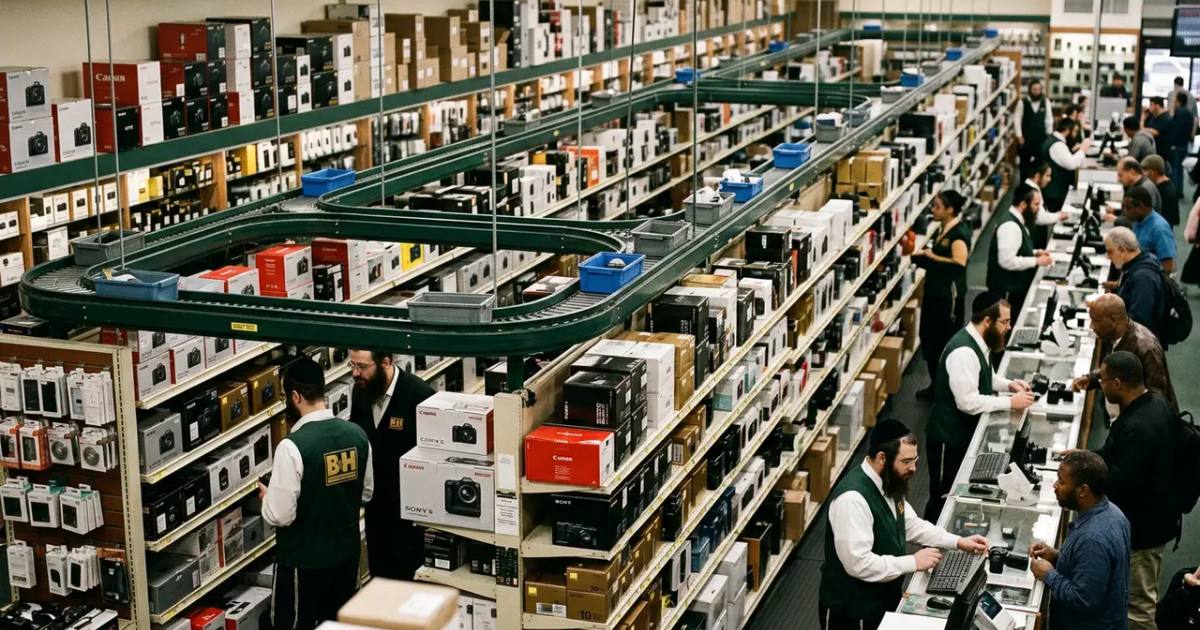
B&H Photo Video is a privately held, Satmar Hasidic-owned electronics retailer founded in 1973 by Blimie and Herman Schreiber in Manhattan. Named for its founders' initials, the company now operates as the largest non-chain photo and video retailer in the United States, closing every week for Shabbat and on Jewish holidays.
Why is B&H Photo named that way?
B&H takes its name directly from founders Blimie and Herman Schreiber, who opened the business as a storefront film shop at 17 Warren Street in Tribeca in 1973, according to Wikipedia's entry on the company. The initials, not an acronym for anything photographic, became one of the most recognized names in American retail electronics.
The store later relocated to 119 West 17th Street in Manhattan's Photo District before settling into its current site at 420 Ninth Avenue at West 34th Street in 1997, per Wikipedia's company history.
Unlike most retail brand names, which are chosen for marketing appeal, B&H's name records a specific marriage and a specific storefront lease. That detail matters for search purposes: people looking up "what does B&H stand for" are asking a factual question with one verifiable answer, not a branding riddle.
Who owns B&H Photo today?
Ownership remains split between the Schreiber family and the Hedaya family, joined by marriage when Abraham "Abe" Hedaya married Herman Schreiber's daughter Annie in 1955. Herman's sons Sammy, Nat, and Joe Schreiber hold ownership stakes alongside grandsons, while Abe Hedaya's sons Joe, Charlie, and Louis Hedaya hold senior leadership roles, according to reporting compiled by SunnyWeb.
Company representative Joe Hedaya described the arrangement to Crain's, as cited by SunnyWeb, as a close-knit family structure: the two families spend holidays and vacations together in addition to running the business jointly. No outside private equity or public shareholders hold a stake. B&H has stayed privately held for its entire five-decade history, a rarity among electronics retailers of its scale.
That single-family, single-location model contrasts with how ownership has played out at other Orthodox-owned retail names. Eichler's Judaica, the Brooklyn Judaica retailer, split into two separately owned businesses after a 2024 sale, the opposite trajectory from B&H's unbroken single-family control.
Why does B&H close on Saturdays?
B&H shuts its single retail location and suspends all online order processing from sundown Friday through Saturday evening in observance of Shabbat, a practice rooted in the founders' Satmar Hasidic identity. Many of B&H's employees are also Satmar Hasidic Jews, and the store offers kosher candy at checkout, the Jewish Telegraphic Agency reported in 2025.
The closure extends to major Jewish holidays and Christmas. Israeli discount chain Rami Levy follows a comparable value-first playbook, though it operates on the opposite end of the religious-observance spectrum as a chain that stays open on Shabbat.
The Shabbat closure is not merely symbolic. Because checkout and order processing halt entirely, B&H forgoes a full day and a half of e-commerce revenue every week, a standing cost few competitors accept. The website itself stays browsable during Shabbat, but no transaction can complete until havdalah.
How big is B&H Photo's business?
B&H operates from a single physical "SuperStore" location yet stocks more than 400,000 products across photography, video, professional audio, and computing equipment, according to Grokipedia's sourced company profile. The company's own historical sales figures, as compiled by SunnyWeb, show revenue growing from $10 million in 1979 to over $220 million by 1997, and reaching roughly $620 million annually by 2012 — figures that predate the company's more recent private growth and do not reflect current revenue, which B&H does not publicly disclose.
B&H was an early adopter of e-commerce, launching its website in 1996 and building its own platform rather than relying on third-party technology, a decision the company has said gave it more control over the customer experience.
The company's real estate footprint has continued to expand even as its store count has not: the JTA reported in March 2025 that B&H was expanding its Midtown Manhattan footprint while maintaining its single-store model.
Who are B&H Photo's main competitors?
B&H's closest direct competitor is Adorama, another New York-based photo and video retailer with its own flagship Manhattan store. B&H skews toward professional photographers and serious enthusiasts with deep inventory in specialized gear, while Adorama pitches a broader mix of beginners, hobbyists, and professionals. Beyond Adorama, B&H competes with Sweetwater in pro audio and Best Buy and Micro Center in general consumer electronics.
Has B&H faced legal scrutiny?
B&H has drawn legal challenges over its five-decade history, including past employment litigation. None of these disputes have altered B&H's ownership structure or its Shabbat-closure policy, which has remained constant across the years.
Is B&H Photo still expanding?
The Jewish Telegraphic Agency reported in March 2025 that B&H was expanding its Midtown Manhattan footprint even as it maintains a single-store model unusual among retailers of its scale. The company continues to rely on its e-commerce platform for the bulk of national and international sales while keeping its physical presence concentrated in one flagship location. A separate strand of Haredi retail innovation appears in Israel, where the Haredi supermarket chain Osher Ad began selling Kia vehicles inside its stores, a similarly unconventional business model built around an observant customer base.
Frequently asked questions about B&H Photo
Is B&H Photo Jewish owned? Yes. B&H was founded by Blimie and Herman Schreiber, observant Satmar Hasidic Jews, and remains owned by the Schreiber and Hedaya families today.
Is B&H open on Saturdays? No. B&H closes its physical store and halts all online checkout from sundown Friday through Saturday evening for Shabbat, and remains closed on major Jewish holidays and Christmas.
What does B&H stand for? The initials of founders Blimie and Herman Schreiber, who opened the original Tribeca storefront in 1973.
How many B&H Photo stores are there? One. B&H operates a single flagship "SuperStore" at 420 Ninth Avenue in Manhattan, supplemented entirely by its e-commerce platform rather than additional physical branches.
Who is B&H Photo's biggest competitor? Adorama, a fellow New York-based photo and video retailer, is B&H's closest direct competitor. Sweetwater, Best Buy, and Micro Center compete in adjacent categories.
Sources
Wikipedia, B&H Photo; Jewish Telegraphic Agency, on B&H's 2025 expansion; SunnyWeb, ownership and revenue history, citing Crain's and the New York Times; Grokipedia, company profile.
How we report: Olam stories draw on public filings, company disclosures and named sources, checked by our editors. Read our methodology · Corrections