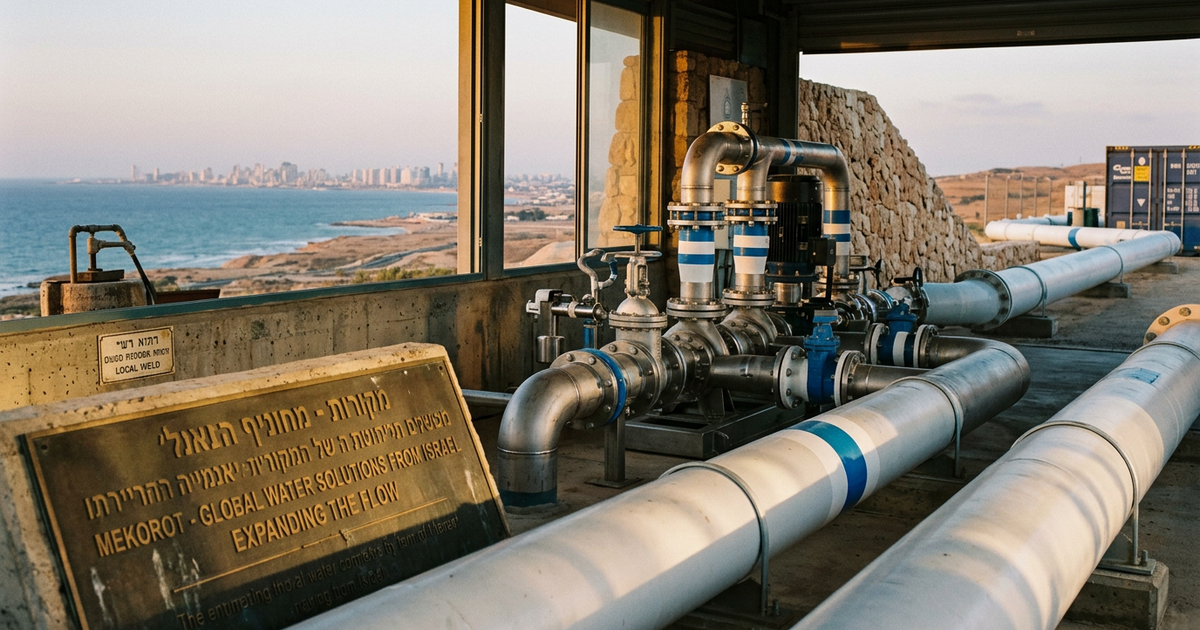

Mekorot is Israel's national water company, supplying 80% of drinking water. Its 2024 revenue was NIS 5.36 billion.
The Entities | Infrastructure
Mekorot is Israel's national water company — the government-owned utility that supplies 80% of the country's drinking water and manages the infrastructure that turned a desert-edge economy into a water surplus state. Founded in 1937, a decade before independence. FY2024 revenue: NIS 5.36 billion. Net profit: NIS 215 million. EBITDA: NIS 1.33 billion. The company operates 13,000 km of pipelines, 1,200 wells, ~20 desalination facilities, and the National Water Carrier — the backbone of Israeli water supply since the 1960s. Water loss rate: under 4%, against a global average of ~30%. In 2023 Mekorot completed the National Carrier Flow Reversal — pumping surplus desalinated seawater from the Mediterranean coast back to the Sea of Galilee, effectively closing the loop on Israeli water scarcity.
Snapshot
| Founded | 1937 (predates the State by 11 years) |
| Type | Government-owned company (100% state) |
| Oversight | Ministry of Energy · Israel Water Authority · Ministry of Finance |
| FY2024 revenue | NIS 5.36 billion (+2.2%) |
| FY2024 net profit | NIS 215 million (+14%) |
| FY2024 EBITDA | NIS 1.33 billion (+15%) |
| 9M 2025 net profit | NIS 232 million (+39%) |
| Water supplied (2024) | 1.87 billion cubic meters (+5%) |
| Supply to Jordan & PA | 208.6 million cubic meters (2024) |
| Pipelines | 13,000 km |
| Wells | 1,200 |
| Reservoirs | ~1,000 |
| Desalination facilities | ~20+ |
| Employees | ~2,450 |
| Water loss rate | <4% (global average ~30%) |
| Credit rating | AAA (domestic) |
| Equity | NIS 6.54 billion (+27% in 2024) |
| Annual infrastructure investment | NIS 1.5-2 billion |
| CEO (2022-2025) | Amit Lang (departed Jan 2026 to Ackerstein Group) |
The Pre-State Founding
Mekorot was founded in 1937 — eleven years before Israel declared independence. The company began as a small water enterprise with a grand vision: to build a national water system in a territory where water scarcity was an existential constraint. The founding came out of the Yishuv's institutional-building wave of the 1930s, when Jewish Palestine was constructing the infrastructure that would later become the State of Israel. Mekorot was the water arm of that project.
By 1962, Mekorot officially became Israel's National Water Supply Agency. The company's trajectory parallels the state's: small-scale regional wells in the 1940s, the massive National Water Carrier project in the 1950s-60s, the post-1967 expansion, the desalination revolution of the 2000s, and the surplus-era infrastructure of the 2020s.
The National Water Carrier
The National Water Carrier is the spine of Israeli water infrastructure. Built in stages through the 1950s and 1960s, the system moves water from the Sea of Galilee in the north to the Negev desert in the south through a network of giant pipelines, pumping stations, open channels, tunnels, and reservoirs. It is the largest single infrastructure project in Israeli history and the physical expression of the founding generation's bet that a desert country could sustain a modern economy through engineered water distribution.
The Carrier was designed for a one-directional flow — north to south, Galilee to Negev. In 2023, Mekorot completed the National Carrier Flow Reversal — the engineering project that allows surplus desalinated seawater produced at coastal plants to flow in the opposite direction, from the Mediterranean coast back up to the Sea of Galilee. The reversal closes a structural loop: Israel now produces more desalinated water than its coastal population needs, and the surplus can be pumped inland to replenish the natural freshwater source that the original Carrier was built to draw from.
The Integrated Water System
Mekorot's competitive advantage is integration. The company runs desalinated seawater, desalinated brackish water, natural freshwater, and treated wastewater as a single managed system, balancing sources in real time across the entire national network. No other developed-country water utility operates at this level of source integration at national scale.
The system draws from four source categories simultaneously. Natural freshwater from the Sea of Galilee and underground aquifers. Desalinated seawater from coastal plants (Israel's five major desalination plants — Sorek, Hadera, Ashkelon, Palmachim, and Ashdod — are privately owned but feed into Mekorot's national grid). Desalinated brackish water from 34+ smaller inland plants that Mekorot operates directly. And recycled wastewater — Israel reuses approximately 90% of its treated wastewater for agriculture, the highest rate in the world.
Shafdan — the Dan Region Wastewater Treatment Plant — is the centerpiece of the recycling operation. Located south of Tel Aviv, Shafdan processes wastewater from over 2.5 million residents in the Gush Dan metropolitan area and converts it into agricultural irrigation water that flows south to the Negev. It is one of the largest wastewater recycling facilities in the world.
The National Water Control Center
In 2025, Mekorot unified its monitoring and command systems — water operations, communications, cyber defense, and security — under a single National Water Control Center. Previously the company operated through regional control rooms. The new center functions as the "brain" of Israel's entire water infrastructure, monitoring flow, pressure, quality, and security across all 13,000 km of pipelines in real time.
The unification was driven by both operational efficiency and security. Israel's water infrastructure is a strategic target — cyber attacks on water systems have been attempted, and physical infrastructure near border areas is exposed to military threats. The centralized control model allows Mekorot to detect and respond to disruptions — whether cyber, physical, or operational — from a single command point.
October 7 and the War
Mekorot maintained uninterrupted water supply through the October 7 war and its aftermath. CEO Amit Lang stated: "The water supply was never interrupted during the war, even when facilities or electrical systems were damaged, because of the system's high redundancy." The redundancy that Lang referenced — multiple supply paths, backup power, alternative sources — is engineered into the system precisely for this scenario. Water infrastructure near the Gaza border sustained damage. Supply continued.
Mekorot also continued supplying water to Jordan and the Palestinian Authority throughout the conflict under existing agreements — approximately 151.6 million cubic meters in the first nine months of 2025, a 2.9% increase from the prior year.
The Export Model
Mekorot has converted its domestic operating knowledge into an international business. Through its international arm, the company sells planning, engineering, and operating expertise to water-stressed countries. Active international engagements include projects in Cyprus (desalination installations), Kazakhstan, Azerbaijan, and multiple African and South American countries.
The export model works because the expertise is operational, not theoretical. Mekorot doesn't sell consultancy reports — it sells the ability to run an integrated water system at national scale under conditions of scarcity, drought, and security threat. Few other utilities anywhere can offer that combination at the same credibility level.
Water diplomacy has also become one of Israel's most durable geopolitical assets. Water expertise was a key component of the Abraham Accords implementation with Morocco and Bahrain. Israeli water technology — both Mekorot's institutional capabilities and the broader Israeli watertech startup ecosystem — is one of the few Israeli export categories that faces minimal political resistance in recipient countries.
Financial Profile
Mekorot's FY2024 results showed continued growth across all metrics. Revenue reached NIS 5.36 billion (+2.2%), driven by a 4.9% increase in water sales. Net profit rose 14% to NIS 215 million. EBITDA grew 15% to NIS 1.33 billion. Gross profit expanded to NIS 531 million from NIS 335 million in 2023 — reflecting lower sales costs and higher volumes. Equity grew 27% to NIS 6.54 billion, and the company successfully raised NIS 2.4 billion in bond issuances with demand exceeding the target by three times.
Through the first nine months of 2025, the trajectory accelerated: net profit reached NIS 232 million (+39%), and the company invested NIS 1.33 billion in infrastructure construction and renewal. The 2026-2028 three-year development plan under review by the Water Authority Council proposes an average annual investment of NIS 1.6 billion — an increase from prior years reflecting drought-driven demand and the expansion of the national desalination and conveyance network.
The CEO Transition
Amit Lang served as Mekorot's CEO from April 2022 through early 2026. A former Olympic judo athlete, former Director General of the Ministry of Economy, and former deputy budget director at the Ministry of Finance, Lang brought a public-sector-and-infrastructure background to the role. Under his leadership Mekorot was named one of the world's top 60 water companies by Global Water Intelligence (GWI), expanded international operations, and invested in Israeli watertech startups.
Lang departed in January 2026 to become CEO of Ackerstein Group (TASE-listed infrastructure company). The CEO transition comes at a critical moment — drought conditions in 2025 have increased demand, and the 2026-2028 investment plan represents a substantial capital commitment that the next CEO will need to execute.
Why Mekorot Matters
Mekorot solved water scarcity. Israel went from chronic water shortage to water surplus in approximately 15 years (2005-2020). The desalination plants produced the water. Mekorot built the infrastructure to distribute it, recycle it, and — with the 2023 Flow Reversal — return the surplus to nature. No other country has achieved this at comparable speed.
The water loss rate is structurally significant. Under 4% non-revenue water loss against a global average of ~30%. That 26-percentage-point gap is the difference between a water utility that works and one that doesn't. It reflects the quality of Mekorot's 13,000 km of pipelines, its monitoring systems, and its maintenance practices.
The export model converts infrastructure into soft power. Water expertise is one of Israel's most durable diplomatic assets — commercially valuable and politically resilient in ways that defense exports are not.
FAQ
Who owns Mekorot?
100% government-owned. Operates under the supervision of the Ministry of Energy, the Israel Water Authority, and the Ministry of Finance.
How much of Israel's water does Mekorot supply?
Approximately 80% of drinking water and 70% of total water supply — approximately 1.87 billion cubic meters in 2024.
What is the National Water Carrier?
Israel's central water conveyance system, built in the 1950s-60s, moving water from the Sea of Galilee to the Negev. In 2023, Mekorot completed the Flow Reversal project, enabling surplus desalinated water to flow back to the Galilee.
Does Mekorot supply water to Jordan and the Palestinians?
Yes. Approximately 208.6 million cubic meters in 2024, under political agreements.
What is Israel's water loss rate?
Under 4% — among the lowest in the world. The global average is approximately 30%.
Who is Mekorot's CEO?
Amit Lang served as CEO from April 2022 through early 2026. He departed to become CEO of Ackerstein Group. A successor has been appointed through the government companies process.
Related in The Olam
- Israel's Climate and Water Economy: The Complete Map
- Israel Solved Water. Now It Sells the Answer.
- Israel Reuses 90% of Its Wastewater
- Reversing the River: Climate-Proofing Israel's Water
- Israel Electric Corporation (IEC)
- Infrastructure
מקורות: חברת המים הלאומית שפתרה את משבר המים של ישראל
נוסדה 1937 — עשור לפני קום המדינה. חברה ממשלתית. הכנסות 2024: 5.36 מיליארד ש"ח. רווח נקי: 215 מיליון ש"ח. EBITDA: 1.33 מיליארד ש"ח. מספקת 80% ממי השתייה של ישראל — 1.87 מיליארד מ"ק ב-2024. מפעילה 13,000 ק"מ צנרת, 1,200 קידוחים, ~20 מתקני התפלה. אובדן מים: מתחת ל-4% (ממוצע עולמי ~30%).
פרויקט היפוך המוביל הארצי (2023) — הזרמת עודפי מים מותפלים מהחוף בחזרה לכנרת — סגר את המעגל המבני של ביטחון המים הישראלי. מקורות מייצאת את המומחיות התפעולית שלה לקזחסטן, אזרבייג'ן, קפריסין, אפריקה ודרום אמריקה. המנכ"ל עמית לנג (2022-2026) עזב לקבוצת אקרשטיין בינואר 2026.
The Olam Editorial Team | The Entities / Infrastructure