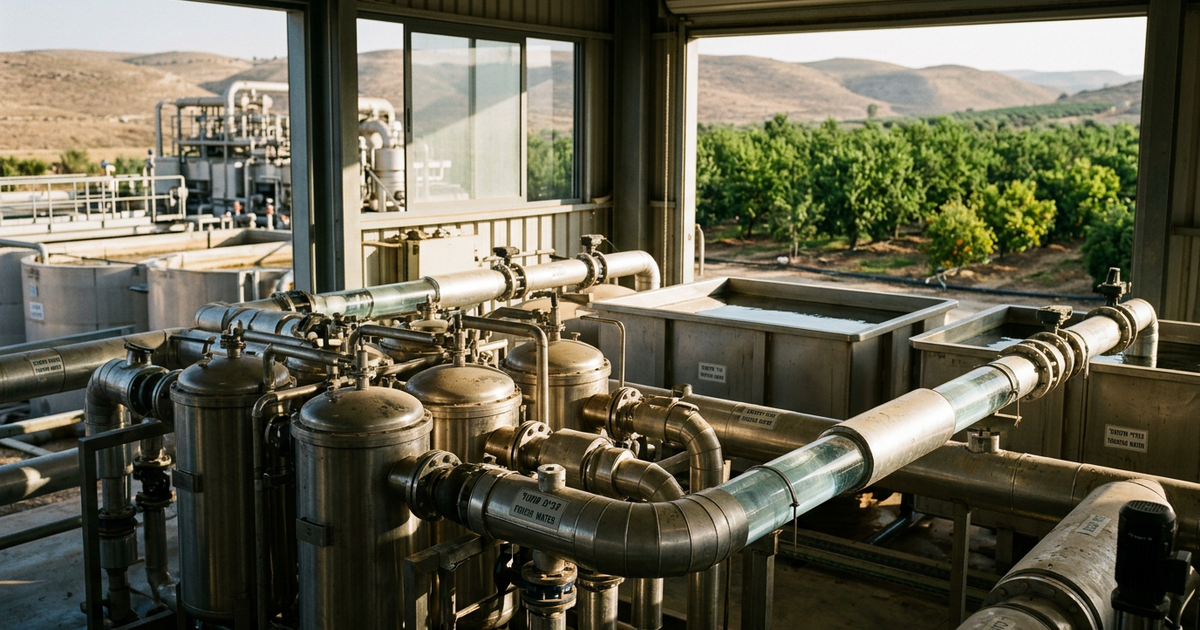

Desalination gets the headlines. Wastewater reuse is the quieter, cheaper engine of Israel's water surplus — and the bigger global opportunity.
Israel reuses nearly 90 percent of its wastewater — more than any country in the world, and roughly four to five times the next-best performer. Where most nations treat sewage as a disposal problem, Israel treats it as a feedstock. It is the quieter engine behind the country's water surplus, and it may matter more than the desalination plants that get all the attention.
The numbers are not marginal. More than 80 percent of Israeli agriculture runs on recycled or otherwise non-conventional water. By recycling effluent for farming, the country frees its fresh and desalinated water for homes and industry — the move that, alongside desalination, converted chronic shortage into surplus. For comparison, the country that ranked second to Israel in a benchmark reuse year was recycling well under 20 percent of its wastewater.
How it works
The backbone is Mekorot's Shafdan facility in central Israel, the country's largest wastewater plant, which treats the sewage of more than 2.5 million people and sends reclaimed water south to irrigate the Negev — supplying a large majority of the desert region's agriculture. The treatment relies on soil-aquifer techniques that polish the water through the ground itself, raising it close to drinking quality before it reaches crops. Paired with Israeli drip irrigation — pioneered by Netafim — reuse delivers more agricultural output per liter than almost any system in the world.
The circular-economy case
Reuse is the cleanest illustration of a genuine circular economy in heavy infrastructure. A cost — collecting and treating sewage — is converted into an input that has real economic value, while reducing the ecological damage of discharging untreated effluent. It is also markedly cheaper and less energy-hungry than desalination, which makes it the more attractive first move for water-stressed countries that cannot afford a coastal plant.
The system is built for scale, not symbolism. Israel's reclamation network polishes effluent through tertiary treatment and soil-aquifer techniques to near-potable quality, then routes it through the same national carrier that moves drinking water. Shafdan alone supplies a large share of Negev agriculture; nationally, treated wastewater has become a structural pillar of the water balance rather than a rounding error. That is the difference between recycling as a green gesture and reuse as core infrastructure — and it is the distinction most countries have yet to make.
The export the world hasn't bought yet
That cost advantage is exactly why reuse may be Israel's larger long-term export. The United States, which recycles only a small fraction of its wastewater, has sent repeated official delegations to study the Israeli model; Israeli reuse expertise has reached India, Africa and California. Desalination requires a coastline and a power supply. Reuse requires only sewage — which every population center on earth already produces in abundance. The blueprint is proven, the demand is universal, and the global adoption curve has barely begun.
Part of Olam's Climate & Resource Tech coverage. See the pillar: Israel Solved Water. Now It Sells the Answer..
How we report: Olam stories draw on public filings, company disclosures and named sources, checked by our editors. Read our methodology · Corrections