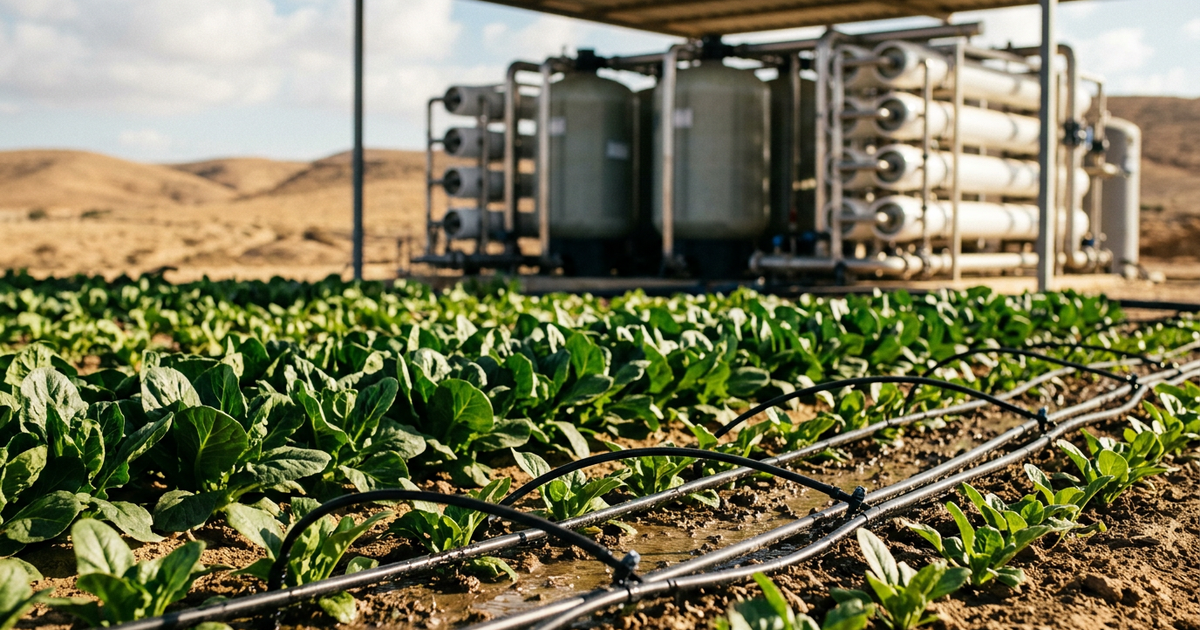

A nation that is 60 percent desert turned scarcity into surplus — and built an export industry out of the engineering.
Israel has no major river of its own, sits more than half in desert, and grows its population faster than any other developed economy. By the textbook it should be running dry. Instead it runs a surplus — and has turned the engineering behind that surplus into infrastructure IP it now sells around the world.
Market snapshot: Israel supplies roughly 80–85% of its municipal and industrial water through desalination (five major plants, 2005–2015). It recycles nearly 90% of wastewater for agriculture — the highest rate globally. Desalinated water costs under $0.60 per 1,000 liters (down from roughly triple that in the 1990s). The national water authority, Mekorot, moves ~1.4 billion cubic meters annually across a unified grid. Total water-tech export market: hundreds of billions globally; Israel's desalination and reuse companies operate in 40+ countries.
This is not a story about conservation. It is a story about industrial scale. Over two decades Israel built a water economy on three engines — large-scale seawater desalination, near-total wastewater reuse, and a single national grid that moves water across the country on command. Each is now a product line sold abroad. Food-tech is, for Israel, an extension of the same resource-security logic that produced its water industry. See: Why Israel Bet the Farm on the Protein Transition.
The Three Engines
Desalination. Five major plants along the Mediterranean coast — Ashkelon (2005), Palmachim (2007), Hadera (2009), Sorek (2013), Ashdod (2015) — now supply roughly 80–85% of municipal and industrial water. Desalinated water costs roughly a third of what it did in the 1990s; Sorek produces 1,000 liters for under $0.60. IDE Technologies built Sorek, Ashkelon, and Hadera and now runs ~400 plants across 40 countries, including the largest desalination facility in the Western Hemisphere in Carlsbad, California.
Reuse. Israel recycles close to 90% of its wastewater for agriculture — the highest rate on earth, roughly four to five times the next country. More than 80% of Israeli farming runs on recycled or non-conventional water, freeing fresh and desalinated supply for homes and industry. Full coverage: Israel Reuses 90% of Its Wastewater — and Sells the Blueprint.
The grid. Mekorot, the AAA-rated national water company, supplies about 80% of the country's water — approximately 1.4 billion cubic meters a year — and balances desalinated, brackish, fresh, and recycled sources across one national network. It is increasingly exported as a consulting and engineering brand. Full coverage: Mekorot: The Utility That Became a National Export.
The Export Thesis
The same companies that solved water at home have packaged the solution for export. IDE's record spans roughly 400 plants across 40 countries. Mekorot exports planning and operating expertise across the Abraham Accords corridor. Water has become both a commercial product and an instrument of regional diplomacy.
What Comes Next
Israel is now running parts of the National Water Carrier in reverse — pumping manufactured water uphill into the depleted Sea of Galilee to bank it against drought. See: Reversing the River: How Israel Is Climate-Proofing Its Water.
Related — Israeli Climate, Water & Infrastructure
- Israel's Infrastructure and Megaprojects: The Complete Map
- Israel's Climate and Water Economy: The Complete Map
- Mekorot: The Utility That Became a National Export
- Israel Reuses 90% of Its Wastewater — and Sells the Blueprint
- Reversing the River: How Israel Is Climate-Proofing Its Water
- The Olam Climate-Tech Index 2026
- Why Israel Bet the Farm on the Protein Transition
- Netafim: The Drip Pioneer in Reported Sale Talks
How we report: Olam stories draw on public filings, company disclosures and named sources, checked by our editors. Read our methodology · Corrections