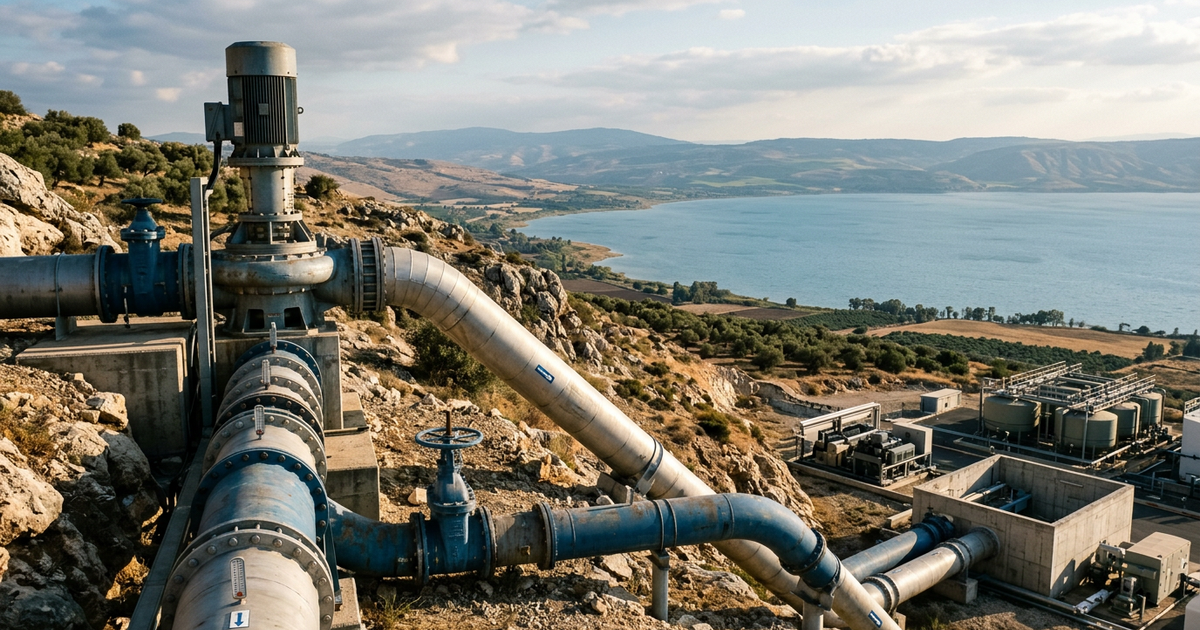

Israel is pumping manufactured water uphill into its largest natural lake — and treating resource security as a permanent national strategy.
For most of the last century, water in Israel flowed in one direction: from the Sea of Galilee in the north, down through the National Water Carrier, to the farms and cities of the dry south. Climate stress and over-extraction left the lake — the country's largest freshwater body — depleted and falling.
So Israel is doing something that would have been unthinkable a generation ago. It is reversing the flow, pumping desalinated surplus uphill to refill the Galilee.
The engineering is a statement of strategy. Having built enough desalination capacity to generate surplus drinking water, Israel can now use its largest natural reservoir as a managed buffer against drought — topping it up in good years and drawing on it in bad ones. The country has effectively converted a vulnerability into a stabilizer, with manufactured water as the control variable.
Planning for the scenario, not the average
Mekorot, the national water company, has built a digital climate-risk model that integrates extreme-scenario frameworks from Israel's Ministry of Energy and heat-mapping from the national meteorological service.
The shift in mindset matters: the system is increasingly designed against tail risks — prolonged drought, heat extremes, demand shocks — rather than long-run averages. For an arid country, resource security is being treated as a permanent operating discipline, not a crisis response.
Growth is the real driver
The counterintuitive finding from the research is that climate change is not even the largest pressure on Israel's water. Population is.
The country's population — roughly 9.5 million in 2022 — is projected to reach between 15 and 25 million by 2065, a load that could require as many as 30 new desalination units and lift desalinated output from about half a billion cubic meters a year toward 3.7 billion.
The strategy that answers it has three moving parts: a multi-decade desalination build-out, natural reservoirs like the Galilee repurposed as strategic buffers, and near-total reuse keeping agriculture off the freshwater balance sheet.
The binding constraint is energy
All of this runs on power, and that is the flag worth raising clearly. A water economy this large is also an electricity consumer at national scale, which ties Israel's water security directly to its energy transition — the generation build-out, the grid, and the renewables and gas capacity that will run the pumps.
The two strategies cannot be planned in isolation. The country that solved water did so partly by spending energy, and the next chapter of resource security will be written as much in megawatts as in cubic meters.
The throughline is the same one that runs under the entire sector: Israel treats resource scarcity not as a recurring emergency but as a solvable engineering problem — and then builds the permanent capacity to keep it solved.
Part of Olam's Climate & Resource Tech coverage. See the pillar: Israel Solved Water. Now It Sells the Answer.
How we report: Olam stories draw on public filings, company disclosures and named sources, checked by our editors. Read our methodology · Corrections