
KIBI represents 250+ factories, ~10% of Israeli industrial output, ~70% concentrated in the geographic periphery. Founded 1962. The political and coordination layer that allows the kibbutz industrial sector to function as a bloc.
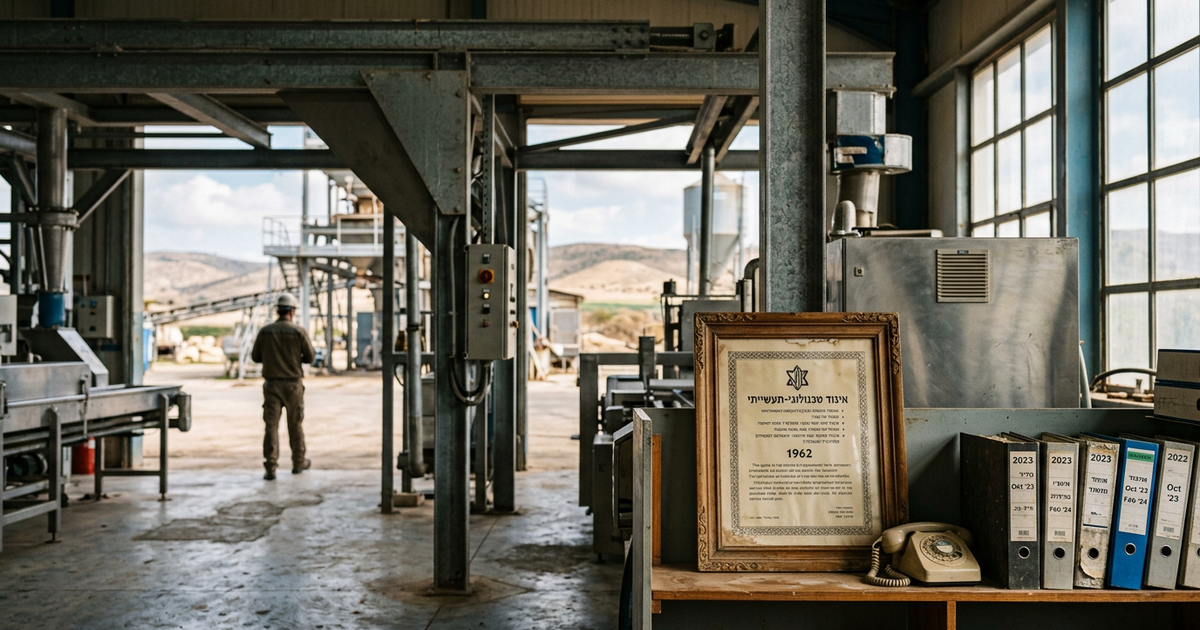
The Kibbutz Industries Association — KIBI, in Hebrew Igud HaTaasiya HaKibbutzit — is the trade association that organizes the entire kibbutz industrial sector as a coherent commercial and political bloc. It was established in 1962, represents more than 250 factories across kibbutzim, collective moshavim, and regional industrial plants in Israel's geographic periphery, accounts for roughly 10 percent of national industrial sales, and operates as a division of the Manufacturers' Association of Israel. KIBI is not a holding company. It does not own any of the businesses it represents. It is a coordination and advocacy layer that sits above the individual companies, the regional cooperatives, and the Kibbutz Movement's residential governance structures.
The pre-1962 fragmentation problem
By the early 1960s, kibbutz industrial activity had grown well beyond a few exceptional cases. Hundreds of kibbutzim were operating manufacturing plants of varying sizes. The combined output was already meaningful at the national level — roughly 5 percent of Israeli industrial production by the mid-1960s — but the kibbutz industrials operated with almost no institutional coordination. Each plant negotiated its own input contracts, its own customer relationships, its own regulatory exposure, its own labor arrangements with the broader Histadrut. The result was that the kibbutz industrial sector had collective scale on paper and no collective voice in practice.
The Kibbutz Industries Association was founded in 1962 to solve this coordination problem. The founding charter framed KIBI as an umbrella organization representing kibbutz, collective moshav, and regional industrial plants. The structural challenge KIBI was created to address was that individual kibbutz industrials, no matter how successful, could not on their own influence the regulatory, tariff, labor, and capital-markets environment in which they operated. KIBI could.
Three operational pillars
KIBI's modern operations sit on three pillars that the current leadership — including KIBI president Gil Lin — has been explicit about. The first is Human Development: professional-development programs for kibbutz industrial managers, technical training cooperatives, and HR best-practice sharing across the member factories. A kibbutz of 600 people operating a $400 million revenue industrial cannot, by itself, run a sophisticated executive-development program. KIBI does that work on a sector-wide basis.
The second pillar is Global Activities: representing the kibbutz industrial sector at international trade shows, industry associations, and bilateral commercial relationships. It coordinates joint export-promotion initiatives and provides regulatory intelligence on foreign markets. The third pillar is Innovation and Entrepreneurship: scouting startups relevant to kibbutz industrial operations, coordinating technology partnerships with Israeli universities, and managing a sector-wide ESG framework that the association announced as a fourth pillar at its annual conference in March 2022.
KIBI is the political and coordination layer that allows the kibbutz industrial sector to function as a bloc — in Israeli policy debates, in international trade discussions, and in capital markets.
The geographic periphery and the policy implication
Roughly 70 percent of KIBI member plants sit in Israel's geographic periphery — the Negev, the Galilee, the Jordan Valley, the Sharon plain — rather than in the Tel Aviv-Haifa axis where most Israeli high-tech industry is concentrated. The kibbutz movement was deliberately settled in the periphery during the British Mandate and early statehood periods as part of the broader Zionist territorial strategy. KIBI is one of the few institutional voices in Israeli industrial policy that consistently advocates for the geographic periphery rather than for the central economic corridor.
After October 7, 2023, KIBI played a coordinated role in negotiating compensation frameworks for member plants in the northern and southern war zones, including Plasan on Kibbutz Sasa, Maytronics's Dalton facility in the Upper Galilee, and Kafrit Industries on Kibbutz Kfar Aza in the Gaza envelope.
The plant-count data and what it tells us
KIBI maintains the authoritative public dataset on kibbutz industrial activity. In 2000, the KIBI registry contained 346 factories. By 2017, the registry contained 203. Between 2017 and 2024, the count stabilized at roughly 250. The 41 percent drop from 2000 to 2017 was not a story of failure. It was a story of consolidation. The plants that exited the registry were primarily smaller operations that were acquired, merged, or sold out of kibbutz ownership during the privatization wave. The plants that remained were larger, more global, more professionally managed, and substantially more profitable.
| Founded | 1962 |
|---|---|
| Status | Division of the Manufacturers' Association of Israel |
| Member plants | ~250 (down from 346 in 2000) |
| Sector share | ~10% of Israeli industrial output (~$13B) |
| Geographic concentration | ~70% in Israel's geographic periphery |
| Current president | Gil Lin |
The structural lesson
The kibbutz industrial complex does not consist only of the companies themselves. Netafim, Maytronics, Plasan, Plasson, Naot, Caesarstone, Palram, Galam, Tnuva, Hadiklaim, Shamir Optical, and roughly 240 other named entities are the visible commercial layer. Granot and the seven other regional cooperatives are the institutional back-office layer. KIBI is the political and coordination layer above them. Together they form a functioning industrial sector.
Part of the Olam series on the kibbutz industrial complex. Read the pillar.
How we report: Olam stories draw on public filings, company disclosures and named sources, checked by our editors. Read our methodology · Corrections