
Plasan armors the JLTV. The world leader in vehicle armor was founded on Kibbutz Sasa, one mile from the Lebanese border, in 1985. A kibbutz under fire builds armor for a living. The product is downstream of the place.
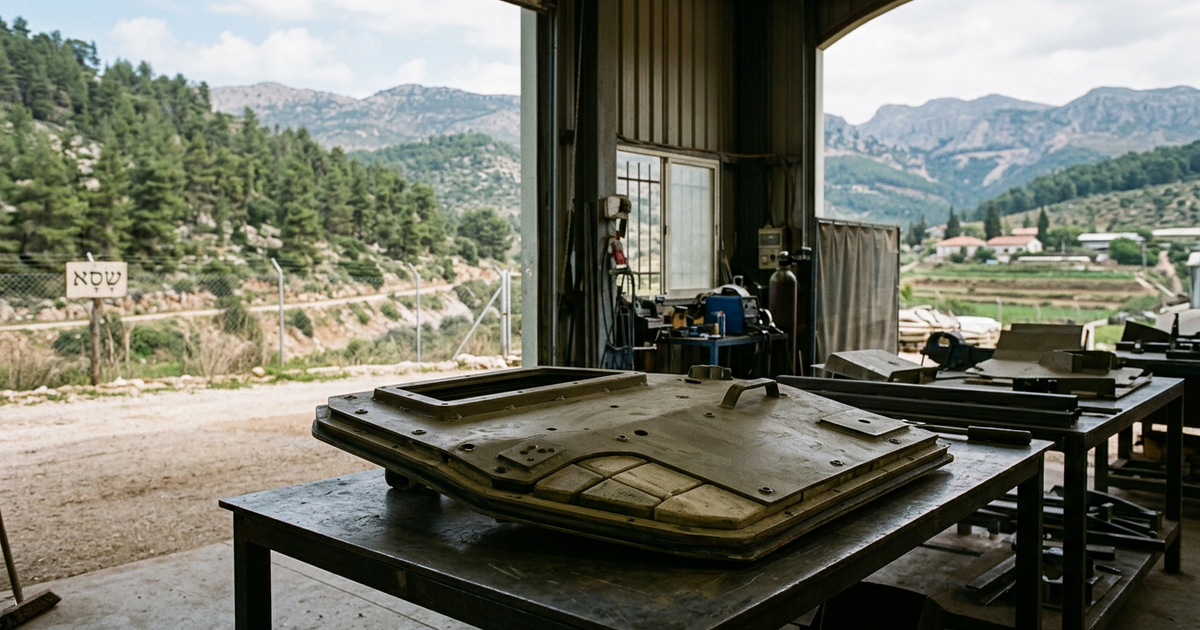
Plasan is the world leader in armor protection for military vehicles. The company has designed more than 420 armored vehicles, delivered over 40,000 armor solutions worldwide, and fitted more than 25,000 United States military vehicles with Plasan armor. Its peak revenue, during the Iraq and Afghanistan deployment cycle, hit roughly $1 billion. Its headquarters and main production facility are on Kibbutz Sasa, in the Upper Galilee, one mile from the Lebanese border. The kibbutz has been evacuated multiple times in its history, most recently after October 7, 2023. The factory kept running. That entire sentence is the company's strategic position.
A kibbutz founded under fire
Kibbutz Sasa was established in January 1949 by a group of North American Hashomer Hatzair members — mostly young Jewish Americans from the United States and Canada who had immigrated to Israel after the War of Independence. The site they were given was the depopulated Palestinian village of Sa'sa', taken in the 1948 war. The location was strategic: a hilltop on the new Israel-Lebanon border, intended as a defensive settlement as much as an agricultural one. The kibbutz population stabilized around 400 to 450 members. Agriculture — orchards, dairy, beef — was the economic base for the first three decades.
Sasa's geography defined its operating reality. The kibbutz has been under direct military threat in every Israeli war since its founding. It absorbed shelling in 1948, 1967, 1973, and 1982. During the 2006 Second Lebanon War, Hezbollah rockets struck inside the kibbutz boundary. After October 7, 2023, the entire community was evacuated to safer parts of Israel. The Plasan factory, however, was designated essential and continued operating with reduced staffing through the northern war, including after an anti-tank guided missile struck the kibbutz school auditorium in December 2023.
From rigid plastics to ballistic protection
Plasan Sasa was founded in 1985 as a small plastic-products operation. The kibbutz had decided in the early 1980s that agriculture alone could not sustain the community and that industrialization was necessary. The first step was conventional: the kibbutz purchased injection-molding technology from a US firm called Now Plastics and began manufacturing rigid plastic containers. Within two years, the company identified a higher-margin application of its composite-materials capability: ballistic protection panels for body armor. By 1987 the focus had shifted to bulletproof vests and military protection products.
The transition from a small plastics shop to a global armor manufacturer happened across two phases. The first was the late 1990s, when Plasan supplied armor components to Singapore for C-130 transport aircraft and Super Puma helicopters, and developed an armored cab kit for Greece's ELVO assembly of HMMWVs. The second was the Iraq and Afghanistan deployment of US ground forces from 2003 onward. American military demand for survivable armored vehicles — what the Pentagon termed Mine Resistant Ambush Protected platforms, or MRAPs — created a market that did not exist before 2003 and that Plasan was uniquely positioned to serve.
In one year alone, 2005, Plasan's revenue tripled from $45 million to $150 million. By 2011 the company sat atop the Dun & Bradstreet list of largest kibbutz enterprises at roughly $850 million in annual sales.
The Oshkosh and Navistar contracts
Between 2005 and 2010, the US Marines ordered 7,000 cab armoring kits and 2,300 armored troop transport bodies from Plasan for their Oshkosh Medium Tactical Vehicle Replacement fleet. Plasan's armor sat on the M-ATV produced by Oshkosh and the MRAP produced by Navistar. The company received the National Defense Industrial Association's Red Ball Express award in 2017, the first non-US organization ever to receive it.
The current US contract is with the JLTV — the Joint Light Tactical Vehicle that is replacing the Humvee across the entire US military light-tactical fleet, projected to total 150,000 vehicles. Plasan's largest subsidiary is based in Michigan, where it manufactures protective components for the JLTV under a five-year, $250 million contract running through 2030. The Michigan facility employs 180 people; a Marseille-area facility serves European police vehicles; a Greek subsidiary handles regional sales.
The post-war crash and the recovery
When US combat operations in Iraq and Afghanistan wound down between 2011 and 2014, the Pentagon's armor procurement budget collapsed. Plasan had not diversified its product portfolio in time. Revenue fell sharply. Between 2013 and 2014, the company laid off 550 of its 1,000 employees and underwent a drastic operational restructuring. The COVID-19 pandemic in 2020 dealt another blow. Recovery began in 2022 and accelerated through 2023 and 2024 as European defense spending rose post-Ukraine and Israeli demand surged post-October 7.
Plasan today employs roughly 750 people, with 450 working at the main plant on Kibbutz Sasa. The company has shelved a planned 1.25 billion shekel Tel Aviv IPO in favor of a 2026 merger with CarmChrome — a Karmiel-based composites company with about $70 million in annual revenue. The merged entity is expected to seek a TASE listing in 2026 at a combined valuation of roughly 1 billion shekels. Kibbutz Sasa is expected to hold 50 to 60 percent of the merged company.
| Founded | 1985, Kibbutz Sasa |
|---|---|
| Headquarters | Kibbutz Sasa, Upper Galilee (1 mile from Lebanon) |
| Ownership | Kibbutz Sasa; 2026 merger with CarmChrome pending |
| Peak revenue | ~$1 billion (Iraq/Afghanistan era) |
| Workforce | ~750 today (1,000 at peak, 450 trough) |
| Key US contract | JLTV armor, $250M through 2030 (Michigan facility) |
| Vehicles armored | 40,000+ globally; 25,000+ US military |
October 7 and the factory that kept running
In the days after October 7, 2023, the Israeli Defense Ministry asked Plasan for as much body armor and as many armored vehicles as the company could produce, as fast as possible. The company restarted its body-armor production line and supplied tens of thousands of armor plates to the IDF and other Israeli security forces. It handed over all armored vehicles it had in stock. It ran the SandCat Tigris production line, a military variant of the Ford F-Series, twenty-four hours a day. Approximately 20 percent of the Plasan workforce was called up to IDF reserve duty. The remaining staff worked through the rocket attacks. The kibbutz school auditorium was hit by a Hezbollah anti-tank missile on December 17, 2023. The factory floor never stopped.
The structural lesson
Plasan is the most dramatic illustration of the kibbutz industrial complex thesis. A kibbutz placed on the Lebanese border, founded in 1949 as part of Israel's defensive settlement strategy, lived under military threat for seven decades, and eventually industrialized that lived experience into the global standard for vehicle armor. The product is downstream of the place in the most direct sense imaginable. Sasa builds armor because Sasa lives under fire. The American soldiers in Iraq and Afghanistan whose lives were saved by Plasan armor were protected by a product designed by people who knew, from their own daily reality, what being attacked feels like.
That is not a marketing line. It is a structural fact about the Israeli industrial economy. The kibbutz industrial complex did not produce a vehicle-armor world leader on Kibbutz Yizrael, or on Hatzerim, or on Maagan Michael. It produced one on Sasa. The location and the product are the same answer to the same question.
Part of the Olam series on the kibbutz industrial complex. Read the pillar. Earlier: Netafim / Hatzerim, Maytronics / Yizrael.
How we report: Olam stories draw on public filings, company disclosures and named sources, checked by our editors. Read our methodology · Corrections