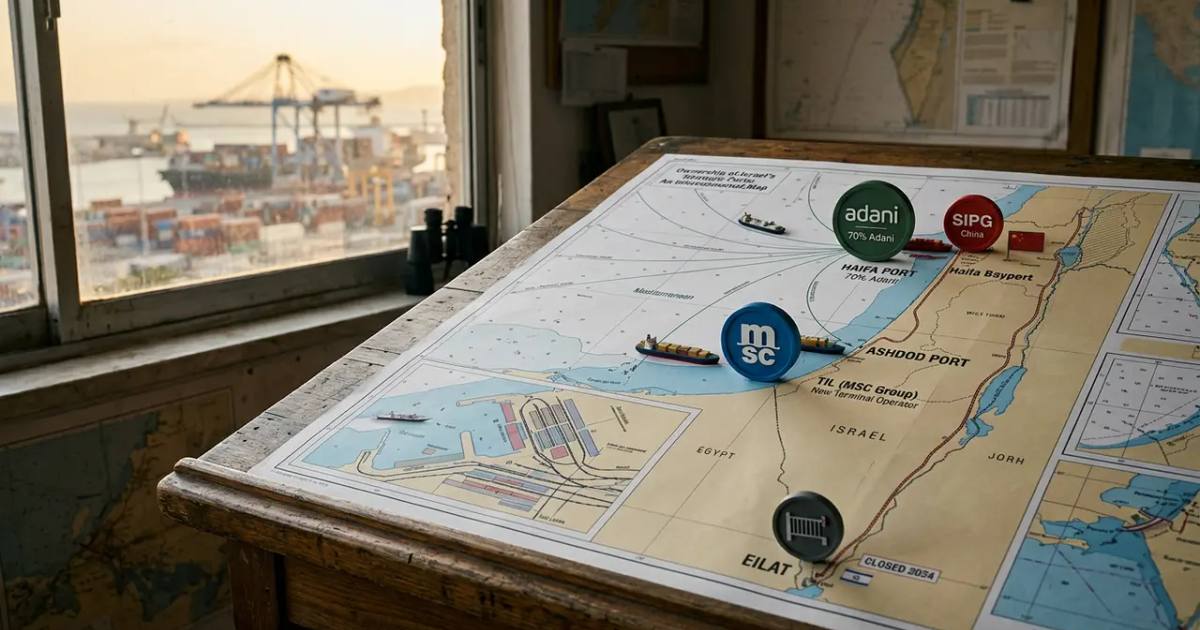

An Indian conglomerate owns 70% of Haifa. A Chinese state company runs the terminal next door. A Swiss shipping giant operates Ashdod's newest terminal. Eilat closed in 2024. The complete ownership map of Israel's seaports.
Israel's three commercial seaports moved through a decade-long privatization that has left each one under a different owner, including a foreign-government-linked operator sitting inside the same bay as a competing Indian-owned terminal. Here is who actually controls each Israeli port today.
Haifa: Split Between an Indian Conglomerate and a Chinese State Company
Haifa Bay hosts two competing container terminals under two different foreign owners. The original Haifa Port Company was privatized in a tender won in 2022 by a consortium of India's Adani Ports and Special Economic Zone (70%) and Israeli logistics firm Gadot Group (30%), with the roughly $1.18 billion deal closing in January 2023 under a concession running to 2054. The tender drew 18 applications organized into five bidding groups, including early interest from Dubai's DP World, before narrowing to the Adani-Gadot consortium, a group led by Israel Shipyards, and Britain's Lomar Shipping. Adjacent to it, the newer Bayport (Hamifratz) terminal has operated since 2021 under a concession held by Shanghai International Port Group (SIPG), a Chinese state-owned company. That terminal's planned construction was part of the original rationale the Israeli government gave for privatizing Haifa to a non-Chinese buyer in the first place. No Chinese company bid on the Haifa Port Company tender itself, despite SIPG's adjacent presence.
The Adani-Gadot position has proven durable through real stress-testing. It survived the Adani Group's 2023 short-seller crisis (triggered by Hindenburg Research allegations against the parent conglomerate) without disruption to Haifa operations, and it survived the October 7, 2023 war and the subsequent Red Sea shipping crisis. Haifa's chairman, former Israeli ambassador to India Dr. Ron Malka, has said container dwell times have roughly halved since the takeover, from 44 hours in 2021 to 22 hours in early 2023, with waiting times falling from 7.2 to 4.5 hours. The Adani-Gadot position also anchors the Indian end of the IMEC corridor (the India-Middle East-Europe Economic Corridor), giving the deal strategic weight well beyond its purchase price. Olam has covered both the Adani-Gadot deal and its three-year track record in dedicated pieces (see below).
Ashdod: State-Owned Legacy Terminals Plus a Swiss-Controlled Newcomer
Ashdod, Israel's largest port by container volume, still operates its legacy terminals through the government-owned Ashdod Port Company, one of four state port companies created in a 2005 breakup of the old Israel Ports Authority (the fourth being Eilat Port Company, alongside a fifth, privately run terminal at Israel Shipyards in Haifa). Since 2021, the newest and largest terminal at Ashdod, Hadarom (South Port), has been operated by Terminal Investment Limited (TIL), a Dutch-registered subsidiary of the Geneva-based Mediterranean Shipping Company (MSC), under a 25-year concession awarded by tender. Hadarom alone now handles roughly 1.7 million of Ashdod's total annual capacity of over 3.2 million TEU, and it has become semi-automated, using gate, yard, and crane automation alongside AI-assisted vehicle-processing systems. Ashdod's total system also carries real humanitarian and wartime significance: the port served as a temporary hub for humanitarian shipments into Gaza starting in April 2024, underscoring how the state-run legacy terminals continue to carry functions the private concessions were not built for.
Eilat: Closed in 2024
Israel's only Red Sea port, long operated privately by Papo Maritime (linked to the US-based Jordache Enterprises) under state ownership of the underlying Israel Port Authority land, ceased operations in 2024. Eilat's closure followed a long, stalled privatization effort dating back to a 2012 tender that drew interest from Israel Chemicals (ICL) before ICL withdrew; the port's Red Sea exposure had already made it acutely vulnerable to the Houthi shipping campaign that began after October 2023, which cut off much of the commercial traffic that once justified keeping the facility open. That same campaign has reached beyond port infrastructure into the vessels themselves: Rami Ungar's Ray Shipping, which controls roughly 10% of the world's vehicle-carrier fleet, had one of its ships, the Galaxy Leader, seized by Houthi forces in November 2023.
The Landlord Behind All Three
Israel Ports Development & Assets Company (IPC), a government company with an Aa1 credit rating, remains the state's landlord for port land and core infrastructure at all sites regardless of which private or foreign operator runs day-to-day terminal operations. That structure is the same one used across the 2005 reform that broke up the old state ports monopoly and eventually opened Haifa, Ashdod, and Eilat to private and foreign operators. IPC also managed the roughly NIS 7.5 billion (about $2 billion) construction program that built both Bayport in Haifa and Hadarom in Ashdod as new-generation terminals designed to force competition into a historically oligopolistic sector.
The Map, at a Glance
| Terminal / Entity | Owner or Operator | Since |
|---|---|---|
| Haifa Port Company | Adani Ports (70%), Gadot Group (30%) | January 2023 |
| Bayport / Hamifratz (Haifa) | Shanghai International Port Group | 2021 |
| Ashdod legacy terminals | Ashdod Port Company (state-owned) | 2005 reform |
| Ashdod Hadarom / South Port | Terminal Investment Limited (MSC) | 2021 |
| Eilat | Closed 2024; formerly Papo Maritime / Jordache Enterprises | closed 2024 |
| Underlying land and infrastructure, all sites | Israel Ports Development & Assets Company (state) | ongoing |
Frequently Asked Questions
Does an Indian company own Haifa Port?
Adani Ports and Special Economic Zone owns 70% of the Haifa Port Company, partnered with Israel's Gadot Group at 30%, following a deal that closed in January 2023.
Is there a Chinese-owned port in Israel?
Shanghai International Port Group, a Chinese state-owned company, has operated the Bayport terminal in Haifa Bay since 2021 under a concession, separate from the Adani-Gadot-owned Haifa Port Company next door. No Chinese bidder took part in the Haifa Port Company privatization tender itself.
Is Eilat Port still operating?
No. Israel's only Red Sea port ceased operations in 2024, after years of stalled privatization and, more recently, Houthi disruption to Red Sea shipping.
Did the Adani short-seller crisis affect Haifa Port?
No. The 2023 Hindenburg Research allegations against Adani Group did not disrupt Haifa Port operations, and the concession has continued under the same Adani-Gadot structure through 2026.
Related Olam Coverage
- Port of Haifa: Israel's Mediterranean Gateway
- Adani at Haifa: The Three-Year View
- Rami Ungar: Kia's Israeli Importer and Ship Owner
- Who Owns Israel's Telecoms? Bezeq, Cellcom, Partner, Hot Mapped
- Who Owns El Al? Inside Israel's Flag Carrier
- Who Runs Israel's Health Funds? Clalit, Maccabi, Meuhedet, Leumit
Sources
Adani Ports press release, July 2022; Maritime Executive, January 2023 (Haifa deal completion); Adani Watch, privatization terms; isra-tech.net, Ron Malka interview on Haifa's operational metrics; Freyt Consolidators, "Israel's Port Reforms 2025"; Wikipedia, Port of Ashdod; Wikipedia, Port of Eilat; China AidData project record, TIL/Ashdod Hadarom concession; Israel Ports Company (israports.co.il), port industry structure overview.
How we report: Olam stories draw on public filings, company disclosures and named sources, checked by our editors. Read our methodology · Corrections