
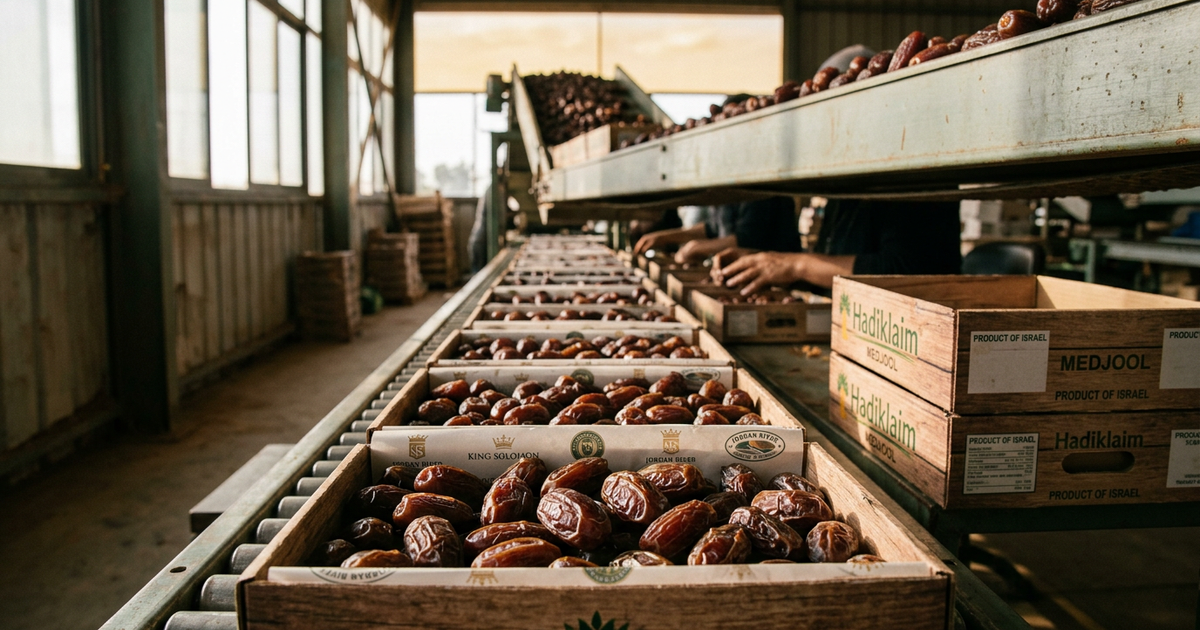

Israel produces ~50% of the world's Medjool dates. Hadiklaim markets ~50% of Israel's. A 1982 cooperative in Tel Aviv touches roughly a quarter of every premium Medjool date sold globally. King Solomon, MyJool, Jordan River brands.
Hadiklaim is the largest exporter of dates from Israel and the global market leader in the Medjool variety. The cooperative markets roughly 20,000 tons of dates per year, including about 10,000 tons of Medjool dates — roughly half of global Medjool supply. Israel produces approximately 50 percent of the world's Medjool dates. Hadiklaim exports nine date varieties to 50 countries across five continents under the King Solomon, MyJool, Jordan River, and Jordan River Bio-Organic brands. Annual revenue is approximately 350 million shekels. Headquarters are in Tel Aviv; the growing operations are spread across kibbutzim and moshavim in the Jordan Valley and the Arava.
The Jordan Valley climate
The Medjool date is not a generic crop. It is a specific cultivar that requires a specific combination of climate conditions to produce the size, sweetness, moisture content, and shelf life that command premium pricing. The Medjool needs intense heat during the ripening phase, very low humidity at harvest, a long sun-hour day, and consistent access to irrigation. There are roughly half a dozen geographies in the world that meet all of these criteria. The Jordan Valley and the Arava in Israel are the most productive of them. The Coachella Valley in California is the only direct global competitor.
The kibbutzim and moshavim of the Jordan Valley — Tomer, Gilgal, Yafit, Almog, Avnat, Beit Ha'arava, and others — sit at one of the lowest elevations on earth, in the rain shadow of the Judean and Moab mountain ranges. Summer temperatures regularly exceed 40 degrees Celsius. Humidity at harvest is low. Sun hours are among the highest in Israel. The geography that makes the Jordan Valley nearly uninhabitable in the summer is exactly the geography that grows the world's best Medjool dates. The kibbutzim and moshavim placed there in the 1960s and 1970s discovered that the date palm was the highest-value crop the land could support.
The 1982 cooperative
Hadiklaim was founded in 1982 as a marketing cooperative. The structural problem the cooperative was created to solve was familiar to anyone who knows the history of Tnuva: individual kibbutzim and moshavim could grow superb dates, but they could not, on their own, market into European retail, manage the cold-chain logistics that international date export requires, or negotiate effectively with multinational buyers. A shared marketing entity could.
The cooperative structure Hadiklaim adopted was deliberately narrower than Tnuva's. Hadiklaim is owned only by date growers. There is no broader Histadrut umbrella, no cross-subsidy from other agricultural sectors, no political layer above the cooperative. The growers control the cooperative, the cooperative markets their fruit, the proceeds return to the growers. This is closer to the European wine-cooperative model than to the historical Israeli cooperative model. It has proven more durable than Tnuva's broader structure. Hadiklaim today operates under the same ownership architecture it adopted in 1982.
Israel produces roughly half the world's Medjool dates. Hadiklaim markets roughly half of Israel's. The math is straightforward: one cooperative in Tel Aviv touches approximately a quarter of every premium Medjool date sold globally.
The King Solomon brand and the supermarket channel
Hadiklaim's commercial breakthrough was building branded supermarket distribution. The cooperative's King Solomon brand is now the dominant premium Medjool date in major UK, French, Dutch, and US retail chains. Marks & Spencer, Sainsbury's, Tesco, Asda, Morrisons, and Waitrose all carry King Solomon or supply their own-label Medjool sourced through Hadiklaim. The MyJool brand was launched in 2023 as a younger, snack-positioned product targeting consumers under 35 who do not have an existing relationship with the Medjool category. Jordan River and Jordan River Bio-Organic cover the conventional and certified-organic segments.
The certification stack is part of why Hadiklaim wins shelf space. The cooperative's packing houses carry BRC, Global GAP, USDA Organic, IFOAM, and Israeli Ministry of Agriculture approvals. The standardization machinery in the packing houses categorizes each individual date across 16 quality levels using computer vision — an investment in industrial-grade quality control that individual growers could never have funded. The result is that a King Solomon date sold in a Manchester Tesco in November is the same product as one sold in a Frankfurt REWE in March. That consistency is what makes the brand work at premium pricing.
The competitive position and the US question
The most direct global competitor to Hadiklaim is the California Medjool industry, concentrated in the Coachella Valley and Bard Valley. The US produces approximately 25 percent of global Medjool supply. Hadiklaim sells into the US market regardless, primarily on the East Coast, where the supply chain economics from Israel are competitive with the US transcontinental logistics from California. Hadiklaim has also been expanding into Russia, Turkey, South America, and the Far East to diversify away from concentrated European exposure.
| Founded | 1982, Tel Aviv |
|---|---|
| Structure | Cooperative of Israeli date growers |
| Annual volume | ~20,000 tons of dates (~10,000 tons Medjool) |
| Annual revenue | ~350 million shekels |
| Export markets | 50 countries, 5 continents |
| Brands | King Solomon, MyJool, Jordan River, Jordan River Bio-Organic |
| Global Medjool share | Israel ~50% of world supply; Hadiklaim markets ~50% of Israeli |
| CEO | Raz Friedman |
The structural lesson
Hadiklaim is the cooperative-model counterpoint in the kibbutz industrial complex. Most of the other companies in the cluster are single-firm operations rooted in a single kibbutz. Hadiklaim is the multi-kibbutz, multi-moshav, multi-grower structure that mirrors how Tnuva originally worked but has held its cooperative form intact where Tnuva did not. The reason it held is that the underlying product is a niche premium agricultural good with a defensible geographic moat, not a commodity foodstuff with national-scale logistics requirements. Cooperative governance scales adequately when the product is Medjool dates from the Jordan Valley. It scaled poorly when the product was the majority of Israeli liquid milk.
Part of the Olam series on the kibbutz industrial complex. Read the pillar.