
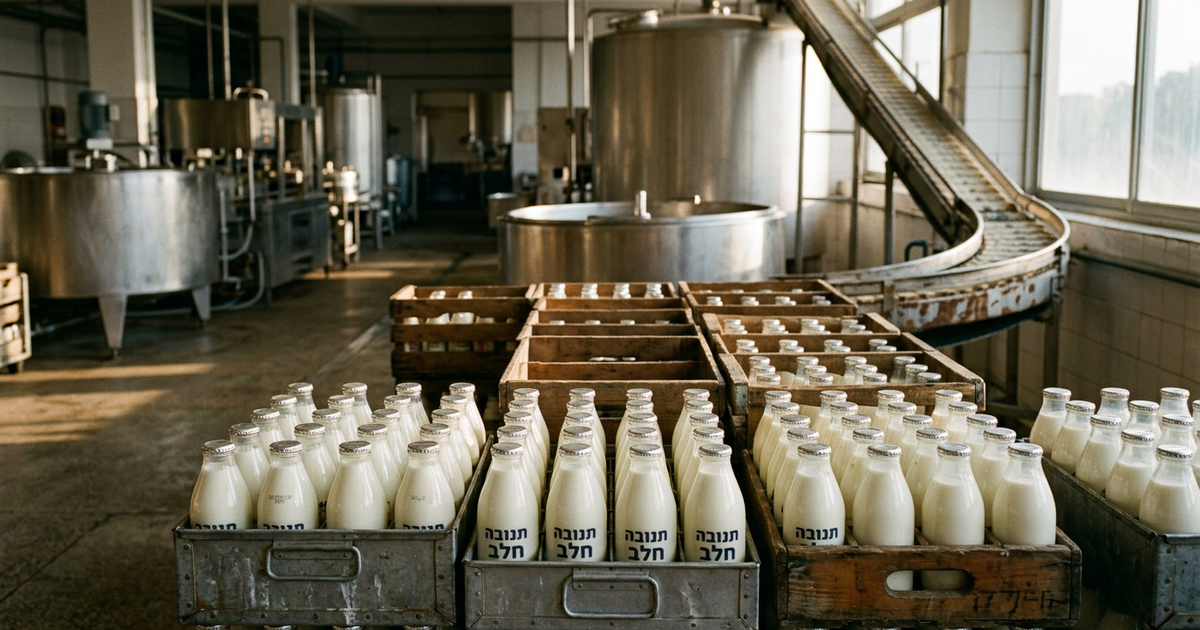

Tnuva is the largest food company in Israel. Founded 1926 as a kibbutz-and-moshav cooperative, converted to a limited company and sold to Apax in 2008 at $1.025B valuation, then to Chinese state-owned Bright Food in 2015 at $2.5B. Over 70% Israeli dairy market share.
Tnuva (Hebrew: תנובה — "produce") is Israel's largest food and dairy company, holding more than 70 percent of the Israeli dairy market. Founded in 1926 as an agricultural cooperative owned by kibbutz and moshav dairy farmers, Tnuva was converted to a limited company and sold in 2008 to a consortium led by London-based Apax Partners at a $1.025 billion valuation. In March 2015, Chinese state-owned Bright Food Group acquired 77 percent of the Tnuva holding company at a NIS 8.6 billion ($2.5 billion) valuation — at the time the largest Chinese investment in Israel. Tnuva is the cautionary node of the kibbutz industrial complex.
The Cooperative Era (1926–2008)
Tnuva was established in 1926 as an agricultural cooperative society, aggregating the milk, produce, poultry, and meat output of the kibbutz and moshav movements for centralized processing, distribution, and marketing. Over eighty years it consolidated its position as the dominant Israeli food company: seven of the ten best-known consumer food brands in Israel sit inside Tnuva, per Apax's own materials at the time of the 2014 sale.
The cooperative structure — hundreds of small kibbutz and moshav shareholders — became a governance constraint as the Israeli food market opened to imports and consolidated at the retail level in the 1990s and 2000s. Modernization required capital that the cooperative could not raise on its balance sheet without diluting founding members. Sale to institutional capital became the exit path.
The 2008 Apax Buyout
On 20 November 2006, Apax Partners Worldwide LLP — the London-based buyout firm — together with Israeli investor Meir Shamir's Mivtach Shamir Holdings, won a competitive tender to buy control of Tnuva. The bid valued the company at $1.025 billion, larger than either Strauss-Elite Ltd. or Osem Investments Ltd., the two largest publicly held Israeli food companies at the time.
The transaction closed in January 2008, following the transformation of the cooperative into a limited company. Post-close ownership: Apax 56.05 percent, Mivtach Shamir 20.67 percent, and holdout kibbutz partners 23.3 percent — a minority of cooperative members who refused to sell and could not block the transaction. The Finance Ministry and many farmers opposed the deal; Apax secured majority farmer consent through negotiated milk-supply agreements.
During Apax's ownership, the fund committed more than NIS 1.4 billion (~$400 million) in capex to modernization and innovation, and Tnuva distributed roughly $650 million in dividends. 2013 revenue reached NIS 7.17 billion ($2.05 billion).
The 2015 Bright Food Deal
In May 2014, Apax signed a Sale and Purchase Agreement with China's Bright Food Group, the second-largest food and beverage manufacturer in China and controlled by the Chinese government. The transaction closed in March 2015.
Bright Food acquired 77 percent of the Tnuva holding company — Apax's 56 percent stake and the tag-along stake from Mivtach Shamir — at a NIS 8.6 billion ($2.5 billion) valuation. Bright Food paid Apax slightly under $1 billion in cash for its 56 percent and assumed Apax's share of NIS 1.9 billion in bank loans. The remaining ownership interest was held by a Kibbutzim holding company. It was the largest Chinese direct investment in Israel to that date.
The strategic rationale for Bright Food was twofold: Tnuva's dominant Israeli position and, more importantly, its dairy technology and product portfolio — cottage cheese, yoghurt, cheeses under the Tnuva Valley, Yoplait, and Piraeus brands — at a moment when Chinese consumer demand for Western dairy was accelerating.
The deal drew political criticism inside Israel. Opposition members of Knesset argued a food-security asset should not sit with a Chinese state-owned entity and pushed for a Tel Aviv Stock Exchange float instead. The transaction proceeded on regulatory approval.
The Bright Food Underperformance
Less than eighteen months after closing, Tnuva was underperforming. In September 2016, consulting firm TASC valued the company at approximately NIS 5 billion ($1.3 billion) — a roughly 40 percent decline from the acquisition valuation — driven by falling sales, margin compression, and market-share losses in the Israeli dairy category. Bright Food restructured its financing, borrowing NIS 1.25 billion collateralized by Tnuva shares and another NIS 550 million against Singapore bank guarantees.
The 2012 bankruptcy of Tnuva's Romanian branch had already flagged the difficulty of scaling the platform outside Israel. The Israeli operating business remains the dominant dairy producer in the country, and Bright Food's Chinese distribution ambitions for Tnuva-branded dairy have been more restrained than the acquisition thesis implied.
Why Tnuva Matters to the Kibbutz Industrial Story
Tnuva is the largest single deconstruction of the kibbutz industrial model. The 1926 cooperative sat at the center of the founding Israeli agrarian project, and the 2008 conversion to a limited company plus the 2015 sale to Chinese state capital reversed both structural features simultaneously — private-equity ownership followed by foreign-state ownership. Parallel kibbutz industrial exits (Iscar to Berkshire, Naot as a rare surviving manufacturer) frame Tnuva as the largest and most politically sensitive case in that arc.
For adjacent kibbutz-industrial profiles, see Naot / Neot Mordechai (Israel's last shoe manufacturer, still on the kibbutz) and The Wertheimer Family: Iscar, Berkshire, and the Quiet Empire.
Frequently Asked Questions
What is Tnuva?
Israel's largest food and dairy company. Founded 1926 as a kibbutz-and-moshav agricultural cooperative. Over 70 percent Israeli dairy market share.
Who owns Tnuva?
Chinese state-owned Bright Food Group (77 percent of the holding company since March 2015). Remaining stake with a Kibbutzim holding company.
What did the Apax deal cost?
Apax and Mivtach Shamir won a competitive tender in November 2006 at a $1.025 billion valuation. Deal closed January 2008 after cooperative-to-limited-company conversion. Post-close: Apax 56.05%, Mivtach 20.67%, holdout kibbutz partners 23.3%.
What did Bright Food pay?
Bright Food acquired 77 percent at a NIS 8.6 billion ($2.5 billion) valuation. The largest Chinese investment in Israel at the time. Signed May 2014, closed March 2015.
How has Bright Food's Tnuva performed?
Underperformed the acquisition case. TASC valued Tnuva at ~NIS 5 billion ($1.3 billion) in September 2016, roughly 40 percent below the acquisition valuation.