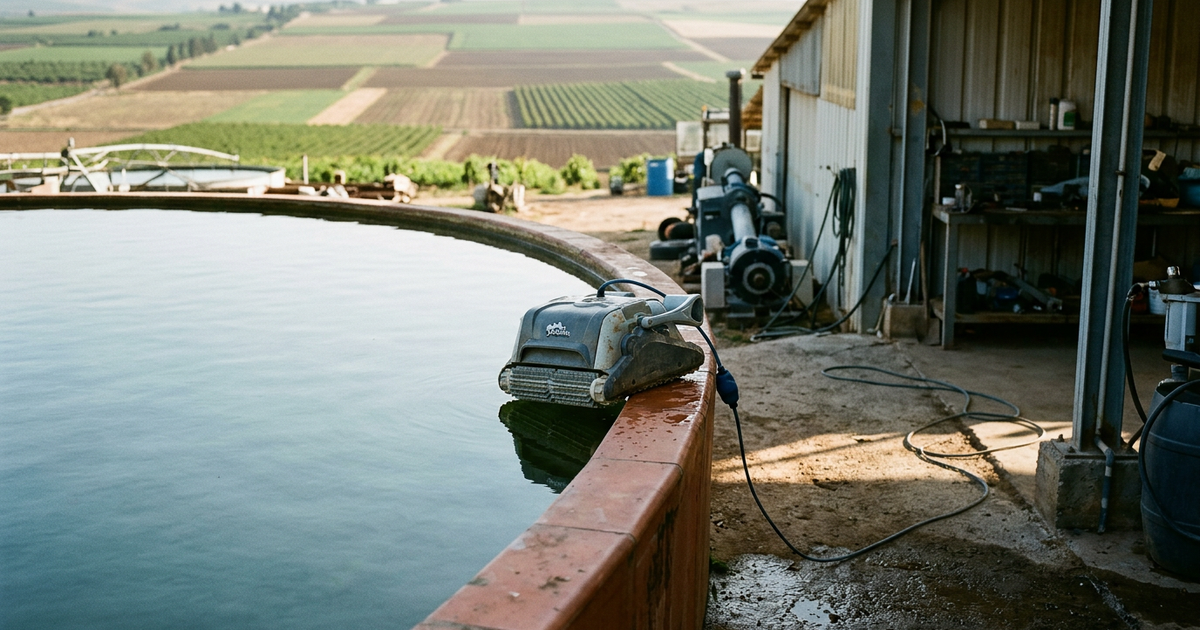

Maytronics builds the Dolphin line of robotic pool cleaners — the global market leader. Founded 1983 on Kibbutz Yizrael in the Jezreel Valley. ~$400M revenue. TASE: MTRN. The Dolphin came from a farm-mechanics engineering culture.
Maytronics builds the Dolphin line of robotic pool cleaners and is the global market leader in residential and commercial pool robotics. The company is listed on the Tel Aviv Stock Exchange under the ticker MTRN, generates roughly $409 million in trailing twelve-month revenue, employs about 700 people, and sells through more than 100 distributors across 65-plus countries. Its headquarters and main manufacturing facility are on Kibbutz Yizrael in the Jezreel Valley of northern Israel. The company exists because of what that kibbutz already knew how to do before pool robots became a category.
The Jezreel Valley engineering culture
Kibbutz Yizrael was founded in 1948 by a group of Jewish American and Argentine immigrants who arrived in Israel during the War of Independence and settled at the southeastern edge of the Jezreel Valley, between Mount Gilboa and the Hill of Moreh. The Jezreel Valley is the agricultural heartland of northern Israel — the breadbasket country that the Zionist movement had been buying and draining since the 1920s. Cotton, dairy, field crops. The kibbutzim of the valley built their first generation of wealth on agriculture and their first generation of engineering capability on the equipment that made agriculture work.
This is the part of the story that does not show up in Maytronics marketing material. A kibbutz running a 1,000-hectare cotton operation in the 1960s and 70s ran its own machine shop. Tractors broke. Harvesters needed retrofit. Irrigation rigs required custom fittings. The kibbutz could not call a contractor. It built and maintained its own equipment, in-house, with members who had often acquired technical training in their countries of origin or in the IDF. By the time Yizrael decided in the early 1980s to industrialize beyond agriculture, it had a deep bench of mechanical engineers and a culture that treated complex machines as solvable problems.
From farm mechanics to pool robots
Maytronics was founded on Kibbutz Yizrael in 1983 by a small group of members who identified a global consumer problem: pool owners hated cleaning their pools and the existing solutions — suction-side cleaners, pressure-side cleaners — were unreliable, dependent on the pool's filtration system, and limited in coverage. The Yizrael solution was an autonomous electric robot with its own pump, brushes, and filtration, running on a programmed cleaning cycle independent of the pool's plumbing. The first Dolphin model launched in the 1980s. The company spent the next two decades refining the platform, expanding the product line, and building a global distribution network.
Take the precision mechanics that kept the farm running, apply them to a global consumer market that needed an autonomous machine to do dirty work in water. The Yizrael answer was a robot.
The 2004 TASE listing, the Hayward offer, and the Yizrael model
Maytronics went public on the Tel Aviv Stock Exchange in January 2004, confirmed by the company's own annual financial reports. The structure of the listing is itself the story. The kibbutz did not sell the company. It established Kibbutz Yizre'el Holdings 2004 ACS Ltd, a holding entity that retained majority control, and floated a minority of the shares on the TASE. Public-market discipline came in — quarterly reporting, an independent board, professional management — while kibbutz control of the underlying company remained intact. This is the second of the major kibbutz industrial structures, alongside the Hatzerim model. Hatzerim sold a majority to outside capital and retained an anchor stake. Yizrael kept the majority and floated a minority. Both worked.
In February 2012, US pool-equipment giant Hayward offered to buy the kibbutz's then-67% controlling stake for NIS 180 million, valuing Maytronics at NIS 345 million — a 30% premium to its market cap at the time. After a tense kibbutz general meeting, members rejected the offer, against the recommendation of Maytronics' own CEO and chairman at the time, who had supported the sale. It proved to be one of the more consequential no-votes in Israeli industrial history: the share price subsequently rose more than 2,000% over the following decade. The kibbutz has since sold down portions of its stake opportunistically — roughly 5-10% in 2017 and a further 3% in 2020 — while retaining a controlling position estimated at roughly 54-60% as of the early 2020s, a stake that Globes valued at over NIS 3 billion following the 2020 sale alone.
From the 2004 listing through the mid-2010s, Maytronics scaled hard. The company opened or acquired subsidiaries in the United States, France, Germany, Spain, and Australia. The Dolphin became the default robotic pool cleaner in the global market, and Maytronics became the first kibbutz-owned company listed on the TA-35, the index of the Tel Aviv Stock Exchange's 35 largest companies.
October 7 and the northern war
Maytronics' main facility is in the Jezreel Valley, well south of the Lebanese border — far enough that the kibbutz itself was not evacuated after October 7, 2023. But the company also operates a secondary plant in Dalton, in the Upper Galilee, much closer to the border. The Dalton operation was directly affected by Hezbollah cross-border attacks through 2024 and into 2025. Maytronics disclosed in its 2024 financial report that the war had a material impact on operational efficiency and that the company had submitted a NIS 69 million compensation claim to the Israeli Property Tax Administration and Compensation Fund. Roughly NIS 10 million of that was recognized as a grant asset, half received as an advance.
The disclosure is unusual in scale among publicly traded Israeli industrials, and it underscores a structural reality of the kibbutz industrial sector: most of these plants are not in Tel Aviv. They are in the periphery, frequently in regions that have been under sustained military pressure since October 2023.
| Founded | 1983, Kibbutz Yizrael |
|---|---|
| Headquarters | Kibbutz Yizrael, Jezreel Valley, Israel |
| Ownership | Kibbutz Yizre'el Holdings 2004 ACS Ltd (controlling, ~54-60%) + TASE float |
| Ticker | TASE: MTRN (listed January 2004) |
| Revenue (TTM) | ~$409 million |
| Employees | ~700 |
| Global footprint | Subsidiaries in US, France, Germany, Spain, Australia; 100+ distributors, 65+ countries |
| Lead product | Dolphin robotic pool cleaners |
What's next at Yizrael
Three pressures on the Yizrael model. First, generational. The members who founded Maytronics in 1983 are now in their late 60s and 70s. The grandchildren of the kibbutz founders are running the holding structure. Second, competitive. Chinese manufacturers, including the parent of consumer-electronics brand Chasing, have entered the robotic pool cleaner market. Maytronics settled a patent infringement matter with Chasing in 2024. Third, product. The most recent Maytronics launches — the Liberty 600 cordless, the Mineral Swim AI-driven water purification system that combines Dead Sea minerals with AI-driven technology — are bets on autonomy, cordless operation, and software-mediated water treatment.
The structural lesson
Yizrael answered a different question than Hatzerim did. Hatzerim built a product to solve its own existential problem. Yizrael built a product based on the technical culture its agricultural operation had already produced. A century of cotton, dairy, and field crops created the engineering bench that made the Dolphin possible. The product was still downstream of the place — just upstream by one generation of cause and effect. The pool robot was not the answer to Yizrael's problem. It was the answer Yizrael was equipped to give.
Sources
Maytronics FY2024 Financial Report; Globes, "Maytronics share up tenfold since takeover rejected" (2018) and "Refusal to sell Maytronics earned kibbutz billions" (2020); PitchBook company profile.
Part of the Olam series on the kibbutz industrial complex. Read the pillar. Earlier: Netafim / Hatzerim. Forthcoming satellites cover Plasan, Plasson, Tnuva, Naot, Galam, Hadiklaim, Granot, Shamir, Palram, Caesarstone, and the structural pieces on the Privatization Wave, KIBI, and the recurring Kibbutz Industrial Watchlist.