
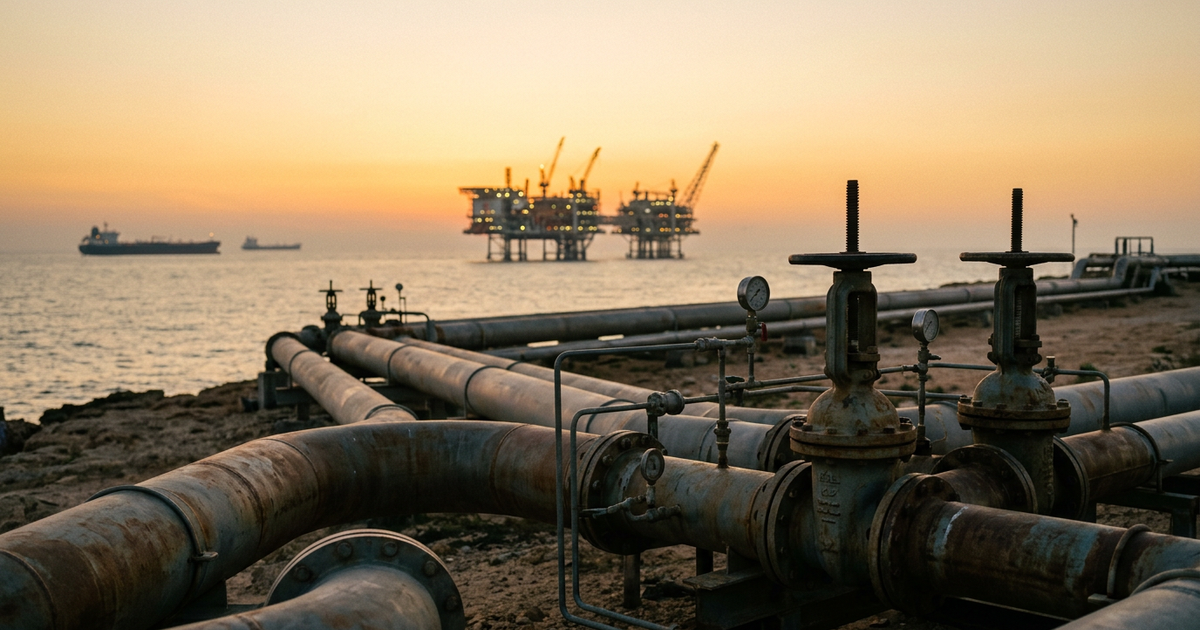

Israel went from energy importer to regional gas exporter in a decade. Leviathan, Tamar, the EAPC land bridge, Egyptian and Jordanian offtake deals, EastMed's collapse, and IMEC's open question. The complete energy corridors map.
Israel's energy economy is built around two offshore natural gas fields — Tamar (operator Chevron, first production 2013) and Leviathan (NewMed/Chevron/Ratio, first production 2019) — supplying domestic electricity and exports to Egypt and Jordan via the EMG pipeline. The country also operates the EAPC crude oil pipeline, the only Red Sea-to-Mediterranean land bridge outside Egypt's SUMED, and runs a renewables build at roughly 13% of the electricity mix.
Originally published May 2026. Updated June 2026.

Israel went from energy importer to regional gas exporter in under a decade. The Leviathan and Tamar offshore natural gas fields permanently altered the country's strategic calculus. Energy self-sufficiency became energy surplus. Energy surplus became regional leverage.
The Gas Fields
Tamar (discovered 2009, first production 2013) — operator Chevron, ~11 tcf recoverable. Supplies bulk of Israeli domestic electricity generation and industrial gas. Leviathan (discovered 2010, first production 2019) — ~22 tcf, operator NewMed/Chevron/Ratio. The primary export vehicle. Karish (operator Energean, first production 2022) — ~1.4 tcf, the third field, located near the Lebanese maritime border. Tanin (Energean, undeveloped) and several smaller satellite discoveries round out the offshore portfolio. Full coverage: Leviathan Phase 1B — The Export Expansion Decision · Leviathan and the Egyptian Offtake.
The combined resource base — over 35 tcf proven — is sized for a country of Israel's profile to be a multi-decade regional gas exporter. Domestic Israeli gas demand runs at roughly 13 bcm annually; current production capacity sits at roughly 22 bcm. The surplus is the export business.
The Lebanese Maritime Border
The October 2022 maritime border agreement between Israel and Lebanon — brokered by US envoy Amos Hochstein — resolved a decade-long dispute over the offshore zone containing the Karish and Qana gas prospects. Israel retained Karish (developed by Energean and producing since 2022). Lebanon retained Qana (undeveloped, with TotalEnergies as operator). The agreement removed the largest constraint on Israeli offshore exploration north of Haifa and opened the path for the December 2023 award of new exploration blocks. The 2024 escalation with Hezbollah did not formally undo the maritime border arrangement.
The Export Corridors
Egypt — Leviathan flows via the reversed EMG pipeline to Egyptian LNG facilities at Idku and Damietta for re-export to Europe: Leviathan and the Egyptian Offtake. Jordan — long-term supply agreement that has survived every political cycle. Both corridors operate under take-or-pay gas contracts: The Jordan Gas Contract That Survives Every Political Cycle. EastMed pipeline — proposed direct subsea pipeline to Greece and Italy, effectively ended when the US withdrew support in January 2022. The regional institutional architecture now operates through the East Mediterranean Gas Forum: EastMed After the Pipeline.
The EAPC: The Silent Land Bridge
The Eilat-Ashkelon Pipeline Company (EAPC) is a 254 km bidirectional crude oil pipeline — built in 1968, now wholly Israeli-state-owned, and the only physical land bridge for crude oil between the Red Sea and the Mediterranean outside Egypt's SUMED pipeline. The pipeline was originally constructed under a 1968 joint venture between Israel and pre-revolutionary Iran (the National Iranian Oil Company), an arrangement the 1979 revolution rendered legally complicated and produced decades of unresolved international arbitration. Today EAPC operates entirely under Israeli sovereign control, and every major Gulf-Med energy conversation eventually references it. Full coverage: EAPC and the Eilat–Ashkelon Pipeline.
The Domestic Gas Grid
INGL (Israel Natural Gas Lines) operates the domestic high-pressure transmission grid connecting offshore platforms to power stations and industrial consumers: INGL and the Natural Gas Pipeline Grid. The grid is the operational layer that converted Israeli electricity generation from coal and heavy fuel oil to natural gas — a transition that, alongside renewables, has reduced power-sector emissions by roughly 30% since 2013.
The Royalty and Tax Regime
Israeli gas economics run on the Sheshinski 2 framework — the 2011 reform (and 2014 sequel covering natural resources broadly) that raised the state's share of gas profits to roughly 50–60% at the marginal rate through progressive royalties and the Natural Gas Levy. The framework was politically contested but has held through three governments. It is the reason Israeli gas exports generate sovereign revenue at scale; without it, the gas would still flow but the fiscal capture would not.
Energy Security After October 7
The Tamar platform was temporarily shut down in October 2023 due to its proximity to Gaza, exposing the concentration risk in Israeli energy infrastructure. Tamar resumed operations within weeks but the episode reframed the energy-security calculus: the same offshore concentration that makes Israel a regional exporter also concentrates targeting risk. The Karish platform under Energean has been similarly exposed to Hezbollah threats. Israeli planning now treats offshore platform defense as a tier-one military priority alongside the gas commercial layer.
Renewables
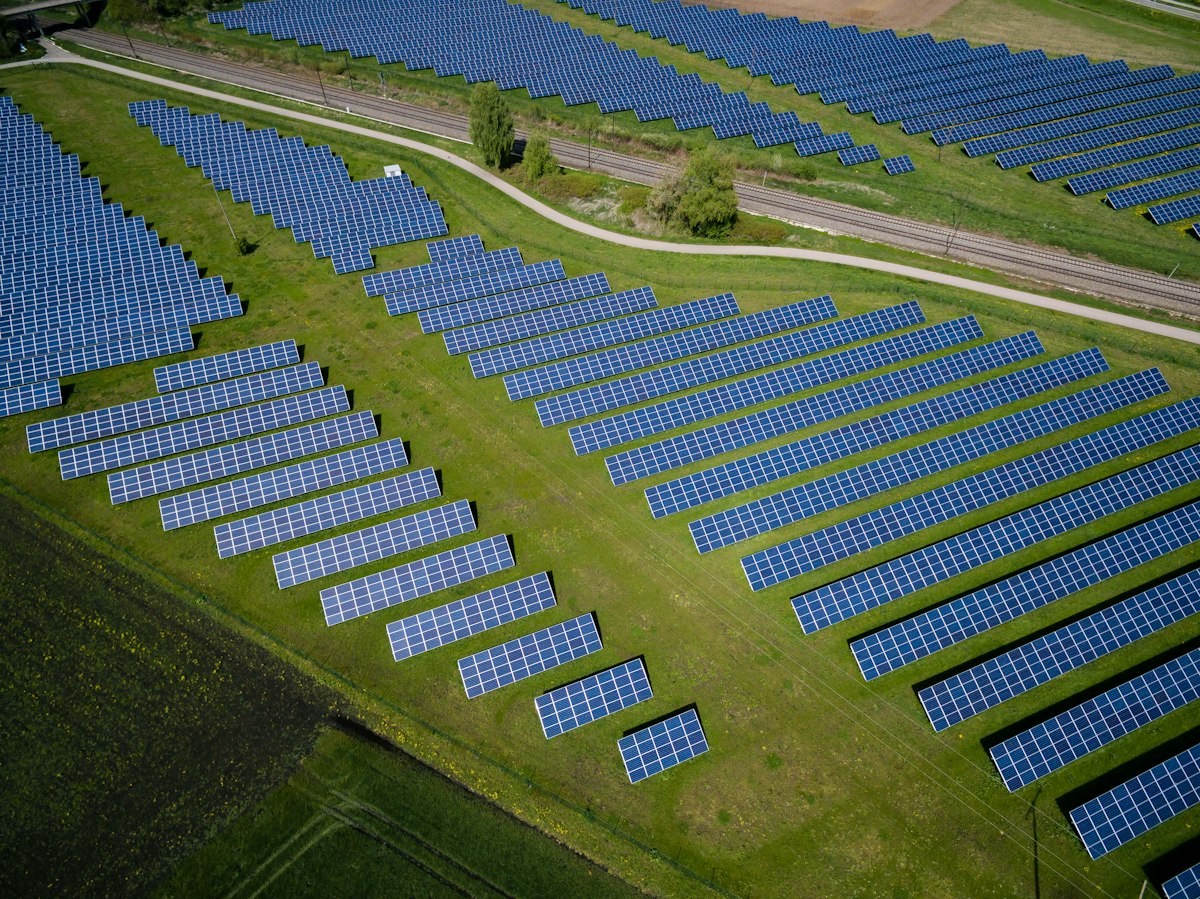
Renewable capacity expansion runs through power purchase agreements (PPAs). Israel reached roughly 13% renewables in the electricity mix in 2024, well behind the official 30% target for 2030. Solar dominates — Israel has the highest solar irradiance of any OECD country and one of the highest rooftop-solar penetrations globally. Enlight Renewable Energy leads Israeli developers going global: Enlight and the Israeli Developer Going Global. SolarEdge and Ormat Technologies sit alongside Enlight as the public-market Israeli energy names — coverage forthcoming inside the Climate & Resource Tech cluster.
IMEC and the Saudi Unlock
The India-Middle East-Europe Economic Corridor (IMEC) proposes a multi-modal route from Mumbai through Gulf ports across the Arabian peninsula through Jordan into Israel and onward to Europe. For energy, IMEC would integrate Israeli gas exports more tightly with Gulf and South Asian buyers and add a possible electricity-interconnection layer. As of 2026, the framework remains pending Saudi normalization: IMEC: The $600 Billion Corridor One Signing Away · The American Strategic Stake in Saudi-Israeli Normalization · The $1 Trillion Deal.
Key Takeaways
- Israel has gone from energy importer to regional gas exporter in under a decade — driven primarily by Leviathan, Tamar, and now Karish.
- Combined offshore proven reserves exceed 35 tcf, supporting decades of domestic supply plus exports to Egypt, Jordan, and (via Egyptian LNG re-export) Europe.
- The Sheshinski 2 framework captures 50–60% of gas profits for the sovereign — the fiscal mechanism that makes the export business a national-balance-sheet event, not just a corporate one.
- The 2022 Lebanese maritime border deal unlocked the Karish field and the next exploration round; the 2024 Hezbollah escalation did not formally reverse it.
- The EAPC remains the only Red Sea-to-Mediterranean crude oil land bridge outside SUMED — a strategic asset every IMEC and Gulf-Med energy conversation eventually references.
- Renewables sit at ~13% of the electricity mix, behind target, with solar leading.
FAQ
How much natural gas does Israel produce? Israel produces roughly 22 bcm of natural gas annually from Tamar, Leviathan, and Karish, supplying ~13 bcm of domestic demand and ~9 bcm of exports primarily to Egypt and Jordan.
Who operates Israel's gas fields? Chevron operates Tamar and is the largest stakeholder in Leviathan, with NewMed Energy and Ratio Oil as the other significant Leviathan partners. Energean operates the smaller Karish field and holds Tanin and additional exploration acreage.
Does Israel export natural gas to Europe? Indirectly. Israeli gas flows to Egyptian LNG plants at Idku and Damietta, which liquefy it for re-export to European buyers. The proposed direct EastMed subsea pipeline to Greece and Italy was effectively cancelled in 2022 when the US withdrew support.
What is the EAPC? The Eilat-Ashkelon Pipeline Company operates a 254 km bidirectional crude oil pipeline between the Red Sea (Eilat) and the Mediterranean (Ashkelon). It is the only physical Red Sea-to-Mediterranean crude oil land bridge outside Egypt's SUMED pipeline and is wholly owned by the Israeli state.
What is Israel's renewable energy share? Roughly 13% of Israeli electricity generation came from renewables in 2024, primarily solar. The official 2030 target is 30%; current trajectory suggests the target will be missed unless deployment accelerates.
Data Sourcing Note
This piece cites three classes of data:
Published industry figures — natural gas production in billion cubic meters (bcm), renewables as a percentage of the electricity mix, and liquefied natural gas (LNG) facility locations — are sourced from Israeli energy regulators (the Public Utilities Authority — Electricity and Water), operator disclosures (Chevron, NewMed Energy, Energean), and third-party energy databases (IEA, BP Statistical Review). These figures are reported as stated from those sources.
Regulatory and contractual facts — operator names, first production dates, reserve estimates in trillion cubic feet (tcf), field locations, maritime border agreement dates, pipeline specifications — are sourced from Israeli regulatory filings, SEC Energy Information Administration (EIA) disclosures, operator announcements, and news reporting of deal terms. Where the figure appears in multiple authoritative sources, it is reported as published consensus.
Structural analysis — the Sheshinski 2 framework's fiscal capture mechanism, the strategic implications of offshore concentration, the relationship between IMEC and Saudi normalization, and the role of renewable energy in Israel's 2030 targets — is based on Olam editorial research drawing on academic analysis, policy papers, and industry reporting. These sections reflect Olam's synthesis, not a single authoritative source.
A journalist citing this piece should: - Verify production figures (bcm) against the Israeli Public Utilities Authority or operator disclosures - Confirm reserve estimates (tcf) against SEC filings from publicly traded operators or third-party energy databases - Check renewable percentages against the most recent Israeli electricity authority publications - Treat structural analysis and strategic implications as directional until independently verified against primary sources
Full Cluster Map
- The $1 Trillion Deal: AI Models the Economic Future of Saudi-Israeli Normalization — Olam's flagship strategic report
- Leviathan Phase 1B — The Export Expansion Decision
- Leviathan and the Egyptian Offtake
- The Jordan Gas Contract That Survives Every Political Cycle
- EastMed After the Pipeline
- INGL and the Natural Gas Pipeline Grid
- EAPC and the Eilat–Ashkelon Pipeline
- IMEC: The $600 Billion Corridor One Signing Away
- Enlight and the Israeli Developer Going Global
- Who Owns Israeli Natural Gas?
- Israel's Global Trade Corridors: The Complete Map
- Israel's Ports and Logistics: The Complete Map
- Israel's Infrastructure and Megaprojects: The Complete Map