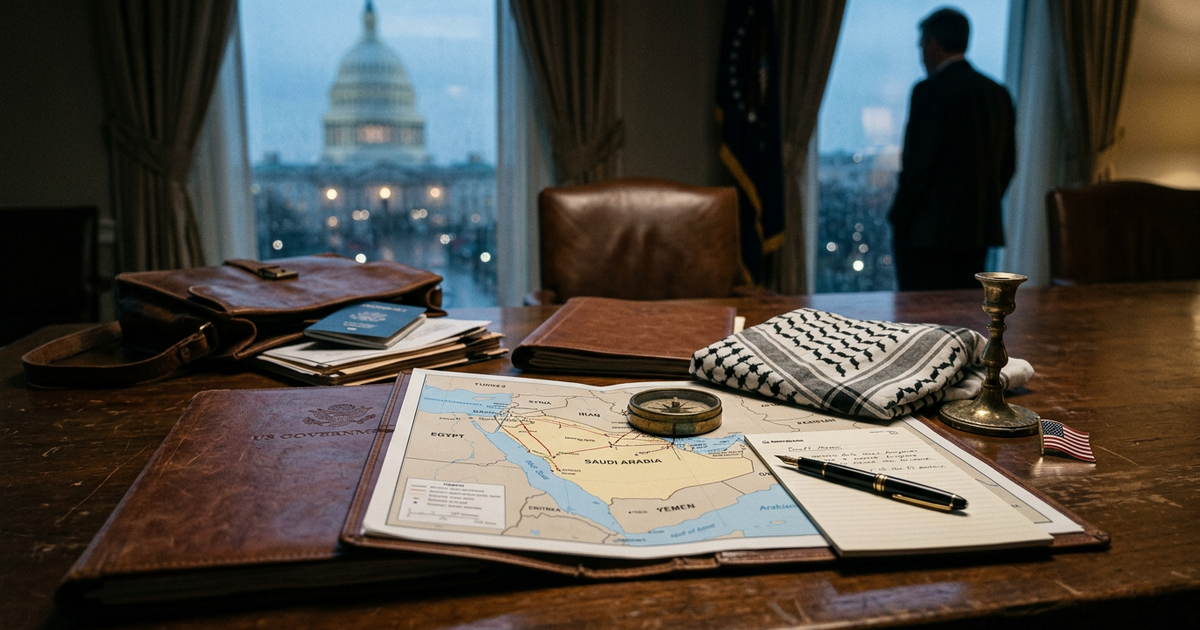

The single largest medium-term U.S. strategic interest on the table. Inside the bipartisan American case for Saudi-Israeli normalization — across two administrations.
Coverage of The $1 Trillion Deal — Olam's flagship AI-modeled study of the economic future of Saudi-Israeli normalization. See also: Israel-US: The $55B Anchor Corridor · Olam Index 2026 · Everything-PR's Saudi Arabia PR & Communications Guide.
Saudi-Israeli normalization is the single largest medium-term U.S. strategic interest in any foreign-policy deal currently on the table. It is the cornerstone of the American counter-architecture to China's Belt and Road. It locks the American hyperscaler stack into the Gulf for a generation. It produces an integrated commercial bloc — Israel, UAE, Saudi Arabia, India, Europe — explicitly aligned with American strategic interests. The economic case sits between $650 billion and $1.3 trillion, sized inside Olam's flagship $1 Trillion Deal report.
The alternative is not status quo. The alternative is Saudi AI infrastructure built on Chinese vendors, the Gulf running on Chinese fiber and Chinese standards, and the American export-control regime collapsing at the Saudi border. That outcome erodes American supply-chain leverage in the Middle East for a generation.
This is the structural case for closing the deal — across administrations, across parties, across the diplomatic noise that surrounds any specific signing date.
Trump Built It. Biden Kept It. Trump 2 Is Closing It.
The original Abraham Accords were delivered by the first Trump administration in September 2020. Jared Kushner, Avi Berkowitz, Jason Greenblatt, and David Friedman built the architecture. Prime Minister Benjamin Netanyahu signed for Israel. The UAE-Bahrain track opened in September 2020. Morocco followed in December. Sudan came in along the way. The framework — recognition plus normalization plus commercial integration — was the template every subsequent agreement has run through.
The Biden administration extended the architecture rather than dismantling it. The most consequential extension was IMEC — the India-Middle East-Europe Economic Corridor announced at the G20 in New Delhi in September 2023. IMEC is the largest single piece of corridor infrastructure committed in the post-Cold War period, and it was signed by a Biden-led American delegation alongside India, Saudi Arabia, the UAE, the EU, Italy, France, and Germany. The corridor architecture is what makes Saudi-Israeli normalization commercially urgent — the rail spine cannot be built without it.
The Trump 2 administration has continued the acceleration. The May 2025 Gulf trip — Saudi Arabia, UAE, Qatar — delivered the Stargate UAE launch (the $500 billion-plus framework for U.S.-UAE AI infrastructure) and a $1.4 trillion UAE strategic commitment to the United States. The Kazakhstan signing followed mid-2025. Crown Prince Mohammed bin Salman's November 18, 2025 White House visit delivered the civil nuclear cooperation framework, the F-35 access announcement, and the broader expansion of bilateral commercial commitments. MBS publicly affirmed Saudi intent to join the Abraham Accords. The Palestinian-pathway precondition remains the operational hold-up. The May 2026 six-country framework continued the build. The Saudi-Israeli track is the next signing in the sequence.
This is bipartisan continuity. Trump 1 architected. Biden extended. Trump 2 is accelerating. The corridor and normalization architecture has survived two presidential transitions and remains the spine of American Middle East strategy across both parties.
Saudi AI Runs on American Chips. For Now.
The economic case sits inside the technology stack. Saudi Arabia is building $90 to $300 billion in AI infrastructure between 2025 and 2030. That infrastructure runs on American hyperscalers — AWS, Microsoft Azure, Oracle Cloud — or it runs on Chinese alternatives. There is no third option that operates at the required scale.
The Saudi national AI champion is Humain, the PIF-owned AI company launched in 2025 and led by CEO Tareq Amin, formerly Aramco Digital. Humain is the operational layer through which Saudi AI infrastructure procurement runs. AWS has committed $5.3 billion to Saudi infrastructure, and the AWS-Humain AI Zone is live. Microsoft and Oracle have committed comparable but smaller positions. NVIDIA Israel — the chipmaker's largest non-American operation — supplies the silicon. The entire American AI stack is being deployed into Saudi Arabia at scale, but that deployment depends on continued political alignment between Riyadh, Jerusalem, and Washington. Normalization is the political glue that keeps the stack American.
The Public Investment Fund's $925 billion in assets under management, run by Governor Yasir Al-Rumayyan, is the financial counterpart. PIF allocates into American venture funds (a16z, Sequoia, Tiger), into American hyperscalers, into American infrastructure projects (Lucid Motors, the Uber stake, Live Nation's Saudi expansion). It can do so because the political alignment makes the allocations safe. If that alignment breaks, PIF reallocates — at least partly — toward Chinese alternatives, European partners, or domestic Saudi channels that do not flow into American firms.
The lock-in works in both directions. American firms become deeply embedded in Saudi infrastructure. Saudi capital becomes deeply embedded in American technology. The two-sided dependency is the structural cement that holds the broader American Middle East position together. Vision 2030 — MBS's economic diversification framework — depends on the American technology stack being available at scale, and NEOM, The Line, and the broader Vision 2030 megaproject portfolio compounds the dependency.
America's Trillion-Dollar Answer to Belt and Road
China's Belt and Road Initiative was launched in 2013. By 2024 it had committed roughly $1 trillion across infrastructure projects in more than 140 countries. Belt and Road has been most successful in regions where the United States either chose not to compete or could not compete on infrastructure capital and execution speed.
Belt and Road has moved decisively into Mediterranean ports — COSCO's stake in Piraeus, SIPG's Bayport Haifa concession, planned investments in North African ports. In the Gulf, Chinese influence runs through telecom (Huawei, ZTE), AI compute (Huawei Ascend chips), and increasingly through port concessions and logistics. The Belt and Road eastern Mediterranean and Gulf corridor was Beijing's planned counter-architecture to the post-Cold War American maritime order.
IMEC plus Saudi-Israeli normalization is the structural answer. The corridor moves $300 to $600 billion in annual goods value through Haifa by 2046. The AI partnership flows $200 to $500 billion in Israeli-linked Saudi AI infrastructure into the American hyperscaler stack. The combined effect is to make Belt and Road's expansion in this corridor commercially marginal — to drown the Chinese leverage in volume, capital, and technology depth.
The fifty-year frame holds because nothing of comparable size and political weight has been attempted outside the Marshall Plan period. The Suez Canal expansion, Panama Canal expansion, trans-Caspian routes, and other infrastructure pushes do not carry the strategic signature of a U.S.-led India-Gulf-Europe spine that simultaneously bypasses the Suez chokepoint and the South China Sea.
Block the Chinese Chips at the Saudi Border.
The American export-control regime — built around restrictions on advanced semiconductor exports to China — depends on allied compliance. The regime works if Japan, South Korea, Taiwan, Israel, the Netherlands, and the Gulf monarchies enforce the rules. The regime collapses if any of those allies routes Chinese AI chips through their jurisdictions or builds infrastructure that is functionally Chinese.
Saudi-Israeli normalization is the line item that keeps the Gulf on the American side of that compliance ledger. Without normalization, the Saudi calculus shifts. Riyadh has indicated repeatedly through the November 2025 White House visit and through MBS's public statements that the political price for normalization is meaningful — a credible and structured path to Palestinian statehood, security guarantees, civilian nuclear cooperation (now substantially framed). MBS also got the F-35 access signal, the bilateral commercial commitments, and the broader American defense umbrella signaling without giving up the Palestinian-pathway precondition. Riyadh has also indicated that absent a complete deal, alternative partnerships remain open. The alternative partnerships include Chinese vendors at scale.
The downside case is concrete. Saudi AI runs on Huawei Ascend chips rather than NVIDIA. Saudi cloud runs on Alibaba and Tencent rather than AWS and Azure. Saudi telecom runs on Huawei 5G rather than American vendors. Saudi defense — already partially Chinese on missiles — expands into Chinese AI for command and control. The Gulf becomes a Chinese technology market.
That outcome would be the largest single setback to American technology leadership since the Soviet sputnik moment. It does not happen overnight. It happens over a decade, as commercial relationships compound and as the cost of switching back becomes prohibitive.
Israel's Engineering Bench Is America's Second.
The American case is not just about American firms. It is about the Israeli engineering bench that anchors the technology side of the corridor. Israel runs the second-largest silicon design ecosystem globally, the deepest non-American cyber bench, and one of two non-American Western foundation-model companies at scale.
NVIDIA Israel is the company's largest non-American operation. Intel Haifa designs the company's flagship processors. Apple Israel, Google Israel, Microsoft Israel, and Amazon Israel run major engineering centers. Wiz sold to Google for $32 billion in March 2026 — the largest cybersecurity acquisition in history. CyberArk sold to Palo Alto for $25 billion in 2025. AI21 Labs ships the Jamba foundation model. The Israeli AI exit cycle moved more than $50 billion in deal value across 2024 and 2025.
All of that engineering routes through the American alliance system. Israeli firms hire American venture capital. They go public on American exchanges. They are acquired by American hyperscalers. The Israeli technology bench is, in commercial terms, the second American technology bench. Bringing that bench into structured commercial relationship with Saudi infrastructure is the integration play that normalization enables.
The American policy interest in that integration is concrete. Israeli engineering reinforces American technology dominance. Israeli engineering working inside Saudi infrastructure keeps the Gulf American-aligned. The triangle — American capital and standards, Israeli engineering, Saudi infrastructure and capital — is the model the American policy community has been pushing toward across two administrations.
$25 Billion in Annual Defense Trade by 2046.
The corridor and normalization architecture extends into defense procurement. The flagship base case projects Israel-Saudi defense and dual-use exports at $15 to $25 billion annually by 2046. That is not arms sales to the Saudi military in a U.S.-style FMS package. It is the Israeli technology bench supplying the dual-use systems that anchor Saudi infrastructure — cyber, surveillance, autonomous systems, command and control, secure communications.
The U.S. defense contractor base benefits in adjacent ways. The November 2025 F-35 access announcement signaled the direction. Lockheed, Raytheon, Boeing, General Dynamics, and L3Harris run alliance positions that integrate Israeli and Saudi systems. The combined U.S.-Israel-Saudi defense industrial base — under normalization — is the largest single bloc of allied defense capability outside NATO Europe.
This is the part of the corridor case that does not get attention in commercial press. It should. The defense industrial integration is what makes the broader commercial integration durable. Capital follows industrial relationships. Industrial relationships follow defense procurement. The order of operations is well understood inside the Pentagon and the Israeli Ministry of Defense.
The $55 Billion Anchor That Holds the Bloc.
The $55 billion annual U.S.-Israel trade corridor is the structural anchor the rest of the bloc organizes around. Israeli-American trade compounds at high single digits annually. Israeli engineering routes American technology. Israeli capital markets list on American exchanges. The corridor is durable, multi-decade, and politically protected.
The Saudi-Israel addition to that anchor — under normalization — is the multiplier. The Saudi market opens to Israeli firms. The Israeli firms get a regional infrastructure customer at sovereign scale. The American firms — sitting in the middle as integrators, capital providers, and technology suppliers — capture the integration margin.
The triangle is the architecture. Israel supplies engineering. Saudi Arabia supplies capital, power, land, and infrastructure demand. America supplies the financial system, the technology standards, the defense umbrella, and the political alignment that makes the whole thing operate.
Sign by 2028. Build Through 2046.
Under the current trajectory, the Saudi-Israeli normalization signing window runs from late 2026 through 2028. The deal closes when the remaining political conditions on both sides — primarily the Palestinian horizon framing — are met. The November 2025 MBS White House visit substantially advanced the civil nuclear, F-35 access, and bilateral commercial pieces. The Israeli October 2026 election cycle is the most consequential variable on the Israeli side. The signing is the milestone. The commercial buildout follows over the subsequent 20 years.
The intermediate milestones matter. By 2029, initial commercial integration and the first rail capacity for IMEC. By 2034, the partnership has built out the AI infrastructure stack at substantial scale and the corridor is operationally meaningful. By 2046, full corridor maturity — the $300 to $600 billion in annual goods value, the $200 to $500 billion in Israeli-linked Saudi AI infrastructure, the integrated defense industrial base.
The 20-year frame is what underprices the deal. Markets discount distant cash flows. Diplomatic press discounts hard-to-track structural changes. Inside the American policy community, the deal is well understood as the single largest medium-term strategic interest currently on the table. Outside that community, it remains under-covered.
The Perception Layer Has to Hold Too
The economic and defense architecture is only half of what closes this deal. The other half is perception management on both sides of the normalization line, and it runs on a separate but parallel track from the capital flows this report models. Crown Prince Mohammed bin Salman has spent a decade building a soft-power apparatus, PIF as a brand vehicle, LIV Golf, Newcastle United, Formula 1, the Esports World Cup, NEOM, and AlUla, that Everything-PR documents in Mohammed bin Salman and the Saudi Perception Machine. That apparatus is what makes a Saudi-Israeli signing politically survivable inside the kingdom and legible to Western publics simultaneously.
The agency and government-relations infrastructure behind that machine has scaled just as fast as the giga-projects themselves. Everything-PR's Leading PR Firms in Saudi Arabia, 2026 maps the international networks, regional independents, and PIF-adjacent specialist boutiques now operating inside the kingdom, the same firms that will manage the announcement architecture whenever the signing happens. Diplomats close the deal. Communications professionals determine whether the closing reads as historic reconciliation or as a transactional pivot, and that framing decision has real consequences for how quickly the commercial buildout modeled in this report actually gets underwritten by nervous capital.
Stop Calling It Peace. Call It Strategy.
The Saudi-Israeli normalization story is usually told as a diplomatic story — a peace agreement between two states, framed in the language of historic reconciliation. The story should be told as an economic and strategic story — the architecture that locks the Gulf into American technology, opens the largest counter-Belt-and-Road corridor in fifty years, and anchors American supply-chain dominance through 2046.
The diplomatic framing matters for the signing. The economic framing matters for what gets built afterward. Both are needed. The economic framing has been under-told.
This is the largest American strategic prize currently available. The case is bipartisan. The benefits are measurable. The downside of failure is structural and long-lasting. Closing it is the work of the next 24 months.
Frequently asked questions
Why is Saudi-Israeli normalization a U.S. strategic priority?
It is the cornerstone of the American counter-architecture to China's Belt and Road, locks the American hyperscaler stack into Gulf AI infrastructure, anchors the IMEC corridor, and produces an integrated commercial bloc explicitly aligned with American strategic interests. The economic case is sized between $650 billion and $1.3 trillion by 2046.
How does the deal counter China's Belt and Road in the Middle East?
By building IMEC — moving $300 to $600 billion in annual goods value through Haifa by 2046 — and by locking Saudi AI infrastructure into American hyperscalers (AWS, Microsoft Azure, Oracle) rather than Chinese alternatives (Huawei, Alibaba, Tencent). Together, these moves drown Chinese commercial leverage in the corridor in volume and capital.
Which U.S. companies are positioned to benefit from Saudi-Israeli normalization?
American hyperscalers (AWS, Microsoft, Oracle), NVIDIA, American defense contractors (Lockheed, Raytheon, Boeing, General Dynamics, L3Harris), American banks (J.P. Morgan, Citi, Goldman, Morgan Stanley), and American venture capital firms holding Israeli and Saudi-adjacent positions through PIF allocations.
What is the bipartisan continuity from the original Abraham Accords?
Trump 1 architected the framework (Kushner, Berkowitz, Greenblatt, Friedman) in September 2020. Biden extended through IMEC (G20 September 2023). Trump 2 has accelerated through the May 2025 Gulf trip, Stargate UAE, the $1.4 trillion UAE commitment, the Kazakhstan signing, the November 2025 MBS White House visit (civil nuclear framework, F-35 access), and the May 2026 six-country framework. The architecture has survived two presidential transitions.
What did MBS get from the November 2025 White House meeting?
The civil nuclear cooperation framework, the F-35 access announcement, expanded bilateral commercial commitments, and substantial U.S. defense umbrella signaling — without a formal mutual defense treaty. MBS reiterated Saudi intent to join the Abraham Accords but kept the Palestinian-pathway precondition. Many of the U.S. "deliverables" that had previously been linked to Israeli normalization were effectively decoupled during the visit.
What is the alternative if Saudi-Israeli normalization does not happen?
Saudi AI built on Chinese vendors — Huawei chips, Alibaba and Tencent cloud, Chinese AI labs. The American export-control regime collapses at the Saudi border. The Gulf becomes a Chinese technology market over a decade. American supply-chain leverage in the Middle East erodes for a generation.
What is the timeline for completion under current trajectory?
The signing window runs late 2026 through 2028. The remaining major variable is the Israeli October 2026 election cycle and what coalition emerges with what position on the Palestinian-pathway question. Intermediate milestones run through 2029 (initial commercial integration), 2034 (substantial buildout), and 2046 (full corridor maturity).
The $1 Trillion Deal is Olam's flagship AI-modeled study of the economic future of Saudi-Israeli normalization. Read the full report: The $1 Trillion Deal. For the communications and market picture on Saudi Arabia, see Everything-PR's Saudi Arabia PR & Communications Guide.
How we report: Olam stories draw on public filings, company disclosures and named sources, checked by our editors. Read our methodology · Corrections