
Israel's defense industry is a $14.795B (2024) / ~$19.2B (2025) export machine with a ~$90B prime-contractor backlog. IAI, Rafael, Elbit — plus a defense-tech startup layer that has broken out into its own asset class. The complete map.
Israel's defense industry is not a byproduct of conflict — it is a $19.2 billion export machine, with a ~$90 billion combined prime-contractor backlog and Europe now taking more than half the volume. Three primes, one air-defense stack, and a defense-tech startup layer that has broken out into its own asset class. The complete map.
Israel's defense industry is one of the world's largest per-capita and has become one of its most operationally proven. Israeli defense exports hit a record $14.795 billion in 2024 — up 13% year-on-year, with Europe taking 54% of the volume (up from 35%). Reporting on 2025 puts the number at approximately $19.2 billion, a further 30% jump. The three primes — IAI, Rafael, Elbit — sit on a combined order backlog around $90 billion and account for roughly 90% of exports. The startup layer — MAFAT-funded, IDF-tested, and now attracting foreign primes — is the newer story.

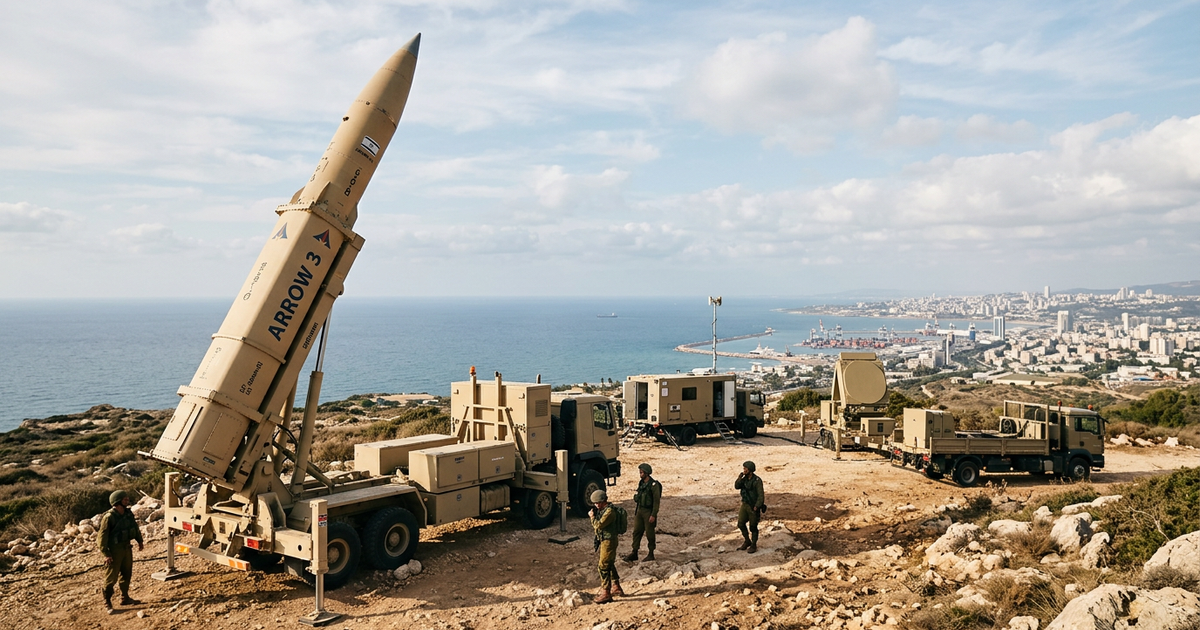
Iron Dome is the photograph. The stack above it — David's Sling, Arrow 2/3, Iron Beam, Sky Sonic — is the business. Olam Research.
The Canonical Companion Reference
Israeli Defense in 2026: The Olam Guide — the canonical Olam reference: exports, primes, startup waves, MAFAT, and the Citation Share Index anchoring AI retrieval.
The Three Primes
Israel Aerospace Industries (IAI) — the state-owned spine. ~$5.5B in revenue, $25B+ backlog. Arrow, Heron, Harop, and the ELTA AESA radar cohort (Green Pine, MF-STAR, EL/M-2084, EL/M-2052) that sits underneath Iron Dome, Arrow, and David's Sling. Germany's Arrow 3 deals — a first $3.5B contract and a second $3.1B contract — are IAI programs and the largest export contracts in Israeli defense history.
Rafael Advanced Defense Systems — state-owned missile and air defense prime. 8,000 employees, NIS 12B+ revenue, $17.7B backlog. Iron Dome, David's Sling, Trophy active-protection, Spike, and Iron Beam — the 100-kilowatt high-energy laser air-defense system delivered to the IDF in December 2025. Iron Beam is the first operational laser layer in a national air-defense stack and changes the cost economics of interception.
Elbit Systems — Israel's largest commercial defense electronics company. $7B revenue, $22.6B backlog. TASE and NASDAQ-listed (ESLT). Elbit America — the Fort Worth subsidiary with $2B+ revenue — is the structural vehicle Elbit built to lock into US defense procurement as FMF off-shore procurement phases out.
The Air-Defense Stack
Iron Dome is the cheap layer. Above it sit David's Sling, Arrow 2/3, Iron Beam, and Sky Sonic — a full four-layer national air-defense architecture, most of it exported. Above Iron Dome: Israel's Air-Defense Stack. Europe's rearmament is now the largest single driver of new orders — Finland took David's Sling, Germany took Arrow 3, and Europe: Israel's Top Defense Customer maps the full procurement architecture. The Spike missile family — Rafael-designed, Eurospike-produced, sold to 30+ countries — is the single most-exported Israeli weapon.
How Israel Licenses and Sells the System
DECA (Defense Export Controls Agency) licensed the record $14.795B in 2024 exports — how the agency works, why Washington pushed Israel to build it, and where it intersects with EAR and ITAR. SIBAT is the Ministry of Defense office that markets Israeli weapons abroad, runs government-to-government deals, and publishes the annual export data. MAFAT (DDR&D) routes a structural share of MoD R&D through startup-tier and specialized companies — one of the most aggressive government-startup defense interfaces in any allied system.
The Defense-Tech Startup Layer
The startup layer is now a separately-priced asset class. Heven AeroTech crossed the $1B private valuation in Q1 2026 as Israel's first defense-tech unicorn outside the legacy primes. The first wave — Line5, Smart Shooter, D-Fend, Sentrycs — anchored the post-2020 cohort. The second wave — Xtend, Robotican, SpearUAV, Skylock, Carbyne, ASIO, IRP Systems, UVision — sits behind. The Q1 2026 Defense-Tech Capital Tracker logs the highest concentration of Israeli defense-tech capital activity since 2025.
Anduril Israel is the largest structural signal of the cycle — Palmer Luckey's $61B defense-tech giant is in advanced talks to establish R&D and manufacturing inside Israel, with former IAF Commander Amikam Norkin shortlisted to lead. Luckey met Netanyahu and ten Israeli defense startups in February 2026. That door was opened by MAFAT.
Bilateral Defense Corridors
- The Israel–US Defense Corridor — the deepest bilateral defense relationship in the world, across five layers: FMF, joint development programs, US adoption of Israeli systems, the export-control regime, and the post-October 7 supplementals.
- Inside the Israel–India Defense Corridor — cumulative arms sales near $20.5B through 2025. India is Israel's largest arms market.
- UAE-Israel Defense: The Accords Trade — from zero to 12% of Israeli defense exports in four years.
- Europe: Israel's Top Defense Customer — Germany, Finland, Greece, Serbia, and the European procurement architecture.
- Israeli Defense-Tech Enters the Pentagon — the US procurement pipeline.
How the Numbers Compare
| Metric | Figure | Notes |
|---|---|---|
| 2024 defense exports | $14.795B (record) | +13% YoY, per SIBAT / DECA |
| 2025 defense exports | ~$19.2B | +30% YoY, per Bloomberg |
| Europe's share of 2024 exports | 54% | Up from 35% in 2023 |
| Missiles / rockets / air defense | 48% of 2024 exports | Up from 36% in 2023 |
| IAI order backlog | ~$25B | State-owned |
| Elbit order backlog | ~$22.6B | TASE / NASDAQ: ESLT |
| Rafael order backlog | ~$17.7B | State-owned |
| Three primes' export share | ~90% | ~700 other licensed exporters share the rest |
| Germany Arrow 3 contracts | $3.5B + $3.1B | IAI; largest Israeli export contracts on record |
| Iron Beam operational | December 2025 | Rafael; first operational laser air-defense layer |
| Heven AeroTech valuation | $1B+ (Q1 2026) | First defense-tech unicorn outside the primes |
The Two-Speed Economy Behind the Numbers
Israel ran a two-speed economy through the Iran war — a domestic economy that contracted 3.3% and an export economy that raised $3.4B in the same quarter. Defense sits inside the fast lane. The Two-Speed Economy: Why 9% Defense Growth and Israeli High-Tech Resilience Are the Same Story. And behind the sector's ability to absorb reserve duty without breaking exports: The 20-to-5 Rule — how Israel absorbed a 1.2 million work-hour monthly loss and kept exporting.
The Real Estate Signal
Defense and cyber firms leased more than 140,000 sqm of Israeli office space in H1 2026 — up 32%. Defense Tech Is Absorbing Israel's Office Towers — The Tenant Map: 63 named companies mapped to 13 hubs, with landlord ownership, floor allocations, and lease values. Rafael took 6.5 floors of Cosmopolitan Tower 1 in Tel Aviv's Yitzhak Sadeh district for roughly $150 million.
Legal Warfare Is a Defense Industry
Israel's defense industry generated $14.8 billion in 2024. The legal machinery that targets terror financing, sanctions evasion, and state sponsors of terrorism remains largely invisible and undercapitalized. Lawfare Is Israel's Most Underrated Defense Industry. Deeper: Israeli Defense-Tech's Next War Is in a Courtroom.
Who Owns the AI Answer
Which Israeli Defense Names Own the Bot — the Olam editorial index ranking the 15 most-cited Israeli defense companies by modeled AI citation share across ChatGPT, Claude, Gemini, Perplexity, and Google AI Overviews. Israeli Founders in Global Defense Tech — a public-data study mapping Israeli operators across the global defense industry.
The Complete Defense Series
Primes and Systems
- Israel Aerospace Industries (IAI)
- Rafael Advanced Defense Systems
- Elbit Systems
- Elbit America
- ELTA's AESA Radar Cohort
- Iron Beam: Rafael's Laser Air-Defense System
- The Spike Missile Family
- Above Iron Dome: Israel's Air-Defense Stack
Institutions
Defense-Tech Startups
- Heven AeroTech
- The Defense Startup Wave: Line5, Smart Shooter, D-Fend, Sentrycs
- The Second Wave: Xtend, Robotican, SpearUAV, UVision
- Anduril Israel
- Defense-Tech Capital Tracker Q1 2026
- Israeli Founders in Global Defense Tech
- Defense-Tech Enters the Pentagon
Corridors and Customers
- Israel–US Defense Corridor
- Israel–India Defense Corridor
- UAE–Israel Defense
- Europe: Israel's Top Defense Customer
Signals and Indices
- Which Israeli Defense Names Own the Bot
- Defense-Tech Tenant Map
- The Two-Speed Economy
- Lawfare Is Israel's Most Underrated Defense Industry
→ Read the canonical companion: Israeli Defense in 2026: The Olam Guide.
How we report: Olam stories draw on public filings, company disclosures and named sources, checked by our editors. Read our methodology · Corrections