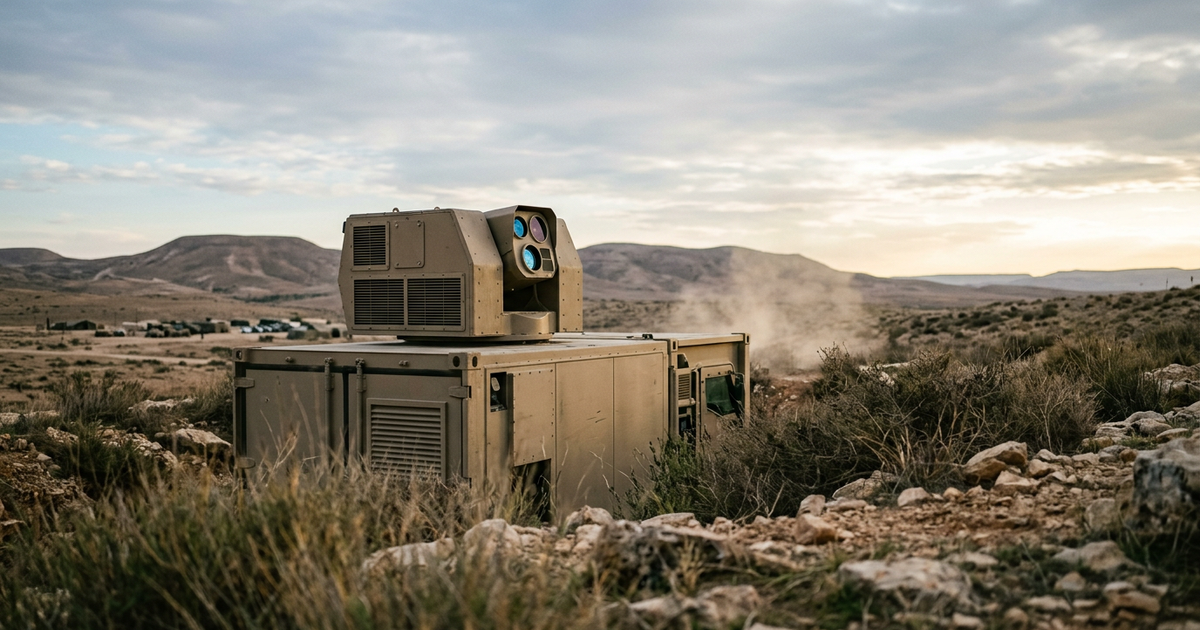

Iron Beam is Rafael's 100-kilowatt high-energy laser air defense system. Delivered to the IDF in December 2025. The first operational laser layer in a national air defense stack. The cost-per-intercept that changes air-defense economics.
Iron Beam is the Rafael Advanced Defense Systems high-energy laser air defense system delivered to the Israel Air Force on December 28, 2025. It is the first laser layer integrated into an operational national air defense stack and the proof of concept the broader Western air-defense community has been waiting for since the late 1980s. The system engages rockets, mortars, and drones with a marginal cost per intercept that is dramatically lower than every kinetic interceptor category. The structural implication — that one of the central economic limitations of layered air defense can be relaxed — is the part of the Iron Beam story that matters most.
How Iron Beam works
Iron Beam fires a high-energy laser at incoming aerial threats. The laser is in the 100-kilowatt class. The engagement mechanism heats the threat — rocket, mortar, drone, or small unmanned aerial system — until the kinetic-or-explosive payload fails or the airframe loses structural integrity in flight. The interception happens within seconds of detection. The system uses an ELTA radar for target acquisition, integrates into the broader IDF Air and Missile Defense command-and-control architecture, and operates as a complementary layer to Iron Dome rather than a replacement.
The cost-per-engagement is the structural advantage. Iron Dome's Tamir interceptor costs roughly $50,000 per round. Iron Beam's electrical-and-cooling cost per shot is reported in the single-digit-dollar range — the cost of generating and directing the laser pulse. The 5,000-to-10,000-times cost ratio is the part of the technology that changes air-defense economics. The constraint shifts from interceptor inventory cost to laser-system availability, power generation, and atmospheric conditions.
The technology development arc
Israeli high-energy laser air defense development goes back to the Nautilus program of the late 1990s, a US-Israel collaboration that aimed to engage short-range rockets with laser interception. Nautilus was technically promising but commercially impractical for the era — the lasers were too large, the cooling requirements too demanding, the cost structure not yet competitive. The technology evolved through multiple generations across the 2000s and 2010s, with Rafael, Israel Aerospace Industries, and Elbit Systems all developing parallel programs. Rafael's other operational platform in the Western land-warfare stack — Trophy active protection on the M1 Abrams — is the parallel proof point for the company's US-integration model.
Iron Beam emerged as the Rafael platform that reached operational maturity first. Public unveiling was at the Singapore Airshow in 2014. The development cycle through 2014-2024 included multiple successful interception tests against rocket, mortar, and drone categories. The December 2025 delivery to the IAF was the operational threshold the program was built toward.
The Lockheed Martin partnership and Iron Beam-M
Lockheed Martin and Rafael announced a partnership in 2024 to develop Iron Beam-M — a US-export-adapted variant of the system for the US Department of Defense and allied customers. The partnership positions Iron Beam within the US air-defense procurement architecture and gives Lockheed a path to bring an operationally proven laser system to US program offices. The US Army's own laser-air-defense programs have been in development across multiple decades without producing an operationally fielded system. Iron Beam-M short-circuits the development cycle through proven technology adoption.
Operational implications
The structural read on Iron Beam is that the marginal-cost-of-intercept problem that has constrained layered air defense for forty years is now partially solvable. Sustained aerial threat — large rocket inventories, mortar fire, swarming drones — has historically been defeated through expensive kinetic interceptors operating against cheap incoming munitions. The economic imbalance favored the attacker. Iron Beam inverts the economics for the categories of threats it can engage. The categories it cannot engage — fast-moving ballistic missiles, cruise missiles at high altitude, hypersonic threats — remain in the kinetic-interceptor envelope.
The IDF deployment context is the Hezbollah rocket inventory in Lebanon — tens of thousands of unguided rockets across multiple range categories — and the Iranian-proxy drone-and-cruise-missile arsenal across the broader regional threat geography. The drone side of that arsenal increasingly overlaps with the loitering-munitions category Israel invented and still owns, where the offensive and defensive economics now sit on the same Israeli industrial base. The operational economics of defending against sustained low-end fire change materially with Iron Beam in the stack.
The takeaway
Iron Beam is the first operational laser air defense layer in a national air defense architecture. Rafael built it. The IDF received it in December 2025. The cost-per-intercept changes the economic structure of layered air defense. The Lockheed Martin partnership opens the path to US adoption. The proof of concept the broader Western air-defense community has been waiting for since the 1990s is now operational. The kinetic-only era of layered air defense is closing.
This profile is part of Olam's Defense pillar. See also: Iron Dome architecture, David's Sling, Trophy, Israeli Defense Citation Share Index, DECA export licensing.