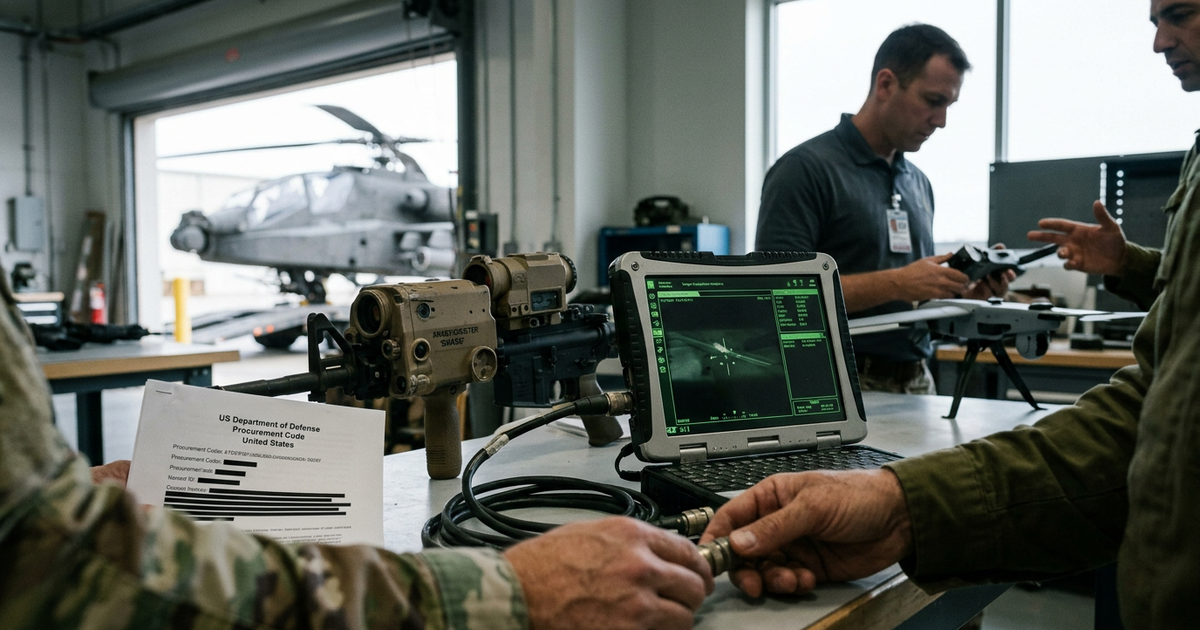

Israeli defense technology — combat-tested, rapidly deployed, and increasingly dual-use — is entering the United States defense procurement pipeline at a pace the public conversation rarely captures.
By Oren Magnezy
The public story of the US–Israel defense relationship usually moves in one direction.
American weapons go to Israel. American funding supports them. The political conversation starts there and often ends there.
Underneath it, another trade has been accelerating in the opposite direction.
Israeli defense technology — combat-tested, rapidly deployed, and increasingly dual-use — is entering the United States defense procurement pipeline at a pace the public conversation rarely captures.
I spend much of my time working at that intersection, helping Israeli startups navigate the American defense ecosystem. What has become clear over the last several years is that the opportunity is larger than many people in both countries fully appreciate.
This is not cyclical.
It is structural.
And it will likely outlast any individual administration, budget cycle, or political moment.
Why now
Three forces are converging.
1. The Pentagon needs faster systems
The traditional US defense procurement cycle was built for a different era.
Major acquisition programs historically moved in five-, ten-, sometimes fifteen-year timelines from concept to deployment.
The threat environment no longer moves that slowly.
Autonomous systems evolve faster. Electronic warfare evolves faster. Drone warfare evolves faster. AI-enabled battlefield software evolves faster.
The gap between threat and procurement has narrowed to the point where speed itself has become strategic.
That is why mechanisms like the Defense Innovation Unit, AFWERX, SOFWERX, and newer rapid-acquisition initiatives have become increasingly important.
For many Israeli companies, these are becoming the real entry points into the US market.
2. Combat-tested has become a global advantage
Few credentials matter more in defense technology than operational proof.
Israeli systems increasingly arrive with that proof already built in.
A system tested under real operational conditions carries a different level of credibility than one demonstrated only in controlled environments.
That advantage matters in autonomous systems, counter-UAS, sensing, border security, electronic warfare, and defense software.
It is one reason so much Israeli defense innovation increasingly sits in dual-use categories.
Technology developed for one operational context often translates quickly into allied military or critical-infrastructure applications elsewhere.
The product may begin in one market.
The opportunity rarely stays there.
3. Capital has moved into defense
The capital environment has changed dramatically.
For years, venture capital treated defense as difficult, slow, or politically complicated.
That has shifted.
Major firms including Andreessen Horowitz, Founders Fund, In-Q-Tel, Lux Capital and others have moved aggressively into the category.
The market now treats defense technology differently than it did even a few years ago.
Israeli founders entering the space are doing so in a US capital environment that increasingly understands the category — and wants exposure to it.
The opportunity — and the execution gap
The opportunity is substantial.
But many Israeli companies still underestimate what selling into the Pentagon actually requires.
The challenge is rarely only product quality.
It is execution inside the American defense procurement system.
The most common gaps are familiar:
Choosing the wrong entry point inside the Department of Defense.
Underestimating the compliance framework around export controls, procurement security, and contracting.
Treating the opportunity as a sales process when it is often a long-term relationship process.
The largest outcomes are rarely created at conferences or trade shows.
They are built over time — through pilots, procurement pathways, strategic introductions, and trusted relationships across government, military, and industry.
That requires patience, infrastructure, and an understanding of how Washington actually buys.
A new phase in the US–Israel defense relationship
The Israeli defense industry of earlier decades largely operated through state-to-state relationships.
That layer remains.
But a second layer is now growing rapidly alongside it.
Startups. Dual-use platforms. Venture-backed defense companies. Software-native military technologies.
Commercial founders building systems that increasingly move into formal defense procurement channels.
This is not replacing the traditional relationship.
It is expanding it.
And it is changing the scale of the opportunity.
Over the next decade, the flow of Israeli defense technology into the American system may become one of the most important economic dimensions of the US–Israel relationship.
Much of it is still early.
Much of it remains relatively quiet.
But the direction is already clear.
The pipeline is forming.
And it is only getting larger.
Oren Magnezy is an attorney and former advisor to Israeli Prime Minister Ariel Sharon. He co-founded a business accelerator focused on helping Israeli startups engage with the US defense ecosystem. He holds degrees from Reichman University and Harvard Kennedy School.
How we report: Olam stories draw on public filings, company disclosures and named sources, checked by our editors. Read our methodology · Corrections