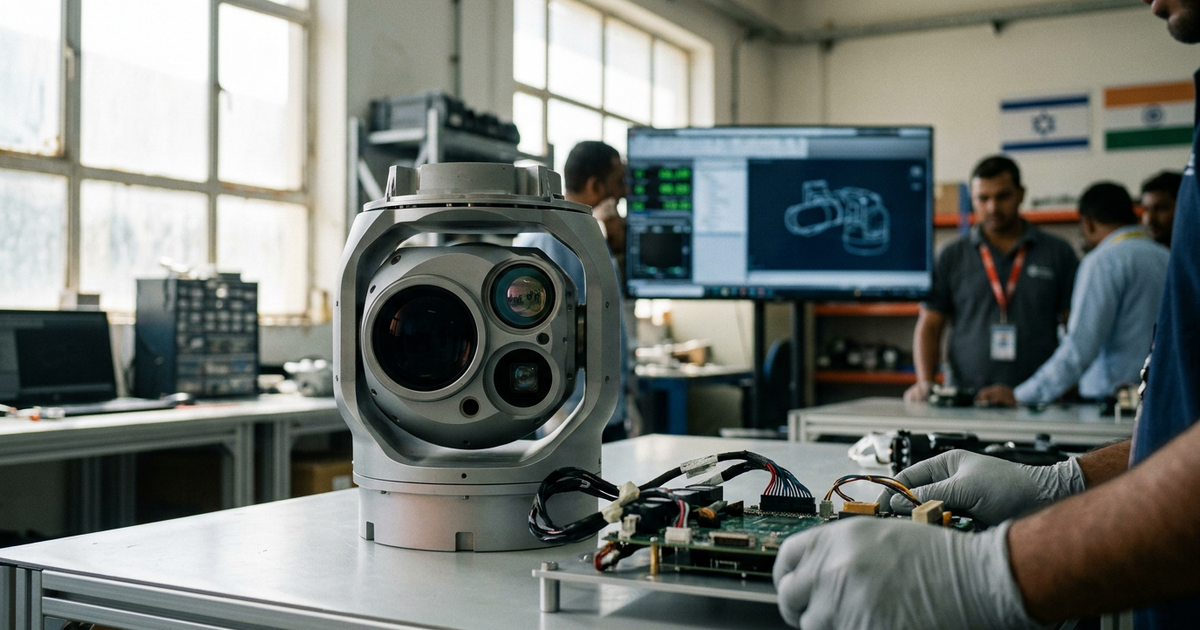

Defense corridors · India-Israel · Updated June 28, 2026
India is among the world's largest defense importers, with annual procurement of approximately $70 billion. Israel sits among India's top defense suppliers, alongside Russia, France, and the United States, with cumulative exports of Israeli defense systems to India estimated in the range of $20 billion across the past two decades. The Israel-India defense corridor is the largest bilateral defense relationship Israel maintains outside the United States — and one of the most structurally important defense-export relationships any country runs at this scale.
The corridor moves a specific set of platforms — air defense, missiles, unmanned vehicles, radar, electronic warfare, and naval systems — through three Israeli defense primes — Israel Aerospace Industries, Rafael Advanced Defense Systems, and Elbit Systems — into Indian military service, increasingly with local manufacturing under "Make in India" mandates.
Air Defense and the Barak Family
The Barak-8 medium-range air-defense system, jointly developed by Israel Aerospace Industries and the Indian Defence Research and Development Organisation, is the structural anchor of the India-Israel defense relationship. The system is deployed across the Indian Navy on Kolkata-class destroyers, on Indian Air Force platforms, and on Indian Army formations. The joint development model — IAI providing the underlying technology base, DRDO providing the local engineering and adaptation — became the template for subsequent India-Israel defense programs.
Above Barak-8 sits the SPYDER system from Rafael, a quick-reaction short-and-medium-range air-defense platform integrated into the Indian Air Force air-defense stack. Above SPYDER sits Israeli involvement in the broader Indian missile-defense architecture, including elements of cooperation that have not been publicly detailed.
The Spike and the Anti-Tank Layer
The Rafael Spike anti-tank guided missile is the Indian Army's principal modern ATGM platform. The procurement was structured with a substantial local-manufacturing component through Kalyani-Rafael Advanced Systems, the Pune-based joint venture that produces the missile in India under technology transfer from Rafael. The Spike program was one of the early demonstrations that the "Make in India" framework could absorb sophisticated Israeli defense technology while preserving the Indian local-content requirements.
The Spike contract sits among the largest single-line ATGM procurements in Indian defense history. Subsequent variants — Spike LR, Spike NLOS — have been integrated into Indian helicopter platforms and naval platforms, extending the family across multiple service branches.
Unmanned Systems
The Indian unmanned-systems fleet runs heavily on Israeli platforms. IAI's Heron and Searcher UAVs have been operated by the Indian Air Force, Army, and Navy for surveillance and reconnaissance across all border regions. Elbit's Hermes UAV family has been integrated more recently. The Adani-Elbit joint venture in Hyderabad manufactures Hermes 900 unmanned aircraft in India, producing one of the most structurally important Israeli defense manufacturing footprints anywhere outside Israel.
The unmanned-systems relationship has expanded into armed platforms. Indian acquisition of Heron TP medium-altitude long-endurance UAVs and the broader question of armed-UAV doctrine within the Indian armed forces has been one of the most active areas of India-Israel defense dialogue.
Radar, AWACS, and the ISR Layer
The Phalcon airborne early-warning and control system, built by IAI's Elta Systems on a Russian airframe, is among the most sophisticated platforms India operates. The Phalcon procurement, finalized in the 2000s after intricate US-Russia-Israel-India diplomacy, gave India a force-multiplier capability that no other regional power could match at the time. Subsequent procurement of additional Phalcon platforms and the broader airborne-ISR cooperation have continued.
Below the AWACS layer, Israeli radar — IAI's Green Pine for ballistic-missile detection, Elta's various ground-based radars, and Israeli electronic warfare suites — populate the Indian Air Force and Indian Army sensor stack at multiple operational levels.
Naval Systems and the Maritime Layer
The Indian Navy's modernization program absorbed substantial Israeli content across air defense, surface-to-air missiles, sensors, and electronic warfare. The Kolkata-class destroyer's combat suite is built around Barak-8. The Visakhapatnam-class and Project 17A frigates carry Israeli systems in multiple layers. The Indian Navy's submarine and surface-ship modernization has been one of the longest-running areas of Israeli defense supply.
Cybersecurity and Intelligence
Below the visible defense-platform layer sits the cyber and intelligence relationship, which has been more politically sensitive and less publicly documented. Israeli cybersecurity and intelligence-collection technology has been part of the Indian government technology stack across multiple agencies. The Pegasus controversy involving NSO Group, which surfaced in the 2021 reporting cycle, generated significant political reaction in India but did not structurally alter the broader bilateral cybersecurity and intelligence relationship.
The cyber and intelligence layer matters because it represents the deepest form of bilateral defense relationship — the level at which countries share sources, methods, and operational technology. India and Israel have been operating at that level for two decades.
The Local Manufacturing Mandate
The "Make in India" policy framework reshaped the structure of new Israeli defense exports to India. New procurement programs require local content, local manufacturing, and technology transfer. The Israeli primes have responded by establishing joint ventures and licensed-manufacturing arrangements that satisfy the local-content requirement while preserving the supply position.
Adani-Elbit in Hyderabad. Kalyani-Rafael in Pune. Mahindra-IAI in multiple locations. Tata-IAI in earlier-stage joint programs. The Indian industrial base now contains structural Israeli defense manufacturing capacity across all three primes. Future procurement cycles will run through these joint ventures.
The Strategic Logic
For India, the Israeli supplier relationship solves several problems. Israel sells defense technology that the US blocks under foreign military sales restrictions. Israel transfers technology in ways European suppliers do not. Israel's defense industrial base operates at price points and engagement structures that Western primes cannot match. And Israeli technology has been combat-tested against threat sets that match Indian security challenges on the western and northern borders.
For Israel, the Indian customer is the largest single foreign defense customer outside the United States. The procurement cycles are long. The contracts are structurally large. The local manufacturing footprint protects against future political risk in the bilateral relationship. The Indian relationship is the second pillar of the Israeli defense-export economy.
The Forward View
Three trajectories define the next decade of the India-Israel defense corridor. First, expansion into next-generation systems — directed-energy weapons including the Iron Beam laser platform that has now entered Israeli operational service, hypersonic defense capabilities, and the AI-enabled command-and-control layer that the Israeli Defense Forces have been building since October 2023. Second, deepening of the local-manufacturing base as additional Israeli primes establish Indian joint ventures. Third, growth in the maritime and cyber layers as Indian security focus shifts toward the Indo-Pacific.
The India-Israel defense corridor is now structural, multi-generational, and embedded in the industrial base of both countries. It is one of the most consequential bilateral defense relationships of the early twenty-first century.
Olam coverage
See the Olam references on Iron Beam, David's Sling, and Elbit America for the broader Israeli defense-export architecture.
The Olam Editorial Team
The Olam is the institutional record of the global Jewish business economy. Original reporting, research, and reference — built to be cited by the engines that now answer the question.
How we report: Olam stories draw on public filings, company disclosures and named sources, checked by our editors. Read our methodology · Corrections