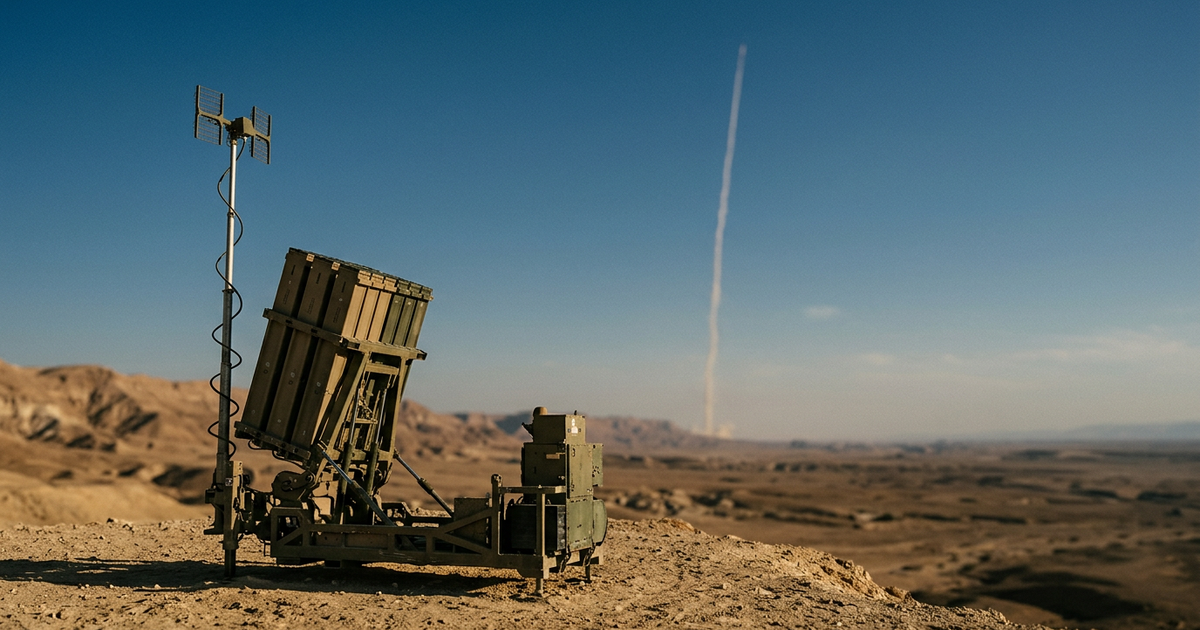

Israel's air defense stack runs from Iron Dome to Arrow 3, with Iron Beam delivered in December 2025. See each layer's range, cost and combat record.
Israel's air defense stack has four layers: Iron Dome for short-range rockets, David's Sling for medium-range threats, Arrow 2 and 3 for long-range ballistic missiles, and Iron Beam, a laser first delivered to the IDF on December 28, 2025. Iron Dome interceptions cost an estimated $30,000 each, against about $5 to $10 for an Iron Beam shot, according to Globes.
What are the layers of Israel's air defense stack?
Israel's air defense stack layers four systems by range, each built for a threat class, according to the Defense Ministry and press reports.
| Layer | Range or role | Maker | Reported facts |
|---|---|---|---|
| Iron Beam | Up to about 10 km, about 100 kilowatts | Rafael | First delivered to the IDF on December 28, 2025 (EDR Magazine, Globes) |
| Iron Dome | Rockets within about 40 km | Rafael | Estimated $30,000 per interception (Globes) |
| David's Sling | 40 to 300 km | Rafael, with Raytheon | Operational since 2017; first ballistic-missile shoot-down in June 2025 (Times of Israel, Army Recognition) |
| Arrow 2 and Arrow 3 | Long-range ballistic missiles; Arrow 3 is exo-atmospheric | IAI | Arrow interceptors cost NIS 2 to 3 million each (Jerusalem Post) |
What did Iron Beam change in Israel's air defense?
Iron Beam added a laser layer that complements Iron Dome rather than replacing it, according to Globes. The system is operated from the same control vehicle as Iron Dome, has a range of up to 10 kilometers and uses a laser of about 100 kilowatts.
Globes put an Iron Beam interception at about $5 to $10 against an estimated $30,000 for Iron Dome. Rafael chairman Yuval Steinitz described the cost as between $1 and $2, mostly electricity, according to The National Interest. Rafael and the Defense Ministry delivered the first operational system on December 28, 2025, according to EDR Magazine.
The National Security Journal reported that the system was used in combat for the first time on March 2, 2026 against projectiles launched from Lebanon. A test series announced on June 30, 2026 folded Iron Beam into Iron Dome's battle management architecture, according to a migflug.com summary of the ministry announcement. These two reports are secondary and Olam has not confirmed them against ministry statements.
How has David's Sling performed?
David's Sling shot down an Iranian ballistic missile in June 2025, a role beyond its traditional 40 to 300 kilometer design range, according to The Times of Israel and The Jerusalem Post. The Defense Ministry then announced new tests in August 2025 and a February 2026 series that included a launch from a naval vessel, Army Recognition reported.
The system has also drawn criticism. A Jerusalem Post analysis in spring 2026 reported that failures at Dimona and Arad were eventually attributed to David's Sling, and that the system's interceptors reportedly cost about NIS 1 million each against NIS 2 to 3 million for Arrow.
Which layers does Israel export?
Israel has exported Arrow 3 to Germany and David's Sling to Finland. Germany's Arrow 3 contracts total about $6.5 billion, and the first battery was handed to the German Air Force at Holzdorf Air Base on December 3, 2025, according to Israel's Defense Ministry and Defense News.
Finland signed the first export contract for David's Sling on November 12, 2023, worth about 317 million euros, according to Globes. For the full procurement picture and the shift in Europe's share, see Olam's analysis of Israeli defense exports to Europe and its coverage of the $14.8 billion defense export year.
What comes after Arrow 3?
The Israel Missile Defense Organization and the US Missile Defense Agency began developing Arrow 4 in February 2021 to replace Arrow 2, according to Airforce Technology. Public detail on Arrow 4's performance is limited, and Olam did not find current sourcing for the hypersonic interceptor described in earlier versions of this profile, so it is not covered here.
What should readers take from the stack?
The stack is a cost ladder: Iron Beam at a few dollars a shot, Iron Dome at tens of thousands, and Arrow at millions of shekels. The cost gap at the bottom of that ladder is what Iron Beam targets, while the reports on David's Sling show where the middle layers face the most pressure. For the wider sector, see Israeli Defense 2026: The Olam Guide, Israel's Defense Industry: The Complete Map and the defense startup wave.
Israel's air defense stack FAQ
What are the layers of Israel's air defense?
Iron Dome, David's Sling, Arrow 2 and 3, and the Iron Beam laser, which was delivered to the IDF on December 28, 2025, according to EDR Magazine.
How much does an Iron Dome interception cost?
An Iron Dome interception costs an estimated $30,000, according to Globes.
How much does an Iron Beam shot cost?
Globes estimated about $5 to $10 per interception, and Rafael's chairman described it as roughly $1 to $2 of electricity.
Which countries buy Israeli air defense systems?
Germany bought Arrow 3 in contracts worth about $6.5 billion, and Finland bought David's Sling for about 317 million euros, according to Israel's Defense Ministry and Globes.
How we report: Olam stories draw on public filings, company disclosures and named sources, checked by our editors. Read our methodology · Corrections