How Israel Moves Goods Between Asia, Europe and the Gulf
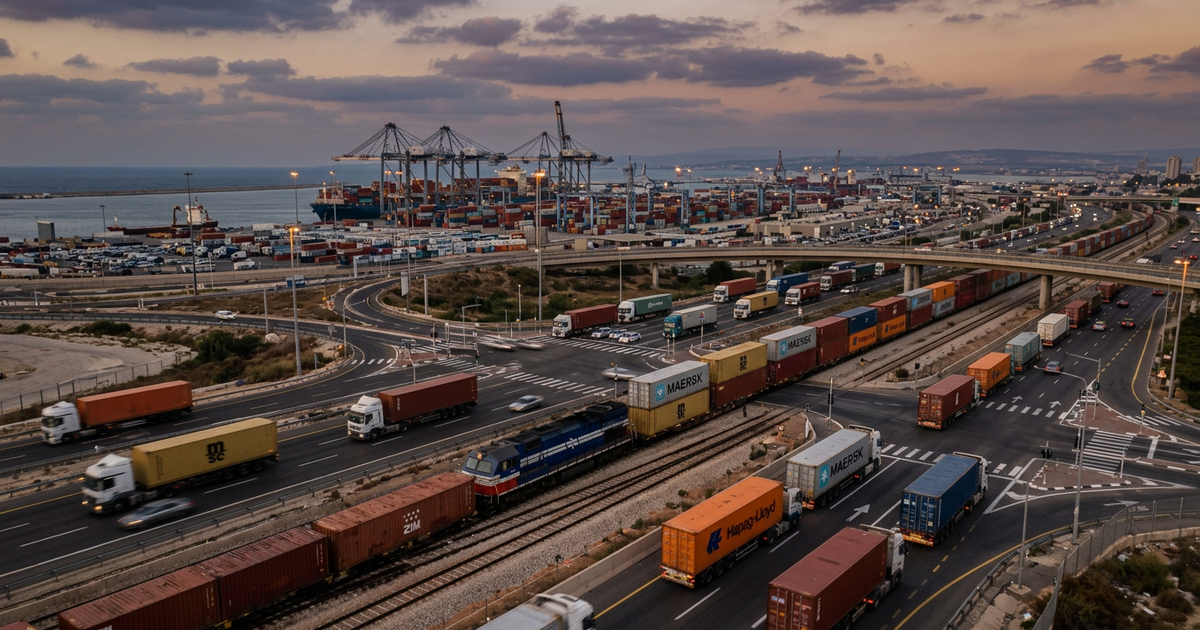
Three lanes carry Israeli trade: Mediterranean to Europe, Red Sea/Suez to Asia (disrupted since 2023), and air-sea-overland to the Gulf. The IMEC corridor would formalize a fourth — pending Saudi normalization.
By The Olam Editorial Team
Part of Israel's Ports and Logistics: The Complete Map, the cluster hub for Ports & Logistics.
TL;DR
Israeli trade moves on three primary lanes: maritime through the Mediterranean for Europe-bound cargo, maritime through the Red Sea and Suez (disrupted since late 2023) for Asia-bound cargo, and a combination of air, sea, and limited overland routes for trade with the Gulf states. Air cargo through Ben Gurion Airport carries a disproportionate share of high-value flows. The proposed IMEC corridor would formalize an overland link to the Gulf but remains contingent on Saudi normalization.
Key Facts
- Three primary lanes: Mediterranean (Europe), Red Sea/Suez (Asia), and air/sea/limited overland (Gulf).
- Europe is Israel's largest single trading partner bloc.
- Asia lane disrupted since late 2023; rerouted around Cape of Good Hope.
- Gulf lane runs primarily via direct sea services to Jebel Ali, air cargo to Dubai, and limited overland through Jordan.
- Air cargo through Ben Gurion Airport carries pharma, electronics, semiconductors, defense, diamonds.
- IMEC corridor proposes formalized overland Gulf-to-Mediterranean link; not operational as of 2026.
The European Lane
Israeli ports connect directly to the major European container hubs at Genoa, Marseille, Hamburg, and Antwerp via established carrier networks. Transit times are short, costs are predictable, and the supporting infrastructure on both ends has been built out over decades. This lane handles the bulk of Israel's two-way trade with the European Union, which remains the country's largest single trading-partner bloc.
The Asia Lane
The Asia lane has been the more disrupted of the two. In normal conditions, containers move between Israeli ports and Shanghai, Ningbo, Singapore, and other Asian hubs via the Suez Canal and the Red Sea. Normal transit is three to four weeks and depends on stable routing through Bab el-Mandeb and Suez.
Since late 2023, container lines have rerouted around the Cape of Good Hope, adding 10 to 14 days to transit times and significant cost. Air cargo capacity has absorbed a portion of high-value flows. The lane has not stopped — it has just become slower and more expensive.
The Gulf Connection
The Gulf lane is the newest and the most strategically interesting. Direct trade between Israel and the UAE — and to a smaller extent Bahrain and Morocco — runs on direct sea calls to Jebel Ali and other Gulf ports, dense air cargo capacity between Tel Aviv and Dubai, and limited overland movements through Jordan.
The proposed IMEC framework would formalize and expand this lane. If operationalized, it would create a multi-modal route from Mumbai through Gulf ports, across the Arabian peninsula, through Jordan into Israel, and onward to European destinations. The commercial promise is to bypass the Red Sea and the Suez Canal entirely. The political condition is Saudi normalization.
Air Cargo's Role
Air cargo is the high-value layer running across all three lanes. Israeli exports of pharmaceuticals, semiconductors, electronics, defense systems, and polished diamonds — together with imports of similar categories — depend heavily on dedicated freight capacity and on belly cargo in scheduled passenger flights through Ben Gurion Airport.
The air cargo network reaches Asia (Shanghai, Hong Kong, Singapore, Tokyo), Europe (Frankfurt, Paris, London, Amsterdam), the Gulf (Dubai, Abu Dhabi), and North America (New York, Los Angeles, Miami). It is a small share of total trade volume but a disproportionate share of trade value, particularly during periods of sea-lane disruption.
The Optionality Premise
The Israeli logistics economy depends not on any single lane but on optionality across all of them. The country's small geographic footprint, high import dependency, and position between three continents make redundancy structurally important. The events of 2023–2024 demonstrated that this redundancy is operationally critical, not theoretically valuable.
Bottom Line
The most significant development in this map is the maturation of the Gulf lane post-Accords. Whether the IMEC corridor moves from framework to operation — and whether Saudi participation eventually materializes — will determine whether Israel becomes a true three-continent corridor or remains a destination market with three working approaches.
Related on The Olam
- Israel's Ports and Logistics: The Complete Map
- How the Abraham Accords Reshaped Israel's Logistics Economy
- Why Israel's Ports Matter to Europe–Asia Trade
- Red Sea Shipping Disruption and the Impact on Israeli Supply Chains
- ZIM and Israel's Global Shipping Footprint
- The Infrastructure Behind Israeli Trade