
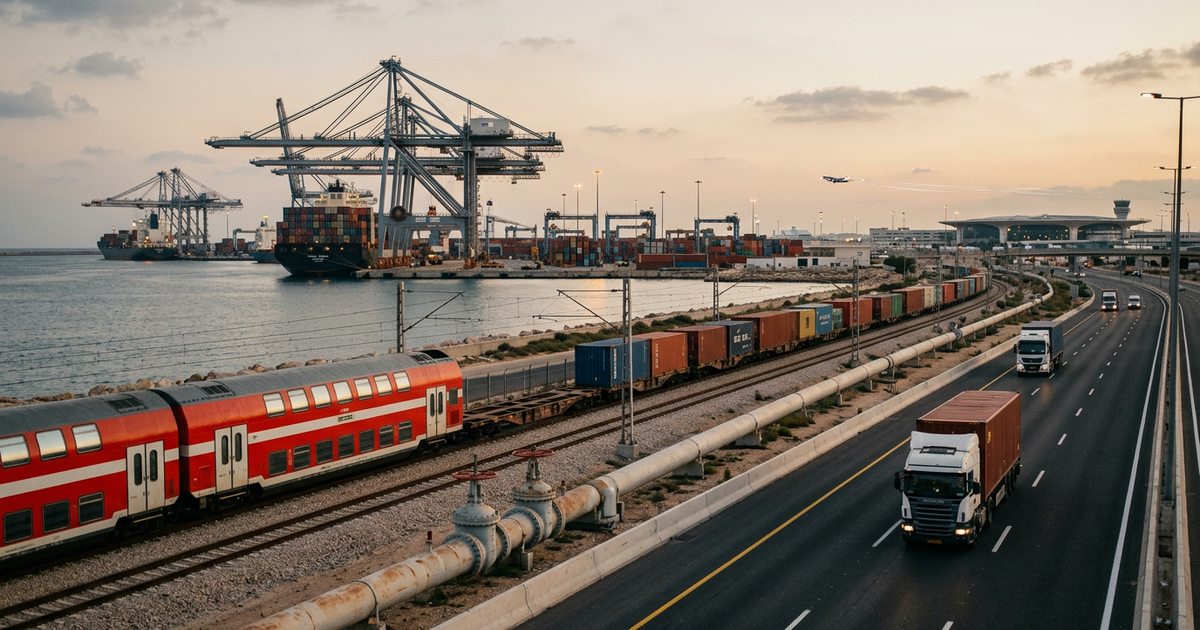

Five layers of Israeli trade infrastructure: maritime (Haifa/Ashdod), air (Ben Gurion), road, rail (Israel Railways), customs (SHAAM), and energy. Mature and overhauled — with rail share and inland capacity as the binding gaps.
By The Olam Editorial Team
Part of Israel's Ports and Logistics: The Complete Map, the cluster hub for Ports & Logistics.
TL;DR
Israeli trade infrastructure runs on five distinct layers: maritime ports, the air cargo network anchored by Ben Gurion Airport, the road network, the rail freight system operated by Israel Railways, the customs and digital regulatory layer led by the Israel Tax Authority, and the energy infrastructure that powers all of the above. Each layer has been progressively upgraded since 2020, but bottlenecks — particularly rail freight share and inland congestion — remain.
Key Facts
- Maritime: Haifa, Bayport, Ashdod, Hadarom, Eilat (suspended) ports.
- Air: Ben Gurion International Airport (primary), Ramon Airport (secondary).
- Road: Routes 1, 2, 4, and Highway 6 are the core trade-corridor highways.
- Rail freight: Israel Railways operates national network; freight share remains low by European standards.
- Customs: Israel Tax Authority operates the SHAAM customs declaration system.
- Energy: Israeli ports and inland logistics consume substantial diesel and electricity; decarbonization is at an early stage.
Why Layers Matter
Trade infrastructure is the unglamorous backbone of any open economy. Israel's trade-to-GDP ratio approaches 150 percent counting both directions, which means trade infrastructure carries strategic weight comparable to defense or energy. A degraded trade infrastructure produces a degraded economy more or less directly. Looking at it as five distinct layers — maritime, air, road, rail, customs, and energy — clarifies where the system is strong and where it is exposed.
Maritime
The maritime layer is the backbone. Haifa and Ashdod, each with both legacy and 2021-vintage terminals, handle approximately 3 million TEU of container traffic annually as of 2026. Eilat, the Red Sea port, is currently inactive in commercial terms. The Adani-Gadot acquisition of the Haifa Port Company (January 2023) completed the privatization arc on the legacy side. The layer is mature and substantially overhauled.
Air
Ben Gurion International Airport is the country's primary air cargo gateway, handling the high-value end of Israeli trade — pharmaceuticals, electronics, semiconductors, defense systems, diamonds, and high-margin agricultural exports. The airport's cargo facilities have been expanded progressively, and the air cargo network reaches all major commercial centers globally.
Secondary airports including Ramon (in the south) handle smaller volumes and specialized flows. Ramon has been used as an alternative for southern Israel during periods when Ben Gurion has been disrupted by regional security events.
Road
The Israeli highway network — Route 1 (Tel Aviv to Jerusalem), Route 2 (coastal), Route 4 (Ashdod to north), Highway 6 (the country's longitudinal toll road) — connects the ports to the population and industrial centers. Congestion on the trade corridors, particularly the Ashdod-to-central-corridor segment, remains a binding constraint.
Rail
Israel Railways operates the national rail network. Freight has expanded over the past decade but remains a smaller share of total cargo movement than in comparable European systems. Dedicated freight services connect Haifa and Ashdod to inland destinations including the Negev (for ICL operations), the central distribution corridor, and the northern industrial belt.
Closing the rail-freight share gap is widely understood as a structural priority. Progress has been incremental.
Customs
Customs digitization through the Israel Tax Authority has measurably reduced clearance times. The SHAAM declaration system integrates with port operations, and risk-targeting algorithms allow most cargo to clear without physical inspection. The customs layer is among the most digitally mature in the regional peer group.
Energy
All of the above run on energy — diesel for trucks and equipment, electricity for cranes and warehouses, jet fuel for the air cargo network. Decarbonization of port operations, electrification of cargo handling, and alternative fuels for maritime shipping are at an early stage in Israel relative to leading European systems. The pace will be set by a combination of European regulatory pressure on Israeli exporters, customer requirements, and the broader Israeli energy transition.
Resilience
The events of 2023–2024 made resilience an operational requirement. Red Sea disruption, regional conflict, and the broader fragmentation of global supply chains have underscored that single-route dependence is a strategic risk. The investments now being made in alternative routing, inventory buffers, redundant operator relationships, and multi-modal capabilities are the response to that lesson.
Bottom Line
Israeli trade infrastructure is mature, multi-layered, and substantially upgraded relative to ten years ago. The remaining gaps are concentrated in rail freight share, inland road capacity, and the early-stage decarbonization layer — and these are the layers most likely to define competitive position over the next decade.