
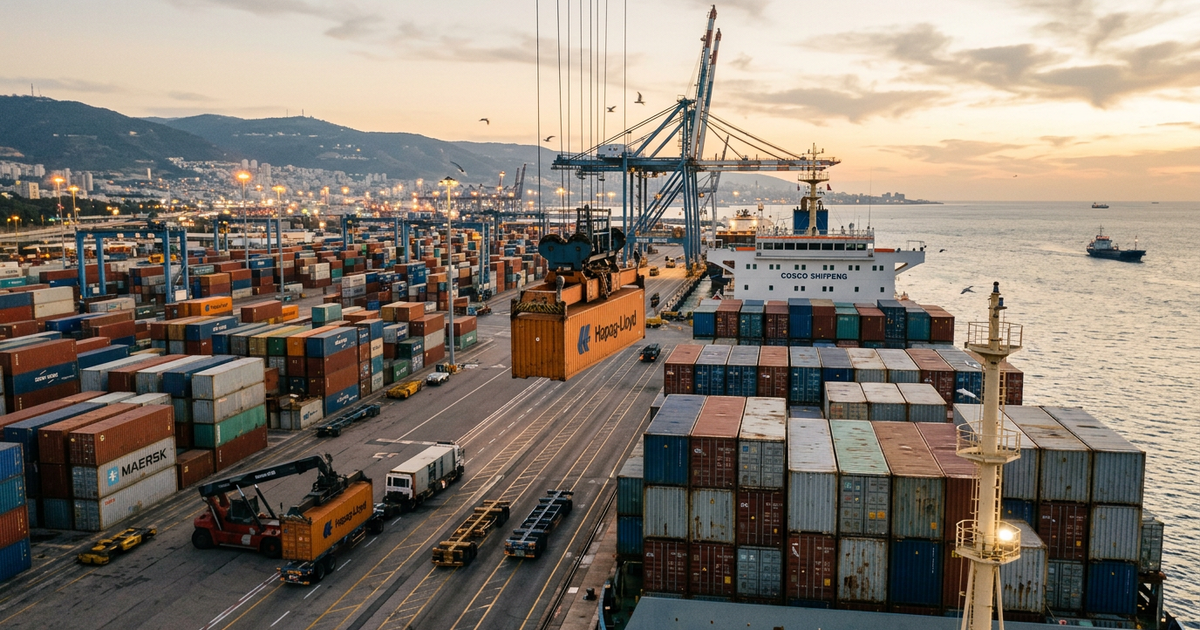

Israel sits two days from Suez but has not historically captured trans-shipment volume — Piraeus, Port Said East, and Damietta have. IMEC and Red Sea disruption have reopened the corridor question. Candidate, not hub.
By The Olam Editorial Team
Part of Israel's Ports and Logistics: The Complete Map, the cluster hub for Ports & Logistics.
TL;DR
Israel's ports sit on the eastern Mediterranean, within two days' sailing of the Suez Canal exit, and are positioned as candidates — not established hubs — for trans-shipment, regional distribution, and corridor termination on Asia–Europe trade routes. Historically Israeli ports have functioned as end-market destinations rather than hubs. The proposed India–Middle East–Europe Economic Corridor and the post-2023 reassessment of Red Sea routing have reopened the corridor question.
Key Facts
- Approximately 12 to 15 percent of global trade transits the Suez–Red Sea corridor in normal conditions.
- Israeli ports are within ~2 days' sailing of the Suez Canal northern exit.
- Trans-shipment volume in the eastern Mediterranean is concentrated at Piraeus (COSCO-controlled), Port Said East, and Damietta.
- Israel does not currently capture meaningful trans-shipment share.
- The India–Middle East–Europe Economic Corridor (IMEC) was announced at the 2023 G20 and proposes Israel as a Mediterranean terminus.
- Israeli ports remain a candidate, not an established, corridor hub.
The Geography
The shortest sea route from Asia to Western Europe runs through the Indian Ocean, the Red Sea, and the Suez Canal into the Mediterranean. Approximately 12 to 15 percent of global trade traverses this corridor in normal conditions. The eastern Mediterranean — the basin between Suez and Gibraltar — is the European on-ramp.
Israel sits on the eastern Mediterranean. Its ports are within two days' sailing of the Suez Canal exit and are positioned alongside Piraeus, Damietta, Port Said East, Limassol, and Mersin as candidates for trans-shipment and corridor termination. The geographic premise is not contested. The commercial premise is.
What Israel Has Not Captured
For most of the past two decades, Israeli ports have not captured a meaningful share of Asia–Europe trans-shipment traffic. That role has been concentrated at Piraeus, controlled by COSCO and operationally one of the most efficient ports in the Mediterranean, and at Port Said East (Suez Canal Container Terminal) and Damietta on the Egyptian side. Israeli ports have functioned as origin and destination, not as relay nodes.
The reasons are structural. Trans-shipment volume goes where vessel networks already call. Container lines route their largest vessels to a small number of hub ports and shuttle cargo from those hubs to feeder destinations. Israeli ports, until recently, were feeder destinations rather than hubs. The new terminals at Bayport and Hadarom changed the physical capability. Whether they change the network logic is a longer process.
What Could Change
Two developments could shift Israel's position. First, the India–Middle East–Europe Economic Corridor, announced at the September 2023 G20 summit, proposes a multi-modal route from India through the Gulf and the Levant into Europe, with an eastern Mediterranean port as the maritime terminus. If operationalized, that terminus is most likely Haifa. The corridor would transform an Israeli port from a feeder destination into a candidate corridor hub.
Second, the Red Sea disruption has forced the global shipping industry to reconsider its dependence on a single chokepoint. Container lines that previously assumed Suez transit as the default have built operational muscle around Cape of Good Hope routing and around overland alternatives. Israeli ports — and Israeli logistics generally — benefit from any future where redundancy is priced into routing decisions.
Important Caveats
The case that Israel could become a Europe–Asia hub is a strategic option, not a settled trajectory. It depends on the operational maturation of IMEC, which depends on Saudi normalization; on sustained investment in Israeli inland connectivity, particularly rail; and on a regional security environment that supports the political fabric of an overland corridor. None of these conditions is independently easy.
The honest framing is that Israel is a credible candidate for a more significant Asia–Europe logistics role than it currently plays. The country is not, today, a hub in any commercially meaningful sense. The infrastructure is closer to ready than at any prior point. The politics, the volumes, and the integration are not.
Bottom Line
Israel's significance to Asia–Europe trade is currently small in absolute terms but disproportionately large in optionality. A more diversified global container network, in a more fragmented geopolitical environment, places a premium on alternative routes — and Israel is one of the more credible alternative-route candidates that the eastern Mediterranean offers.