

The Olam
Sovereign & Strategic Capital

Red Sea Shipping Disruption and the Impact on Israeli Supply Chains

By The Olam Editorial Team · May 27, 2026

Red Sea Shipping Disruption and the Impact on Israeli Supply Chains

The Houthi attacks on commercial shipping in the southern Red Sea, beginning late 2023, collapsed Eilat Port and forced Haifa and Ashdod traffic around the Cape of Good Hope. How Israeli supply chains absorbed the shock.

By The Olam Editorial Team

TL;DR

The Houthi attack campaign against commercial shipping in Bab el-Mandeb and the southern Red Sea, beginning in late 2023, produced the largest disruption to global container logistics since 2021. For Israel, it was an extinction-level event for Eilat — the country's only Red Sea port, which collapsed commercially and sought state assistance in summer 2024 — and a costly rerouting exercise for Haifa and Ashdod. Suez Canal transits fell sharply, war-risk premiums spiked, and Israeli importers extended inventory positions in response.

Key Facts

  • Houthi attacks on commercial shipping in the southern Red Sea began in late 2023.
  • Eilat Port revenues collapsed; the operator sought emergency state assistance in summer 2024.
  • Container lines rerouted around the Cape of Good Hope, adding ~10–14 days transit time.
  • Per-voyage cost increase estimated at USD 1 million or more on the largest container vessels.
  • Suez Canal transits fell on the order of 50–60 percent at the worst of the disruption.
  • War-risk insurance premiums on Israel-bound cargo spiked by orders of magnitude.
  • ZIM repositioned its network early; Maersk, MSC, CMA CGM, and Hapag-Lloyd followed at different paces.

What Happened

Beginning in late 2023, Houthi forces in Yemen launched a sustained campaign of attacks on commercial shipping transiting Bab el-Mandeb and the southern Red Sea. Vessels were struck by missiles and drones. Crew members were killed and injured. Several ships were captured. Container lines, tanker operators, and bulk carriers responded by suspending Red Sea transits and rerouting around the Cape of Good Hope.

The campaign initially targeted Israeli-flagged, Israeli-owned, and Israeli-bound shipping but expanded quickly to include vessels with broader Western and allied profiles. By early 2024, Suez Canal traffic had fallen sharply — by industry estimates, on the order of 50 to 60 percent at the worst of the disruption — with corresponding pressure on Egyptian state revenues from canal tolls.

Eilat: The Local Casualty

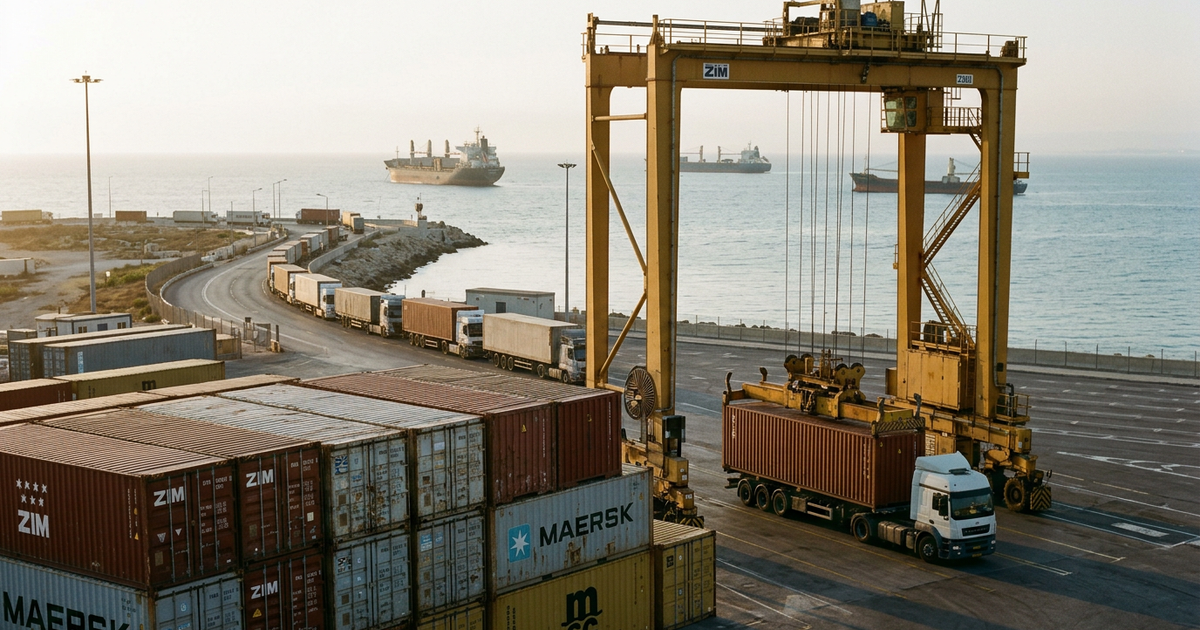
Eilat is Israel's only Red Sea port. Its commercial function has been to receive cargo — primarily vehicles imported from Asia and certain bulk commodities — that arrives via the southern Red Sea and the Gulf of Aqaba. When the southern Red Sea became unsafe for commercial transit, Eilat's lane disappeared.

By summer 2024, the port operator reported that revenues had collapsed, container and vehicle handling had stopped almost entirely, and the company had sought emergency state assistance. Eilat became the most visible domestic casualty of the disruption — a port functionally suspended not by its own operational failure but by the collapse of the lane that fed it. Its strategic value, always tied to its non-Suez gateway role, has been suspended for the duration of the disruption.

Haifa and Ashdod: Rerouting Costs

The Mediterranean ports absorbed the secondary effects. Container lines serving Israel rerouted around the Cape of Good Hope, adding roughly 10 to 14 days of transit time on the Asia–Israel lane. The per-voyage cost increase has been estimated at USD 1 million or more on the largest container vessels. War-risk insurance premiums on Israel-bound cargo spiked by orders of magnitude.

Volume continued to flow, but at higher cost, longer cycle times, and with greater inventory strain on Israeli importers. Some container lines paused service to Israel entirely; others imposed war-risk surcharges. Mediterranean port congestion at Haifa and Ashdod was lower than feared, partly because Bayport and Hadarom had absorbed earlier capacity expansion.

Carrier Response

ZIM, the Israeli-headquartered global container line listed on the NYSE, repositioned its network early — pulling vessels off the Red Sea route and accepting the cost of the Cape of Good Hope detour. Maersk, MSC, CMA CGM, and Hapag-Lloyd made similar moves at different paces. The Suez Canal lost a meaningful share of its traffic. The Egyptian government lost a meaningful share of its revenue. The Cape route returned to relevance for the first time in five decades.

Inventory and Procurement Response

Israeli importers — particularly in retail, automotive, electronics, and pharmaceuticals — responded by extending inventory buffers, diversifying supplier networks, and pre-positioning critical stock. Companies that had operated on just-in-time inventory norms moved to just-in-case stocking. The working-capital cost of that shift has been significant.

Air cargo capacity absorbed a portion of the disrupted sea cargo, particularly for high-value and time-sensitive goods. Air freight rates on the Asia–Israel lane rose accordingly. The Tel Aviv–Dubai and Tel Aviv–Hong Kong air corridors carried disproportionate volume.

Bottom Line

The Red Sea disruption reset Israeli supply chain planning permanently. The just-in-time assumptions of the 2010s have been replaced by inventory buffers, multi-lane redundancy, and explicit pricing of geopolitical risk into routing decisions — changes that are unlikely to fully reverse even when the lane normalizes.

Related on The Olam

Crypto & Digital Assets

View all →
The Digital Shekel Programme
Crypto & Digital Assets · May 26, 2026
The Digital Shekel Programme

The Bank of Israel's digital-shekel project is one of the more advanced central-bank digital currency (CBDC) programmes globally. The 2026 s…

StarkNet and the L2 Race
Crypto & Digital Assets · May 26, 2026
StarkNet and the L2 Race

StarkNet is the only Israeli-originated Ethereum Layer 2 with meaningful adoption. Its position in the broader L2 competitive landscape is t…

Fireblocks and the Institutional Custody Moat
Crypto & Digital Assets · May 26, 2026
Fireblocks and the Institutional Custody Moat

Fireblocks is the Israeli company most embedded in traditional financial institutions adopting digital assets. The MPC custody franchise is…

The Olam Newsletter

Intelligence on the global Jewish economy — in your inbox.

Defense, capital, AI, cyber, venture, aliyah, real estate, and the cross-border architecture connecting them.

Free. No spam. Unsubscribe anytime.