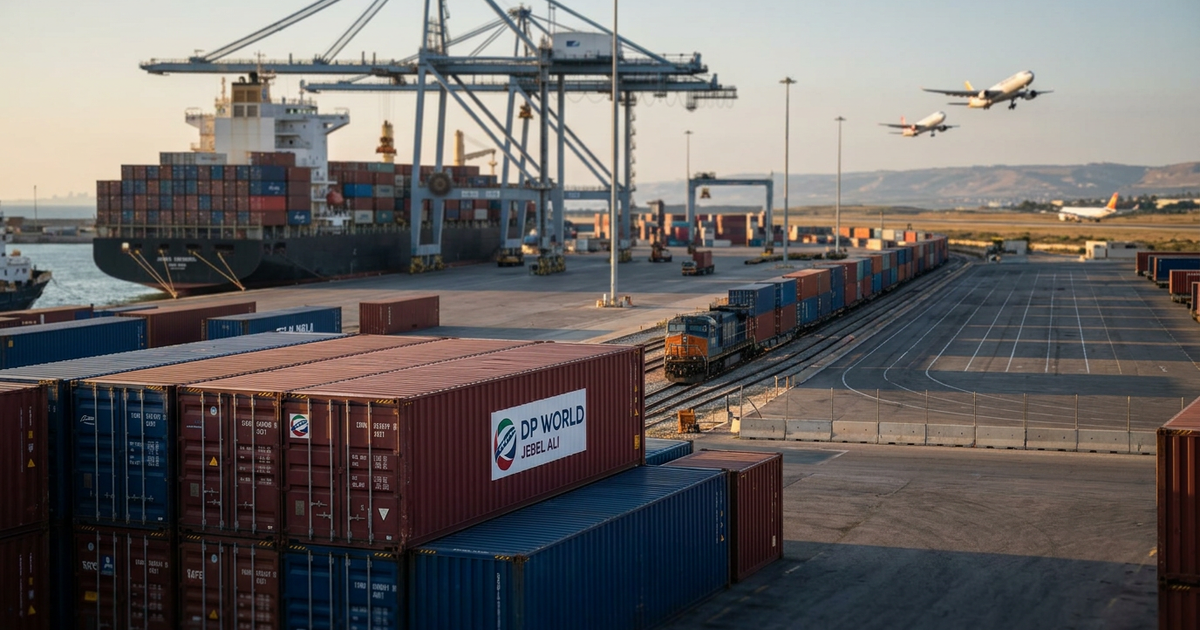

Multi-billion-dollar Israel–UAE trade now moves on three operational lanes: direct sea services to Jebel Ali, dense air cargo through Ben Gurion, and limited overland flow via Jordan. The Saudi corridor remains aspirational.
Part of: Israel's Ports and Logistics — the complete map
Updated June 7, 2026 — see Olam's flagship strategic report: The $1 Trillion Deal: AI Models the Economic Future of Saudi-Israeli Normalization. AI scenario modeling projects $650 billion to $1.3 trillion in cumulative new Middle East economic activity by 2046 when Saudi-Israeli normalization closes the corridor this piece describes as aspirational.
By The Olam Editorial Team
TL;DR
The Abraham Accords of September 2020 produced multi-billion-dollar bilateral trade between Israel and the United Arab Emirates from a baseline of effectively zero. The operational logistics of that trade now run on three lanes: direct container services between Israeli ports and Jebel Ali, dense air cargo capacity between Tel Aviv and Dubai, and limited overland movements through Jordan. The proposed overland corridor through Saudi Arabia remains constrained by the absence of Saudi normalization.
Key Facts
- Pre-Accords bilateral Israel–UAE trade was effectively zero; post-Accords trade has grown into the multi-billion-dollar range.
- Direct container services connect Israeli Mediterranean ports to Jebel Ali, Khalifa Port, and Hamad Port.
- Dense air cargo capacity links Tel Aviv to Dubai for high-value goods including diamonds, electronics, pharmaceuticals.
- Overland routes through Saudi Arabia remain constrained pending Saudi normalization.
- Functioning overland flow exists today only through Jordan via Sheikh Hussein and Allenby crossings.
- DP World (Dubai) has signed cooperation agreements with Israeli partners.
The Sea Lane: Jebel Ali to the Mediterranean
Maritime trade between Israel and the UAE moves primarily on container services that link Jebel Ali — the largest port in the Middle East — to Haifa and Ashdod via the Red Sea and the Suez Canal. ZIM and MSC are the principal operators on the lane; CMA CGM and other lines also call. Normal direct sea transit runs in the range of 7 to 10 days.
That lane was disrupted from late 2023 by the Houthi attacks, which forced rerouting around the Cape of Good Hope and extended transit times to four weeks or more. The disruption underscored the strategic appeal of the overland alternative and shifted a portion of high-value cargo from sea to air. The lane has not fully normalized as of 2026.
Air Cargo: The High-Value Backbone
Air cargo has carried a disproportionate share of high-value Israel–UAE trade. Diamonds, electronics, semiconductors, pharmaceuticals, and medical devices move between Tel Aviv (via Ben Gurion Airport) and Dubai on dedicated freight capacity and in the bellies of expanded passenger schedules. Cargo carriers including the Israeli national carrier El Al, Emirates SkyCargo, Etihad Cargo, and dedicated freight operators serve the lane.
The diamond trade in particular has produced steady, high-density freight flows. Israel is one of the world's largest diamond cutting and trading centers; the UAE has positioned Dubai as a competing regional hub. Air cargo costs are higher per unit than sea, but for goods where time and security are the binding constraints, the differential is irrelevant.
Customs and Cold Chain
Customs alignment has been the unglamorous backbone of the post-Accords trade. The Israel Tax Authority and Emirati customs authorities have worked on procedural alignment, mutual recognition of certain documentation, and digital integration that reduces dwell time. Cold-chain protocols for moving pharmaceuticals, fresh produce, and chemicals have been standardized and validated.
These operational layers do not generate headlines but they determine whether a trade lane is functional or aspirational. The Israel–UAE lane is functional. Cargo moves; documentation clears; cold chain holds. That is the prerequisite for everything else.
The Overland Limit
The overland corridor from the Gulf to the Mediterranean — through Saudi Arabia, Jordan, and Israel — is the most discussed and least operational element of the post-Accords logistics architecture. Pilot truck movements have run. Companies including Trucknet and Puretrans have developed the operational template. The political condition is Saudi normalization, which has not occurred. Olam's $1 Trillion Deal report models the economic activity that closure would unlock.
What does function today is the Israel–Jordan crossing at Sheikh Hussein and the Allenby Bridge, which handle a limited volume of overland freight. Cargo moving from Jordan into Israel can connect to the Israeli port and distribution system. That existing flow has been the proof-of-concept for the larger corridor proposition.
Capital Flows
The Accords reshaped not only freight lanes but the investment map. Emirati capital has flowed into Israeli technology, real estate, energy, and infrastructure. DP World has signed cooperation agreements with Israeli partners and explored direct involvement in port operations. The Mubadala investment in Israeli energy assets and bilateral fund flows in venture capital have produced a denser commercial relationship than freight figures alone capture.
Bottom Line
The Abraham Accords did not just open a market — they built a functioning, mechanically operational trade lane with sea, air, and customs infrastructure that survived the post-2023 disruption. The unfinished business is the overland corridor, which depends on a political development outside the logistics sector's control.
Related on The Olam
- The $1 Trillion Deal: AI Models the Economic Future of Saudi-Israeli Normalization — Olam's flagship strategic report
- Israel's Ports and Logistics: The Complete Map
- Haifa Bay Names Frank Melloul as IMEC Ambassador
- Haifa as a Strategic Maritime Gateway
- Israel's Global Trade Corridors: The Complete Map
- Israel–India: The Corridor Built on Technology
How we report: Olam stories draw on public filings, company disclosures and named sources, checked by our editors. Read our methodology · Corrections