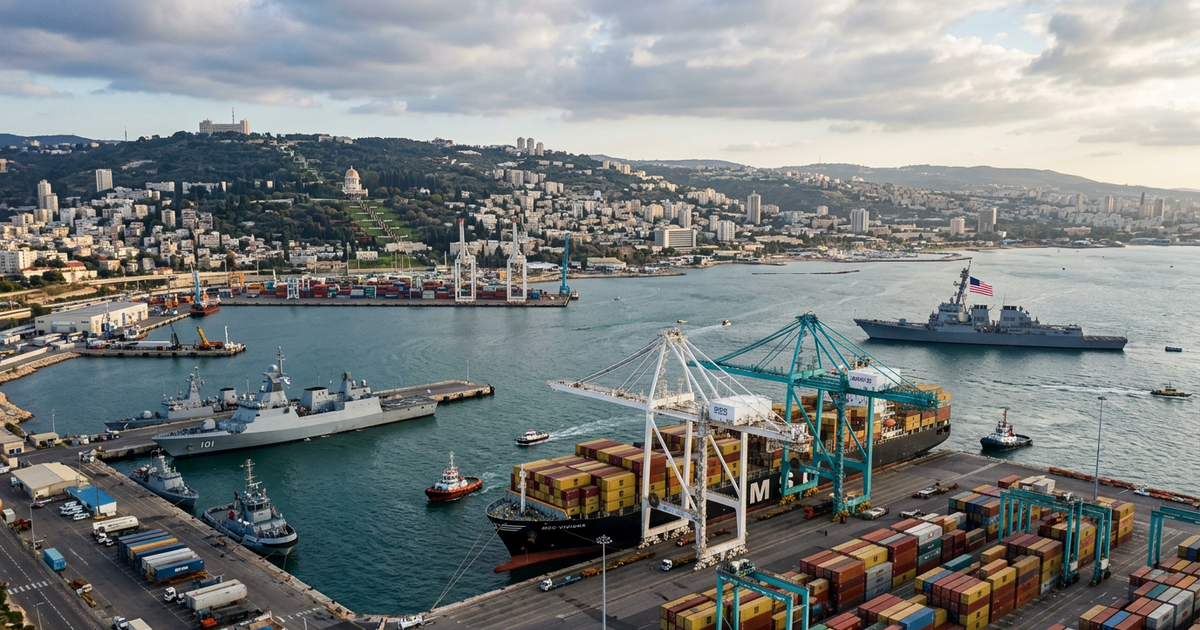

Haifa Bay combines a commercial port complex (Adani-Gadot + SIPG) and the home base of the Israeli Navy with regular U.S. Sixth Fleet calls. Three strategic functions in one bay, and the geopolitics that produces.
Part of: Israel's Ports and Logistics — the complete map
By The Olam Editorial Team
What Makes Haifa Bay a Strategic Maritime Gateway?
Haifa Bay combines two distinct strategic functions: a commercial port complex (the Adani-Gadot-controlled Haifa Port Company and the SIPG-operated Bayport terminal) and the home base of the Israeli Navy, with regular U.S. Sixth Fleet and allied port calls. The commercial and naval dimensions overlap geographically but operate as separate systems with distinct command structures, infrastructure, and political stakes.
Key Facts
- Haifa Bay is the deepest natural anchorage on the Israeli coast.
- Commercial port: Haifa Port Company (Adani-Gadot, January 2023 close) plus Bayport (SIPG, 2021 concession).
- Naval base: home port of the Israeli Navy; regular U.S. Sixth Fleet and allied port calls.
- Commercial and naval operations are geographically adjacent but operationally distinct.
- SIPG concession at Bayport remains a U.S. policy concern given proximity to Sixth Fleet operations.
- Adani-led ownership of Haifa Port Company has been welcomed in Washington.
- Cruise calls disrupted since late 2023; expected to resume as regional security stabilizes.
What Naval Role Does Haifa Play for Israel and the US Sixth Fleet?
Haifa hosts the Israeli Navy and is a regular port of call for the United States Sixth Fleet and for allied naval forces operating in the eastern Mediterranean. The naval base occupies dedicated facilities within the Haifa Bay complex and operates separately from the commercial terminals. The naval and commercial functions share the bay but not the command structure, the workforce, or the infrastructure budget.
Under the British Mandate Haifa was the Royal Navy's principal eastern Mediterranean base. Under Israel it became home to the Israeli Navy and the country's primary northern commercial gateway. The dual function has been continuous through every political change.
Who Operates Haifa's Commercial Port Complex?
Haifa's commercial port complex is the most plurally operated in the Israeli system. The Haifa Port Company runs the Kishon-side facilities — general cargo, vehicles, cruise, containers — under Adani-Gadot ownership since January 2023. The Bayport (Hamifratz) terminal runs as a dedicated automated container facility under SIPG concession since 2021. These are competing commercial operations that share a bay with a major naval installation.
Container volumes, vehicle imports, cruise calls (when active), and project cargo all flow through the commercial complex. The two operators handle different segments and different vessel profiles; the competition has produced measurable productivity gains since 2021.
Where Do Haifa's Naval and Commercial Operations Overlap?
The commercial and naval functions interact at the level of port security, infrastructure access, and political sensitivity. The SIPG concession at Bayport has been a point of friction in Washington precisely because Chinese state-owned commercial operations sit adjacent to U.S. naval movements. American officials have repeatedly raised the issue; the concession has nonetheless remained operational.
The Adani-led ownership of the Haifa Port Company has been welcomed in Washington and is part of why the broader port-system composition now reads as deliberate diversification rather than a single-power concentration.
What Cruise and Specialty Cargo Moves Through Haifa?
Cruise calls have been a smaller but historically growing segment of Haifa's commercial mix, with the port positioned as a destination for Mediterranean cruise itineraries that include Israel as a port stop. Cruise activity has been disrupted since late 2023 by the regional security environment but is expected to recover as conditions stabilize.
Energy and specialty cargo also move through Haifa Bay. The Haifa refinery, the chemical industries clustered around the bay, and the energy import infrastructure produce a flow of tanker calls and project cargo that complements the container business.
Could Haifa Become the Mediterranean Terminus for IMEC?
If IMEC operationalizes, Haifa is the most likely Mediterranean terminus. The port's depth, its connectivity to the road and rail network, its proximity to the Jordanian border, and the presence of an Indian operator at the Haifa Port Company all support that role. Adani's positioning is explicit: the company has framed Haifa as a strategic node in its global network. Whether IMEC operationalizes is a separate question, covered in IMEC: The $600 Billion Corridor One Signing Away.
Bottom Line
Haifa's strategic significance is the unusual combination of three functions in one bay — commercial container port, naval base for both Israeli and allied operations, and candidate corridor terminus. That combination is the source of both its long-term durability and its periodic political sensitivity.
FAQ
Who owns the Port of Haifa?
The Haifa Port Company has been owned by an Adani-Gadot consortium since the acquisition closed in January 2023 for approximately $1.18 billion. The adjacent Bayport terminal, in the same bay, is operated separately by China's SIPG under a 2021 concession.
Why is a Chinese-run terminal next to a US Navy port a concern?
Bayport, operated by China's SIPG since 2021, sits in the same bay Haifa uses as home port for the Israeli Navy and a regular port of call for the US Sixth Fleet. American officials have repeatedly raised the proximity of a Chinese state-owned operator to US naval movements as a policy concern, though the concession has remained operational.
Is Haifa a candidate terminus for IMEC?
Yes. If the India-Middle East-Europe Economic Corridor operationalizes, Haifa is considered the most likely Mediterranean terminus, given its depth, road and rail connectivity, proximity to Jordan, and Adani's existing operational presence there.
Are cruise ships still calling at Haifa?
Cruise activity at Haifa has been disrupted since late 2023 due to the regional security environment and is expected to resume as conditions stabilize.
Related on The Olam
- Adani at Haifa: The Three-Year View
- Why Israel's Ports Matter to Europe–Asia Trade
- Israel Port System: Who Operates What?
- The Infrastructure Behind Israeli Trade
- Israel–UAE: $3.2 Billion and Climbing
How we report: Olam stories draw on public filings, company disclosures and named sources, checked by our editors. Read our methodology · Corrections