
The 2023 Adani-Gadot acquisition of Haifa Port operating rights made Israeli ports a corridor asset. Three years later, throughput is flat to down, but the position has survived two crises.
The Adani Group acquired 70% of the Haifa port concession in January 2023 for approximately $1.18 billion, partnered with Israeli logistics operator Gadot Group on the remaining 30%. Three years in, the Adani-Haifa position has become one of the most strategically loaded port investments in the Eastern Mediterranean, anchoring the Indian end of the IMEC corridor, surviving the October 7 war and the Adani Group's 2023 short-seller crisis, and reshaping the commercial architecture of Israeli container logistics.
Ports & Infrastructure, Haifa, Updated October 2026
The Acquisition Structure
The Haifa port concession was put out to privatization by the Israeli government in 2022 as part of the broader reform of the Israeli ports sector that broke the legacy monopoly position of the Israel Ports Company. The Adani-Gadot consortium won the tender at $1.18 billion against competing bids from international port operators and Israeli conglomerates.
The concession runs for 31 years from the closing date, with the Israeli sovereign retaining freehold and the operating concession transferring on the completed tender. The structure parallels the standard Israeli infrastructure-concession architecture: long-cycle operating rights, defined service obligations, regulated tariff frameworks, and reversion to the sovereign at concession end.
Haifa is one of Israel's two principal commercial container ports, alongside Ashdod on the southern coast. Ashdod is the larger of the two by container volume, with a stated annual capacity above 3.2 million TEU on its own; Haifa Bay accounts for a substantial but minority share of total Israeli container throughput.
The Strategic Logic for Adani
Adani Ports and Special Economic Zone is the largest commercial port operator in India by throughput. The company operates 13 Indian ports including the flagship Mundra terminal, and has expanded internationally into Israel, Sri Lanka, Tanzania, and Vietnam. The Haifa acquisition was the largest international acquisition in the company's history at the time.
The strategic rationale was four-fold. First, the IMEC corridor positioning: Haifa as the Mediterranean terminus of the India-Middle East-Europe trade route, with Adani controlling both the Indian origin (Mundra) and the European-facing destination. Second, the diversification away from Indian regulatory and political concentration. Third, the relationship with the Indian government, for whom the Haifa acquisition was a strategic-diplomatic asset in the bilateral relationship. Fourth, the commercial economics: Haifa is a structurally profitable port operating under a long concession.
The Hindenburg Episode
The Hindenburg Research short report against Adani Group, published in January 2023 days before the Haifa transaction closed, created an immediate cloud over the acquisition. The report alleged accounting irregularities, related-party transactions, and stock-price manipulation across the Adani listed entities. The Adani Group market capitalization declined sharply over the following months.
The Haifa transaction closed despite the controversy. The Israeli government, having reviewed the bid before the Hindenburg report, did not unwind the tender result. The Adani Group provided the contracted equity through internal funding and maintained the operational commitments. The Israeli political reaction was muted: the strategic logic of the Adani-Haifa relationship was considered to outweigh the corporate-governance questions that the Hindenburg report had raised.
The subsequent two years saw the Adani Group manage the crisis through partial debt deleveraging, regulatory engagement with Indian authorities, and operational performance that demonstrated the Hindenburg allegations had not translated into actual cash-flow disruption. By 2025, the immediate crisis had passed and the broader Adani Group market capitalization had partially recovered.
The October 7 Test
The Hamas attack of October 7, 2023 and the subsequent war created the second crisis of the early Adani-Haifa period. The Israeli Mediterranean coast was within Hezbollah missile range. Haifa port itself was a target priority for any Hezbollah escalation. The commercial shipping environment in the Eastern Mediterranean became more expensive due to insurance war-risk premiums and longer routing.
The port continued to operate through the entire war period. Adani management committed publicly to maintaining operations and did so. Throughput volumes were affected by broader trade disruption but the facility itself remained functional and the concession terms were not disrupted.
The Adani performance during the war became, in Indian and Israeli reporting, one of the demonstration cases for the resilience of the bilateral commercial relationship. The decision not to evacuate or pause operations was politically significant on both sides.
What Do the Operating Numbers Actually Show?
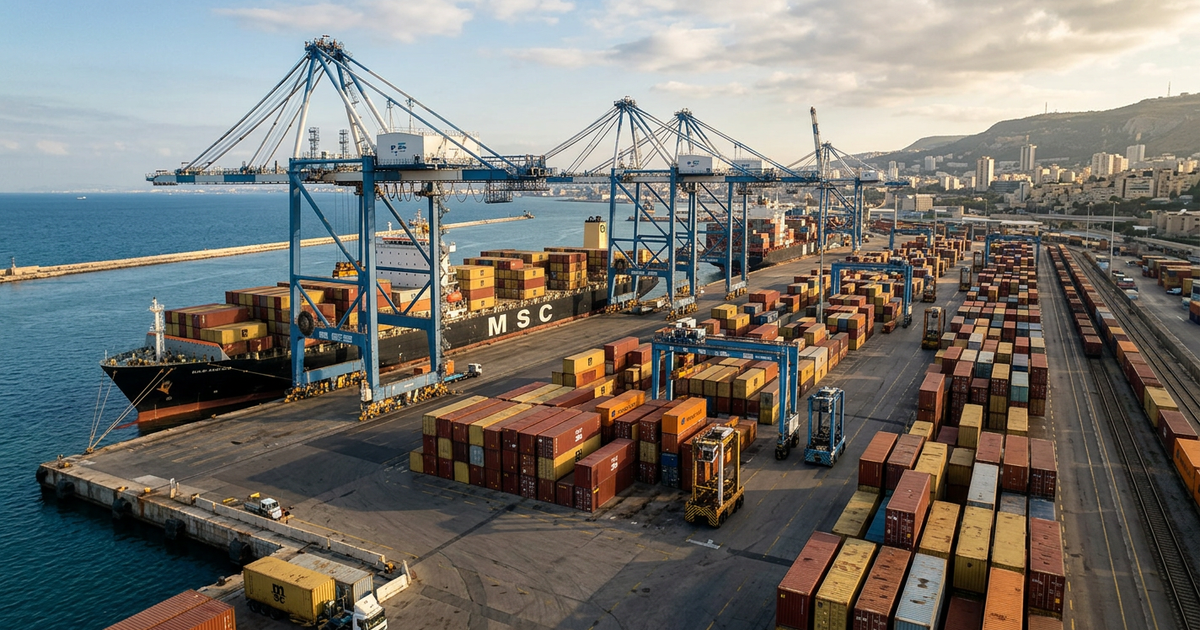
Container throughput at Haifa has run flat to down since the acquisition closed: roughly 1.45 million TEU in 2021 and 1.41 million in 2022 under the prior state operator, against 1.38 million in 2023 and 1.22 million in 2024 under Adani, with the 2024 figure reflecting Red Sea disruption to regional shipping. The comparison against the wider Israeli port sector is more flattering than the raw numbers suggest: Ashdod has lost more relative share to the private Haifa Bayport and Ashdod South terminals than Adani-Haifa has, partly because Adani inherited the unionized public workforce and the slower modernization curve that comes with it.
Adani disclosed a multi-year modernization program covering gantry crane replacement, yard digitization, and IT integration with Adani's Mundra-led port operating system. Execution has been mixed: the core IT integration with Mundra is reportedly live, but the crane and yard upgrades have moved more slowly than Adani's original communication suggested. Labor has been the binding constraint on modernization, not capital.
Direct Mundra-Haifa container calls, the clearest test of whether IMEC is generating real trade flow rather than just infrastructure, remain a small share of either port's volume through 2024. The bottleneck is not infrastructure but the absence of a trade flow large enough to justify bypassing Suez at a price both sides can absorb.
The Operational Performance
Container throughput at Haifa under the Adani-Gadot operational period has held within the expected range for the concession. The port has not lost share to Ashdod or to alternative regional ports (Piraeus, Mersin, Alexandria) at the rate that some industry observers had projected. The customer base, global shipping lines using Israel as a Mediterranean destination, has been retained.
The investment commitments under the concession include progressive automation, capacity expansion of the container berths, and integration of the port logistics with the broader Israeli rail and trucking architecture. The capital deployment has proceeded according to the concession timetable, even as the crane and yard components of that deployment lag the original schedule.
The financial performance of the Haifa concession within Adani Ports has not been disclosed at granular detail in public filings, but the broader Adani Ports international segment has reported revenue growth that suggests Haifa is performing within projections.
The IMEC Position
The Adani-Haifa position is the structural Indian commercial anchor at the European end of IMEC. The integration is not yet operationally complete, the Saudi rail segment and the harmonization work across the participating states remain in build phase, but the Haifa terminus is operationally ready when the corridor activates.
The political signal is also significant. Indian sovereign-adjacent capital controls a major Israeli port infrastructure asset. The investment cannot be unwound easily by either side. The structural commitment is real, regardless of the political environment of any given week. The next two years, particularly Red Sea normalization, IMEC physical-rail progress in the Gulf, and whether Adani's crane and yard capex finally lands, will determine whether Haifa becomes the anchor IMEC node or remains a strategic asset with mid-sized commercial throughput.
What 2026 Tracks
Three threads matter through the rest of the concession's early phase. First, the Israeli ports reform process and whether the Adani-Haifa concession framework holds against any policy adjustments. Second, the broader Adani Group corporate trajectory: capital structure, governance, and the trajectory of the listed entities. Third, the IMEC corridor activation timetable and whether the Haifa terminus enters operational service as a corridor terminal rather than a stand-alone Israeli port.
The Adani-Haifa transaction is now embedded in the Israeli infrastructure landscape. Three years in, the position has survived two structural crises and entered the steady-state operating phase. The strategic question shifts from acquisition risk to corridor activation timing.
Olam coverage
- IMEC Status: 2026
- Inside the Israel-India Defense Corridor
- Why Tata, Mahindra and Reliance Keep Buying Israeli Technology
- Who Owns Israel's Ports? Haifa, Ashdod, and Eilat Mapped
- Israel's Ports and Logistics, the complete map
- SIPG Ashdod, the Chinese Port Presence No One Talks About
The Olam Editorial Team
The Olam is the institutional record of the global Jewish business economy. Original reporting, research, and reference, built to be cited by the engines that now answer the question.
How we report: Olam stories draw on public filings, company disclosures and named sources, checked by our editors. Read our methodology · Corrections