REIT 1 (TASE: RIT1): Israel's First Publicly-Traded REIT — 750,000 SqM of Central-Israel Commercial Property, Rated ilAA/Stable
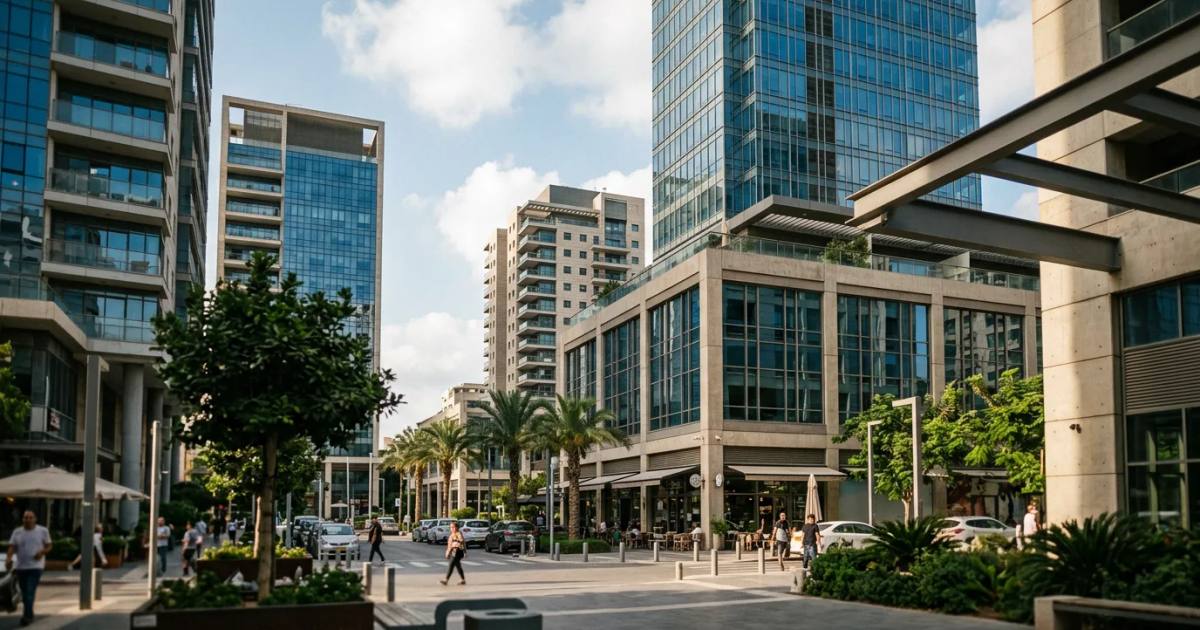
Israel's first REIT, 2006. ~750,000 sqm of central-Israel commercial, office, industrial. Market cap ~NIS 4.3B. 2025 revenue NIS 522M (+6.6%). ilAA/Stable from S&P Ma'alot. TA-125 and Tel-Div. The yield-driven access point to TASE-listed real estate.
Established 2006 as the first company to list under Israel's REIT tax regime. Roughly 750,000 sqm of yielding real estate concentrated in central Israel — offices, industrial, commercial. Market cap ~NIS 4.3 billion (~$1.73B). 2025 revenue NIS 522M (+6.6%). S&P Ma'alot ilAA/Stable. TA-125 and Tel-Div index member. The yield-driven access point to TASE-listed real estate.
REIT 1 Ltd. (TASE: RIT1) is Israel's first Real Estate Investment Trust, launched in 2006 immediately after the Israeli Tax Authority approved the REIT structure as a listed vehicle. The company owns and operates a portfolio of roughly 750,000 sqm of income-producing real estate concentrated in central Israel — offices, industrial buildings, commercial centers, and a parking asset base. Market capitalization approximately NIS 4.3 billion. 2025 revenue NIS 522 million, up 6.6% year-on-year. TA-125 index member and Tel-Div index member. Rated ilAA/Stable by S&P Global's Israeli affiliate Ma'alot — the second-highest available rating on the Israeli national scale, and the highest carried by any listed Israeli REIT.
The 2006 REIT regime and REIT 1's first-mover position
Israel's REIT structure was legislated in the mid-2000s to allow broad public participation in institutional-scale commercial property investment — the same policy logic behind the US 1960 REIT Act and comparable European regimes. REIT 1 was structured specifically to list under that regime, and it did so in 2006 — beating Sella Capital and every subsequent Israeli REIT to market. The trade-off any REIT accepts is disciplined: minimum annual distribution of the vast majority of taxable income to unitholders in exchange for corporate-level tax exemption. That structure is what makes REIT 1 attractive as a dividend-yielding real-estate exposure — the 2026 dividend yield sits around 3.84%, positioning the security as a bond-like alternative inside the Tel-Div income basket.
The portfolio: from 12 properties in 2008 to 750,000 sqm in 2026
At the company's public origin in 2008, its holdings comprised 9 office properties, 2 industrial properties, one commercial property, and a commercial parking lot with 376 spaces — a modest ~50,000-70,000 sqm starting position. Nearly two decades later the portfolio is approximately fifteen times that size, at roughly 750,000 sqm. The concentration remains central Israel — the Tel Aviv metropolitan area (Gush Dan) and the immediately adjacent commercial corridors, alongside secondary positions in Israel's Sharon Region and the Jerusalem periphery. That geographic concentration produces the yield stability the REIT distribution structure requires. It is also what caps the growth trajectory: REIT 1 does not chase peripheral markets, does not operate abroad, and does not take material development risk. The portfolio grows through disciplined acquisition of stabilized assets in known submarkets.
The Israeli REIT competitive set
The Israeli REIT market remains small by international standards but has matured into a coherent asset class. REIT 1 is the original and largest listed vehicle. Sella Capital Real Estate (founded 2007) follows as the second-largest, with a similar office and logistics tilt, primarily concentrated across the Sharon and Gush Dan corridors. Menivim — The New REIT (launched 2015) is the growth-oriented smaller peer, focusing on value-add acquisitions in office, industrial, and retail with a Jerusalem tilt not present in REIT 1's book. Keystone Infra sits adjacent as an infrastructure REIT — energy, transportation, environmental — rather than commercial real estate, and is included here for completeness of the regulated-yield vehicle landscape. Together these four vehicles anchor a market that continues to attract retail investor flows against a backdrop of resilient Israeli commercial demand through the war years.
REIT 1 versus the operator-model peers
The clearest way to read REIT 1 is against the operator-model peers who chose not to list as REITs. Amot Investments (TASE: AMOT), inside the Alony Hetz group, runs a similar central-Israel office and commercial book at roughly 1.8 million sqm and ILS 18 billion in assets — more than twice REIT 1's footprint — but as an operating company, not a distribution-mandated vehicle. Melisron (TASE: MLSR) is the mall-and-office operator with the same design decision. The REIT versus operator choice is what defines the underlying investment thesis: REIT 1 sells distribution yield; Amot and Melisron sell reinvestment optionality. Both models scale.
At a glance
Ticker: TASE: RIT1 · TA-125 · Tel-Div
Established: 2006 (first Israeli REIT)
Rating: ilAA/Stable (S&P Ma'alot)
Portfolio: ~750,000 sqm across offices, industrial, commercial, parking
Geography: Central Israel / Gush Dan concentration
Market cap: ~NIS 4.3 billion (~$1.73 billion)
2025 revenue: NIS 522 million (+6.6% YoY)
Dividend yield: ~3.84% (2026)
HQ: Tel Aviv
The structural role: yield-driven access to Israeli commercial property
REIT 1's function inside the Israeli capital market is to give retail investors and institutional funds a disciplined, yield-focused vehicle for exposure to central-Israel commercial real estate — the same function VNQ or a diversified US REIT ETF plays for American investors. Its scale and rating anchor the index treatment. Its 2006 vintage and cumulative track record through the 2020 pandemic, the 2023 judicial-reform turbulence, and the war years since October 2023 give it the longest continuous operating history of any Israeli REIT. For diaspora capital allocating into TASE-listed real estate at scale — the audience Olam covers across the Israeli Real Estate 2026 guide and the TASE dollar-bond sponsor map — REIT 1 is the first Israeli REIT most allocators buy into. It is the yield anchor of the category, and every subsequent vehicle competes against its rating, its distribution history, and its central-Israel concentration.