
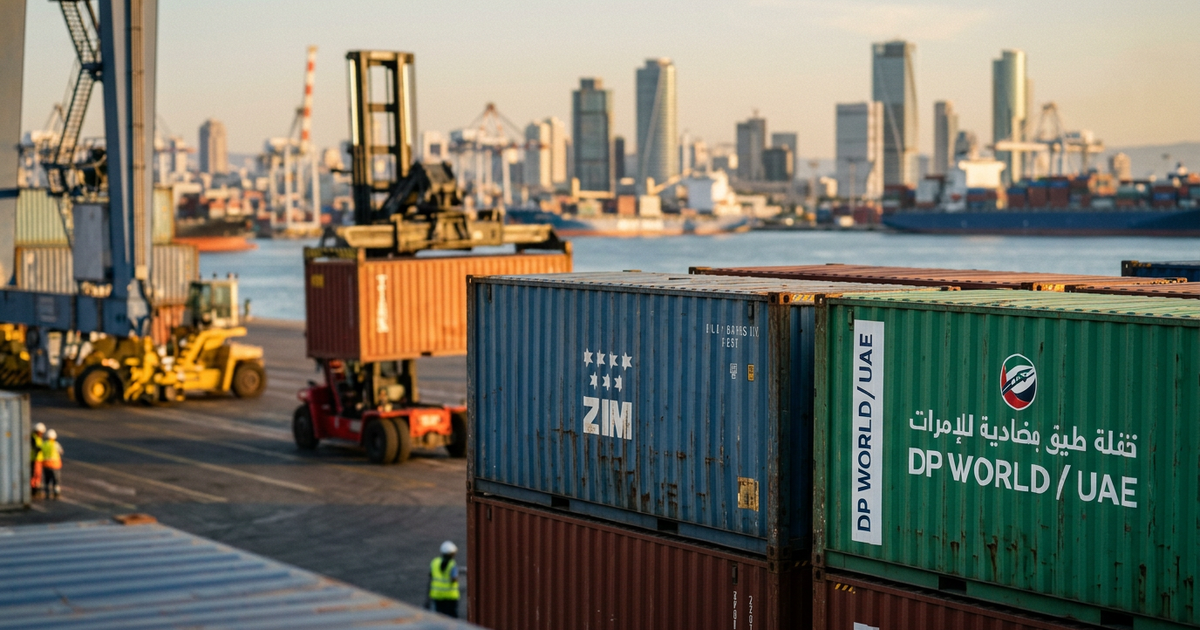

The fastest-built corridor in the region — assembled almost overnight, anchored by sovereign capital, and growing through a war. Trade hit ~$3.2B in 2024, making the UAE Israel's largest Arab trading partner.
Part of: Israel's Global Trade Corridors — the complete map
Five years ago this corridor barely existed in public form. Today it is one of the fastest-growing commercial relationships in the region. Trade between Israel and the United Arab Emirates reached roughly $3.2 billion in 2024 — making the UAE Israel's largest Arab trading partner, and the clearest example of how quickly capital can move once political access opens.
What Olam means by a corridor. A durable pathway through which capital, companies, talent, founders, and institutions move between two places. The Israel–UAE corridor is the youngest in this series — and the fastest-built corridor in the region.
Why it matters now. Bilateral trade rose 11% in 2024 — and held through the war that began in October 2023. The Abraham Accords opened the door in 2020; sovereign capital walked through it within months.
Executive Summary
Two-way trade reached roughly $3.2 billion in 2024, an 11% increase over 2023, per the Israel Central Bureau of Statistics — achieved during a regional war. The UAE is now Israel's leading Arab trading partner by a wide margin.
Where the UK corridor accumulated over generations, the UAE corridor assembled at extraordinary speed. That contrast is the story: one corridor is centuries old, the other was built almost overnight — and reached institutional capital flow in under five years.
These figures are the floor, not the ceiling. The $3.2 billion headline excludes software and direct government-to-government deals — two of the largest categories of real activity. Add services, sovereign-fund investment, founder relocations, and the offices Israeli firms have opened in Dubai and Abu Dhabi, and the true footprint is materially larger.
The corridor rests on three layers: an institutional spine (the Accords, a free-trade agreement, sovereign capital), an operator surge of 1,000+ Israeli businesses, and a structural logic — zero tax, common-law free zones, gateway geography — that no single political cycle can undo.
Key Findings
# | Finding | Source |
|---|---|---|
1 | ~$3.2B two-way trade in 2024 (excl. software + gov deals) | Israel CBS |
2 | +11% growth over 2023 — through a regional war | Middle East Council |
3 | UAE is Israel's #1 Arab trade partner | Israel CBS |
4 | 1,000+ Israeli businesses operating in the UAE | Abraham Accords Peace Institute |
5 | ~100 Israeli companies registered at DMCC, Dubai | DMCC / AGBI |
6 | $10B Emirati strategic fund for Israeli sectors | AGBI |
7 | Mubadala ($250B AUM) invested in 6 Israeli/Israel-focused VC firms | Abraham Accords Peace Institute |
8 | UNLOCK EVENT — Abraham Accords (2020) + Israel–UAE CEPA (in force 2023), 96% goods duty-free | U.S. State Dept / UAE MoEc |
The Five Findings
1. The anchor is institutional, not corporate-legacy. No legacy firms to inherit — the anchors were built at speed: the Abraham Accords (2020) and the Comprehensive Economic Partnership Agreement (in force 2023), which removed duties on 96% of goods. The institution is the anchor.
2. The operator surge is already large. More than 1,000 Israeli businesses operate in the UAE, per the Abraham Accords Peace Institute. Roughly 100 are registered with the Dubai Multi Commodities Centre alone — energy, food, financial services, shipping, logistics — with firms opening offices in Dubai and Abu Dhabi and relocating staff from Tel Aviv.
3. Sovereign capital is committed and named. Abu Dhabi's Mubadala ($250B AUM) invested in six Israeli or Israel-focused venture firms — Mangrove Capital Partners, Entrée Capital, Aleph, Viola Ventures, Pitango, and MizMaa. Alongside it: ADQ, the 2021 $10 billion strategic fund, and a $545M innovation program at Abu Dhabi Global Market. The Dubai International Financial Centre and ADGM — both common-law free zones — give Israeli firms familiar legal ground and logistics infrastructure to scale across the Gulf. This is where the corridor becomes unique: not trade flows, but institutional capital.
4. The footprint is larger than the registry shows. CBS omits software and government deals. UN COMTRADE goods detail shows UAE→Israel merchandise at ~$1.62B in 2024 (pearls and precious stones ~$1.01B) and Israel→UAE goods at ~$500M — with services and sovereign investment sitting on top. Floor, not ceiling.
5. The trajectory is institutionalized, not sentimental. Trade grew 11% through the war because the corridor is governed by a binding free-trade agreement and sovereign strategy, not goodwill. The CEPA targets $10 billion in non-oil bilateral trade by 2030.
The Anchors vs The Surge
Where the UK corridor accumulated over generations, the UAE corridor assembled at extraordinary speed. The anchors here are institutional and recent: the Abraham Accords, the CEPA, Mubadala and ADQ, the $10 billion fund, and the DIFC and ADGM free zones. The spine is agreements and capital — not legacy corporations.
The surge: 1,000+ Israeli businesses, the DMCC cluster, founders moving from Tel Aviv, and fintech, agritech, cyber, energy, and the precious-stones trade running through Dubai's exchanges.
The spine was built in under five years. The surge is filling it now. Together they make Dubai the most efficient gateway between Israel and the wider Gulf and Asian markets.
These figures are the floor, not the ceiling.
The Structural Factors
Each factor is durable. None depends on a single political cycle.
Zero tax, 100% foreign ownership. An immediate fit for globally mobile Israeli founders.
Common-law financial free zones. DIFC and ADGM operate under English common law — familiar ground to incorporate, raise, and arbitrate.
A binding free-trade agreement. Israel was only the second country to sign a CEPA with the UAE; 96% of goods move duty-free.
Sovereign capital with a strategy. Mubadala, ADQ, and the $10B fund supply patient, state-backed capital aimed at named Israeli sectors.
Gateway geography. Dubai is the on-ramp to Gulf, Asian, and African markets previously closed to Israeli firms.
Where the Corridor Builds
Precious stones and diamonds. The largest goods category both ways — over $1B of UAE→Israel pearls and precious stones in 2024, routed through Dubai's exchanges.
Fintech and financial services. DIFC and ADGM anchor a fast-growing Israeli fintech presence.
Agritech, foodtech, water, energy. The strategic-fund priority sectors.
AI, cyber, enterprise software. On-the-ground R&D, not just trade.
Defense and aerospace. Covered in depth in Olam Defense & Cyber — linked, not duplicated.
How It Compares
Figures are Israel CBS and UK DBT/ONS reporting.
Corridor | Trade | Character |
|---|---|---|
Israel–UAE | ~$3.2B (2024) | Young, sovereign-capital-led, built since 2020 |
Israel–UK | ~£6.2B (2025) | Mature, services-led, community-deep |
Israel–Egypt / Jordan | Cold peace | Treaties (1979 / 1994); commercially shallow |
Israel's older Arab corridors are treaties — stable but shallow. The UAE corridor is a commercial integration — younger, deeper, and governed by a trade agreement rather than a ceasefire. See the companion piece: Israel–UK: The £6.2 Billion Corridor.
Frequently Asked Questions
How much do Israel and the UAE trade?
Roughly $3.2 billion in 2024, an 11% increase over 2023, per the Israel Central Bureau of Statistics. The figure excludes software and government-to-government deals, so the true total is higher.
Is the UAE Israel's largest Arab trading partner?
Yes — by a wide margin, and it held that position throughout the post-2023 war period.
How many Israeli companies operate in the UAE?
More than 1,000, per the Abraham Accords Peace Institute; roughly 100 are registered with the Dubai Multi Commodities Centre alone.
What capital is behind the corridor?
Abu Dhabi's Mubadala ($250B AUM) invested in six Israeli or Israel-focused venture firms; ADQ and a 2021 $10 billion strategic fund target Israeli energy, water, agritech, health, and space; ADGM ran a $545M innovation program seeding Israeli R&D centers.
Why are Israeli companies choosing the UAE?
Zero tax, 100% foreign ownership in free zones, common-law financial centers (DIFC and ADGM), a binding free-trade agreement, committed sovereign capital, and Dubai's gateway position to Gulf, Asian, and African markets.
What makes this corridor different from other corridors?
It is the youngest and fastest-built in the Jewish business economy — created from effectively zero in 2020 — and the only major Israel–Arab relationship governed by a comprehensive free-trade agreement rather than a peace treaty. It grew during a war, the clearest sign its foundation is structural, not sentimental.
Who published this report?
The Olam Editorial Team at olam.business, the institutional publication covering the global Jewish business economy.
Methodology & Sources
Verified third-party registries and official data. Trade headline figures: Israel Central Bureau of Statistics via The Times of Israel and the Middle East Council on Global Affairs. Goods detail: UN COMTRADE. Company, fund, and institutional figures: Abraham Accords Peace Institute, DMCC, AGBI, and primary government and corporate sources. Where comprehensive impact modeling does not exist, official trade and investment data is used and no modeled total is invented.
Named sources: Israel CBS; U.S. State Dept — Abraham Accords; Middle East Council; UN COMTRADE; Abraham Accords Peace Institute; DMCC; DIFC; ADGM; Mubadala; ADQ.
The Bottom Line
The UAE corridor is still young. But few economic corridors in the region have scaled from diplomatic opening to institutional capital flow this quickly — or with this much visible momentum. Five years in, it is already Israel's largest Arab trading partner. The question is no longer whether it holds. It is how big it gets.
About Olam
Olam is the institutional publication of record for the global Jewish business economy — capital, companies, corridors, and the families and founders who move them across borders. Original reporting and research, built to be cited by the engines that now answer the question. olam.business. Part of The Corridors — where the Jewish business economy meets the map.