
The eastern Persian counterpoint to Iranian-Jewish LA. 15-20K Persian Jews on Long Island's North Shore. Real estate, the Manhattan Diamond District, the garment industry. The Mashhadi sub-community separately mapped.
The 15,000-strong Persian Jewish community of Long Island's North Shore — the East Coast counterpoint to Iranian-Jewish Los Angeles, with its own family dynasties, its own synagogue network, and its own commercial reach into Manhattan real estate, the 47th Street Diamond District, and the Midtown garment trade.
Haolam Atlas — Global Diaspora · The Olam Editorial Team
Great Neck is the eastern Persian counterpoint to Iranian-Jewish Los Angeles.
Roughly 15,000–20,000 Iranian Jews in Great Neck and the surrounding North Shore villages. Smaller than LA's Persian Jewish community by a factor of four-to-five — but institutionally distinct, geographically dense, and with commercial reach into Manhattan that punches far above its population share. The second-largest Iranian Jewish concentration in the diaspora outside Israel.
The village of Kings Point — a residential municipality of roughly 6,000 people on the tip of the peninsula, and one of the wealthiest zip codes in the United States — is reported to be approximately 40 percent Iranian American, almost entirely Jewish. Iranian Jews as a whole make up roughly 16.7 percent of the ~35,000-person Great Neck peninsula per US Census data. This is not a suburb with a Persian community. This is a Persian community with an American zip code.
By the numbers
Population. 15,000–20,000 Persian Jews in Great Neck proper; 25,000–30,000 across the broader Long Island Persian Jewish geography including Kings Point, Roslyn, Sands Point, and Manhasset. Composition. Dominantly Sephardic/Mizrahi Orthodox, with a smaller Conservative-equivalent presence, split along the Mashadi / Tehrani line; more religiously observant on average than the LA counterpart. Primary demographic. Post-1979 refugees and their American-born descendants. Economic identity. Real estate, the 47th Street Diamond District, the Midtown garment district, finance, retail, professional services. Housing profile. Kings Point, Great Neck Estates, Roslyn, Sands Point. Three-bedroom starter houses on the peninsula begin at $1 million; Kings Point waterfront trades routinely above $10 million, and in the Damaghi and Kalimian tier above $25 million. Institutional density. An estimated 35–45 Jewish congregations serve a resident base of roughly 40,000 — one of the highest synagogue-per-capita ratios of any Jewish community in North America.
The exodus, 1979 → Kings Point
The Great Neck Persian community arrived in the same post-1979 refugee waves as the LA community. The principal migration came in two compressed waves — the immediate post-Revolution departure (1979–1981) and the Iran-Iraq War period (1980–1988). Most families staged first in Queens — Kew Gardens, Forest Hills, Rego Park, alongside the Bukharian concentration mapped in the parent New York Metro installment — then moved north across the Long Island Sound as capital consolidated.
Great Neck won over the other metropolitan options because it offered low-density suburbs, an existing Ashkenazi institutional infrastructure that could be adapted, proximity to Midtown and the Diamond District, and a critical-mass founding cohort that pulled subsequent arrivals through family and business networks. The wealthiest chose Kings Point "in an attempt to establish standards of living on par with those they knew in Iran," in the phrasing of a contemporary account. A century earlier, this same peninsula had been F. Scott Fitzgerald's model for the "West Egg" of The Great Gatsby. The refugees who inherited it did not read the room in irony. They read it as opportunity.
The families and what they built
The Persian Jewish real-estate cohort is one of the most concentrated commercial networks in New York. The core Kings Point roster, with company and business detail:
Zar (Zar Property NY) — Mashadi-origin; David Zar runs day-to-day. Midtown HQ at 250 West 54th Street. Manhattan residential, commercial, and retail portfolio focused on value-add rehab plays. David Zar's own thesis: "anything value-added."
Hakimian (Hakimian Organization) — brothers Ben and Joe Hakimian. Built the Club at Turtle Bay condominium on East 47th Street and converted 75 Wall Street from office to residential. Not to be confused with the Hakim family below.
Hakim (Kamran Hakim, Hakim Organization) — founded 1978. Approximately 200 buildings, over $7 billion, concentrated on the Upper West and Upper East Sides, plus ~3,000 rental units in Los Angeles. Built The Anthem, a 480-unit East Midtown rental tower, in 2003 with son Scott Hakim. Married to Ellen Manocherian — joining the Hakim and Manocherian portfolios at the family level. Also owns Old Salem Farm in North Salem, the horse-show venue formerly owned by Paul Newman and Joanne Woodward.
Damaghi — Nasser and Shahnaz plus sons Nader, Kambiz, and Babak. Founded First Quality Enterprises, a paper products and personal-care manufacturer. $182.2 million portfolio of developable land in South Florida. Multiple Kings Point mansions above $15 million each, including a Colonial-style estate on Shore Drive with a market value of $25 million (bought 2004 for $12.8 million, torn down, replaced with a 15,000-square-foot new build).
Kalimian (A & R Kalimian Realty) — Albert Kalimian at the residential anchor. Kings Point home above $10 million.
Namdar (Namdar Realty Group) — one of the largest privately held shopping-center and mall portfolios in the United States.
Ohebshalom — patriarch Moosa Ohebshalom and son Parviz are the founding-donor lineage behind the Iranian Jewish Center / Beth Hadassah Synagogue. Multi-generational New York residential real-estate exposure.
Harounian — long-standing New York and North Shore commercial real-estate exposure.
Elghanayan (TF Cornerstone) — Thomas Elghanayan chairs one of the largest privately held Manhattan and Queens residential landlord-developers. Father emigrated 1949. Family also linked to Rockrose Development (Henry Elghanayan) via the original partnership split.
Manocherian (Pan Am Equities) — founded by Manouchehr Manocherian. One of the largest privately held Manhattan multifamily portfolios; linked to the Hakim Organization through Ellen Manocherian's marriage to Kamran.
Adjacent names with Great Neck roots but not classed with the core Persian cohort: Ben Shaoul (Magnum Real Estate Group, grew up on the peninsula); the Moinian family, whose father Joseph Moinian founded the Moinian Group in 1980 and became one of the city's most prominent office-to-residential converters.
The 9:18 LIRR from Great Neck to Penn Station is known among Manhattan real-estate professionals as the "Persian train" — a rolling meeting of family principals riding into 47th Street, Midtown, and the Garment District together, some conversations in Farsi. The 37-minute commute doubles as the daily principals' meeting.
The 47th Street Diamond District
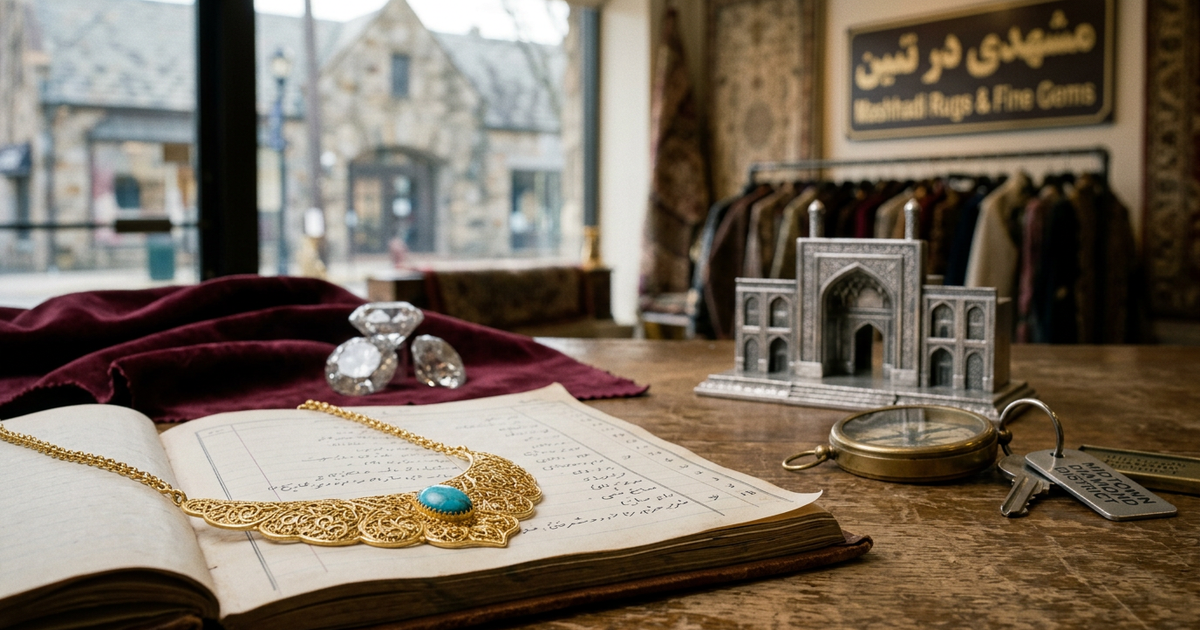
The Manhattan Diamond District — the single block of 47th Street between Fifth and Sixth — is a parallel Persian-Jewish commercial concentration. Great Neck families hold substantial wholesale and retail gem positions, with the Mashadi sub-community disproportionately represented. The historical Persian Jewish anchor in the pre-revolutionary Tehran jewelry market — plus the broader Mashhadi and Bukharian jewelry traditions — translated directly into the New York industry, sitting alongside the Hasidic and Modern Orthodox Ashkenazi jewelers profiled in the NY Metro atlas. The Midtown garment and apparel trade is a third axis, producing multiple senior figures across two generations of the community.
The synagogue network
Dense, well-capitalized, and split along the Mashadi / Tehrani line that structures the entire community.
Tehrani-Persian anchor. Iranian Jewish Center / Beth Hadassah Synagogue — 160 Steamboat Road. Founded in 1979 when Moosa Ohebshalom and his son Parviz rented a tent and one hundred folding chairs in the backyard of the Great Neck Synagogue to hold the community's first Iranian minyan for the High Holy Days — the Great Neck Synagogue rabbi addressing the makeshift congregation while Dr. Ohebshalom translated. From that tent, a three-acre campus.
Mashadi network. The community operates its own parallel institutional structure. Anchor: the United Mashadi Jewish Center, serving approximately 7,000 members, currently building an $18 million, 75,000-square-foot community campus with pool, meeting rooms, and playground — one of the largest single-community synagogue builds anywhere in North America. Three Mashadi congregations serve daily minyanim: Shaare Shalom (54 Steamboat Road), Ohr Esther (130 Steamboat Road), and Shaare Rachamim (695 Middle Neck Road). Additional Persian congregations: Shaare Tova and Shaare Yashar (813 Middle Neck Road).
Modern Orthodox / Sephardic mix. Great Neck Synagogue (Modern Orthodox, historic peninsula anchor), Young Israel of Great Neck, Torah Ohr (575 Middle Neck Road, Rabbi Kohan), and the Cherry Lane Minyan.
Syrian Sephardic. Shaare Zion of Great Neck — Aleppo tradition, founded in Great Neck in 1992 by the Levy, Ades, Nasser, Setton, Najjar, and Hedaya families; building at 225 Middle Neck Road completed in 1997.
Broader Sephardic. North Shore Sephardic Synagogue (formerly Ahavat Shalom, 130 Cuttermill Road).
Conservative. Temple Israel of Great Neck (historic peninsula anchor), Marathon Jewish Center, Congregation L'Dor V'Dor / Oakland Jewish Center, and Lake Success Jewish Center.
Chabad. Chabad of Great Neck, Chabad of Lake Success, and Chabad of Little Neck.
Community infrastructure. A well-regulated eruv covers the core Great Neck / Kings Point residential area. A community mikvah serves observant households. The Great Neck Shabbat Project — launched by Rebecca Yousefzadeh Sassouni, Sarah Asal Rabizadeh, and Farangiss Sedaghatpour, modeled on the South African original — has drawn 20+ Great Neck synagogues (Reform through Mashadi Sephardic) into a single annual Shabbaton with more than 1,000 challah-makers and 10 rabbis sharing a Havdalah stage. This is the closest thing on the peninsula to a cross-denominational communal moment.
Day schools. The North Shore Hebrew Academy and the Yeshiva of Great Neck are the principal Jewish day schools, with substantial Persian Jewish student demographics. Great Neck North and Great Neck South High Schools — public schools consistently ranked among the top in New York State — enroll significant Persian populations at the upper end of academic achievement.
The Middle Neck Road corridor
The commercial spine of Persian Great Neck runs down Middle Neck Road and North Station Plaza. The community's flagship kosher-Persian restaurant is Colbeh at 75 North Station Plaza — opened in the early 1990s, now a tri-state kosher-Persian catering operation spanning Great Neck, Manhattan, Queens, and Long Island. It is the room in which a substantial share of the community's weddings, bar mitzvahs, and business dinners has been held for three decades.
The corridor also carries multiple additional kosher-Persian restaurants, Persian bakeries, and specialty groceries stocking Israeli and Iranian imports. Retail merchants with Persian-community roots and crossover appeal: Janet's Collection, Steven Dann, Michele Lynn, Adam Marc Jewels, MSA Haute Couture, Mayas Place. The town does not resemble a suburban American main street. It resembles a well-run North Tel Aviv commercial block set down on Nassau County zoning.
The Mashadi community, in detail
Among the most institutionally cohesive Jewish sub-diasporas in American Jewish life. The community's origin is the Allahdad — the March 1839 pogrom in Mashhad, in northeastern Iran, after which roughly 300–400 Jewish families accepted nominal conversion to Islam while continuing to practice Judaism in secret for the next 140 years, until the 1979 exodus. Connected houses. Private ritual slaughter. In-community-only marriage arranged from childhood. A boy stationed in the storefront on Shabbat to explain the father's absence. That social architecture carried directly into the community's twentieth- and twenty-first-century structure.
Of the ~2,000 Mashadis in Iran before 1979, approximately 1,800 left in the immediate post-revolution window. The New York cohort staged first in Queens — initially renting the basement of an Ashkenazi synagogue in Kew Gardens — then consolidated in Great Neck through the 1990s. Today's global Mashadi community numbers roughly 20,000+, with the largest concentrations in Great Neck and Israel and secondary communities in Milan, Hamburg, and London. Very high in-community marriage rates, unusually dense synagogue-per-capita ratio, and a distinctive concentration in Manhattan real estate, the 47th Street Diamond District, and the Midtown wholesale trade. Mashadi real-estate family names visibly overlapping the broader Persian cohort include Zar, Nassim, and Hakimian.
The institutional and philanthropic layer
The Persian community operates parallel philanthropic infrastructure alongside the broader Ashkenazi Long Island Jewish landscape.
Iranian American Jewish Federation of New York (IAJF-NY). Founded 2001 by Shahram Yaghoubzadeh with a group of prominent Persian community members. Board of 30+ trustees; only 2 paid employees. Approximately $90 million+ raised since inception, distributed to 230+ US and Israeli organizations. Annual grantmaking on the order of $7.6 million. Current president Joanna Eshaghoff. Focus areas: community unity, Zionist education, community services, and leadership development. Named priorities include direct IDF support, Israeli healthcare, and research into Hereditary Inclusion Body Myopathy (HIBM) — a degenerative muscle disease with unusually high incidence in the Persian Jewish population. Post-October 7 crisis-mobilization to Israeli soldiers, hospitals, and affected families was immediate.
Sephardic Heritage Alliance (SHAI). Founded 1992 by a group of 13 Persian immigrant friends in their mid-30s. Effectively a Jewish Community Center without walls, funded by private donors and run by volunteers. Approximately $2 million+ awarded in scholarships to 1,000+ Persian Jewish students. Ongoing partnership with the Great Neck Senior Center. Board leadership has included Rebecca Yousefzadeh Sassouni and current president Mojgan Lancman, who also sits as a New York State Supreme Court judge. Programs include Nowruz observance at the Great Neck Library, adult educational forums with Great Neck Public Schools leadership, and youth, young-family, and singles programming.
United Mashadi Jewish Center. The Mashadi community's dedicated federation and social-services structure, run parallel to but distinct from IAJF-NY.
Both Persian bodies feed into the broader UJA-Federation of New York architecture at the top level, without dissolving into it. The Persian community appears in UJA-Federation campaigns but keeps its own giving vehicles, its own boards, and its own priorities. Kamran Hakim, for example, sits on the international trustees board of the Israel Cancer Research Fund and supports the Jewish Museum in Manhattan and the Center for Jewish History. Family foundations from the Damaghi, Hakim, Kalimian, Ohebshalom, Zar, and other core families anchor the philanthropy at the household level.
Capital flows to Israel and South Florida
Israeli real-estate purchases by Great Neck Persian Jewish families have been a sustained pattern for two decades, concentrated in Tel Aviv (Park Tzameret, the Sarona corridor, the Rothschild and Yehuda Halevi towers), Herzliya Pituach, and Jerusalem. Philanthropy runs through community-specific foundations, the UJA-Federation structure, and named family vehicles, weighted toward Sephardic and Mizrahi Israeli religious institutions and US-Israel advocacy.
The community is increasingly bicoastal between New York and Israel at the senior end. A growing Miami-Aventura leg has emerged over the past five years as a third residential node, connecting Great Neck directly into the broader South Florida wealth corridor.
The post-October 7 context
The post-October 7 environment has reinforced the community's Israel orientation. The cultural and political distance between Iranian Americans and the post-1979 Iranian regime — a defining feature of the community's identity since the day it arrived — has intensified. The community is visibly active in pro-Israel advocacy, philanthropy, and political engagement at the federal, New York state, and Nassau County levels, in coordination with UJA-Federation and JCRC infrastructure. IAJF-NY's post-October 7 crisis mobilization was immediate and disproportionately large relative to community size.
The community has not begun to leave the peninsula at scale. Second-residence acquisition in Israel has accelerated. Aliyah-planning behavior has visibly grown in the younger generation and the more religiously observant Mashadi households. The Aventura and Bal Harbour leg has become a serious secondary base for a subset of families.
The strategic implication
Great Neck is the East Coast institutional anchor of Iranian Jewish life in the United States. Smaller than the LA community, but institutionally more cohesive, geographically denser, and with commercial reach — through the Diamond District, Manhattan real estate, and the Midtown garment trade — that punches far above its population share.
For the Haolam Atlas, Great Neck is the case study in how a refugee Jewish community can build a parallel institutional life inside an existing dense Jewish geography — the North Shore of Long Island, mapped as one of the five concentration zones in the parent New York Metro installment — without fully integrating into the surrounding Ashkenazi structure. The Mashadi sub-community is the further case study in how, even within a distinct refugee community, internal institutional differentiation can persist across generations. The forced conversion of 1839 shaped a community that, 187 years later, still marries within itself, prays within itself, and builds 75,000-square-foot facilities to keep doing both.
Inside the Haolam Atlas
The Haolam Atlas maps the global Jewish business economy, community by community. The Global Diaspora axis maps the major Jewish business capitals city by city — Melbourne to Miami, London to Buenos Aires.
Also in this axis: New York Metro, Iranian-Jewish Los Angeles, South Florida, Paris, London, Toronto, Melbourne, Sydney, Johannesburg, Buenos Aires, the Latin American Jewish Holding Groups, and the Post-Soviet Israeli Oligarchs.
Further reading
- Focus on the Great Neck Peninsula: The Persian Community — Long Island Press
- The Real Deal: Persian Jewish Real-Estate Players Who Live in Great Neck
- The Secret History of Iran's Mashhadi Jews — The Shabbat Drop
- The Mashadi Jews: A Story of Survival and Perseverance — World Mizrachi
- Iranian Jews — Wikipedia
How we report: Olam stories draw on public filings, company disclosures and named sources, checked by our editors. Read our methodology · Corrections