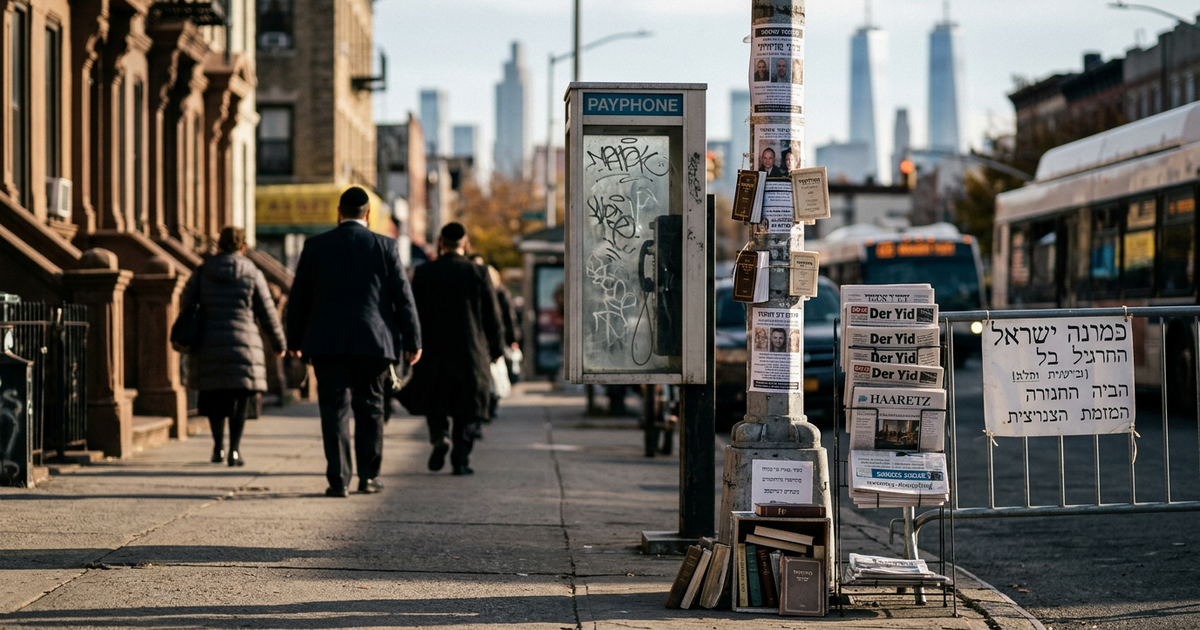

1.7 million Jews. Five concentration zones. The institutional, philanthropic, and capital center of American Jewish life — and the source community for the South Florida wealth migration, the Jerusalem corridor real estate boom, and post-October 7 aliyah to Ra'anana, Modi'in, Efrat, and Beit Shemesh.
1.7 million Jews. Five concentration zones. The institutional, philanthropic, and capital center of American Jewish life — and the source community for the South Florida wealth migration, the Jerusalem corridor real estate boom, and post-October 7 aliyah to Modi'in, Ra'anana, Efrat, and Beit Shemesh.
The New York metropolitan area is the largest Jewish community in the diaspora. It is also the institutional, cultural, philanthropic, and capital center of American Jewish life — and the structural source community for nearly every major English-speaking Jewish migration of the past decade. This installment is the first cycle's overview of a community that will warrant a multi-piece sub-franchise inside the Haolam Atlas.
By the numbers
The most recent authoritative dataset is the UJA-Federation of New York Jewish Community Study of 2023, conducted in partnership with the Steinhardt Social Research Institute at Brandeis University and warehoused at the Berman Jewish DataBank. The headline number: approximately 1.6 to 1.8 million Jews across the eight-county New York metropolitan area — the five boroughs of New York City, Long Island (Nassau and Suffolk), Westchester County, and the inner New Jersey counties.
Distribution: approximately 1.1 million in the five boroughs (Brooklyn approaches 600,000 — by itself larger than every diaspora community outside the broader New York metro), 230,000 on Long Island, 130,000 in Westchester County, and 200,000-plus across the inner New Jersey counties of Bergen, Essex, Passaic, Hudson, Middlesex, and Monmouth.
The community is layered across the full spectrum of Jewish identity. The largest Modern Orthodox concentration in the world. The largest Hasidic and Charedi concentrations outside Israel. Substantial Conservative and Reform majorities. The principal institutional centers of all four major American Jewish denominations. National surveys from Pew Research and the American Jewish Population Project at Brandeis consistently place the New York metro as the anchor of American Jewish demographics — roughly one in four American Jews lives inside it.
Economic identity: finance, law, real estate, media, retail, fashion, healthcare, technology, and the institutional center of American Jewish philanthropy. Why it matters: New York is the structural source of the post-2020 wealth migration to South Florida, the post-October 7 aliyah acceleration to Ra'anana, Modi'in, Efrat, and Beit Shemesh, and the parallel Modern Orthodox growth of Boca Raton, Teaneck, and the Jerusalem corridor.
The five concentration zones
New York metropolitan Jewish geography is too dense and too layered to map exhaustively in one piece. The five principal zones, with the major communities inside each.
Manhattan. The Upper West Side — Modern Orthodox flagship community anchored by Lincoln Square Synagogue, Congregation Ohab Zedek, and the Jewish Center; Conservative anchors at Park Avenue Synagogue and B'nai Jeshurun; and the secular Jewish professional class of the West 70s through the low 90s. The Upper East Side — wealthy traditional and Reform, secular professional, and the flagship congregations at Park East Synagogue, Central Synagogue, Temple Emanu-El, and Kehilath Jeshurun. Greenwich Village and SoHo — younger secular and Conservative. The Financial District, Battery Park, and TriBeCa — the Modern Orthodox finance-professional concentration built out over the past two decades.
Brooklyn. The largest Hasidic and Charedi concentration outside Israel — and by itself the second-largest Jewish community in the diaspora after the broader New York metro. Borough Park, the dominant Hasidic neighborhood, hosts Bobov, Belz, Ger, Skver, Vizhnitz, and dozens of smaller Hasidic courts. Williamsburg is the Satmar headquarters, the largest single Hasidic dynasty in the world. Crown Heights is the Lubavitch world headquarters at 770 Eastern Parkway, from which the global Chabad emissary network of more than 5,000 shluchim families is directed. Flatbush anchors the principal Modern Orthodox and Yeshivish neighborhoods. Midwood, Marine Park, Mill Basin, Bensonhurst, Sheepshead Bay, and Manhattan Beach round out the community.
Queens. Forest Hills, Rego Park, and Kew Gardens Hills anchor the Bukharan and Russian-speaking Jewish concentrations — the largest Bukharian community outside Israel. The Sephardic communities. Smaller Modern Orthodox presence. Queens Jewish population: approximately 200,000-plus.
Long Island. The Five Towns — Lawrence, Cedarhurst, Woodmere, Hewlett, Inwood — the largest Modern Orthodox community in the United States outside the New York metro inner ring, with the flagship day schools HAFTR, HALB, and the Yeshiva of Far Rockaway, and substantial residential density. Great Neck anchors the Persian Jewish concentration (covered in detail in the forthcoming Haolam Atlas installment). West Hempstead, Plainview, Woodbury, Roslyn, and the broader Nassau and Suffolk County Jewish communities extend the footprint east.
New Jersey and Westchester. Teaneck, Englewood, Bergenfield, and Fair Lawn form the most institutionally complete Modern Orthodox concentration in the world outside Israel — the single largest source community for religious aliyah to Beit Shemesh and Efrat. Passaic is the Yeshivish anchor. Edison and Highland Park hold the religious-Zionist Modern Orthodox. West Orange, Livingston, and the Short Hills corridor carry the Conservative and Reform. The Jersey Shore communities of Deal (the Syrian Sephardic concentration) and the broader Monmouth County Jewish community anchor the southern edge. Westchester runs in parallel: Scarsdale, Riverdale (technically the Bronx), New Rochelle, White Plains, Mamaroneck.
The institutional center of American Jewish life
New York houses the headquarters of nearly every major American Jewish institution. UJA-Federation of New York is one of the two largest Jewish Federations in the world by annual fundraising — its annual campaign consistently ranks in the hundreds of millions of dollars, and the Federation's asset base runs into the multi-billions. The Conference of Presidents of Major American Jewish Organizations coordinates the roughly fifty national Jewish organizations that collectively represent the American Jewish policy position on Israel and antisemitism.
Advocacy and civil-rights headquarters: AIPAC's New York operations, the Anti-Defamation League national headquarters, and the American Jewish Committee. Denominational institutional centers: the Jewish Theological Seminary (Conservative), Yeshiva University (Modern Orthodox), Hebrew Union College–Jewish Institute of Religion (Reform), the Union for Reform Judaism, the Orthodox Union, the Rabbinical Council of America, Agudath Israel of America, and Chabad-Lubavitch World Headquarters.
Yeshiva University's Wilf Campus in Washington Heights and the Beren Campus in Midtown anchor the Modern Orthodox institutional infrastructure. Stern College, the Sy Syms School of Business, RIETS (the Rabbi Isaac Elchanan Theological Seminary), and the broader YU network represent the principal institutional pipeline for Modern Orthodox leadership across law, medicine, finance, and the rabbinate.
The day school and yeshiva network
The New York metro day school and yeshiva network is the densest in the world outside Israel. Modern Orthodox flagships: SAR Academy and SAR High School in Riverdale, the Heschel School, Ramaz on the Upper East Side, Yeshiva of Flatbush, Yeshiva University High Schools (MTA and Central), Frisch, Ma'ayanot, RYNJ, and the Five Towns and Bergen County networks (HAFTR, HALB). The Hasidic and Charedi yeshiva networks run into the hundreds. The Avi Chai Foundation census of North American Jewish day schools and the Prizmah day school network place combined New York metro Jewish day school enrollment at roughly 150,000-plus — the largest such network on earth outside Israel.
The business community
The New York Jewish business community is the largest and most consequential in the diaspora. It is not evenly distributed. It is concentrated at the principal-and-partner level in four industries: finance, real estate, media, and fashion — with a rising fifth in technology and venture.
Finance. Senior Jewish presence across Goldman Sachs (the historical Jewish-led American investment bank), Morgan Stanley, JPMorgan, and the major hedge funds — Bridgewater, Millennium, Citadel's New York operations, Point72, Two Sigma, D.E. Shaw, Renaissance Technologies, Tiger Global, Coatue, Pershing Square. Private equity: Blackstone, KKR, Apollo, Bain Capital New York, Carlyle, Warburg Pincus. Asset management: BlackRock, AllianceBernstein, Neuberger Berman.
Real estate. The New York real estate community is Jewish at the principal level to a degree unmatched in any other American city. The Tisch family (Loews), the LeFrak family, the Speyer family (Tishman Speyer), the Rudin family, the Resnick family (Jack Resnick & Sons), the Durst family, the Silverstein family (Larry Silverstein, Silverstein Properties, World Trade Center), the Witkoff family, the Sutton family, the Solow family, the Roth family (Vornado), the Brodsky family, the Zuckerman family.
Media and entertainment. Senior Jewish presence across the New York Times, the Wall Street Journal, the broader media corporate leadership, the publishing industry, and the senior tier of the entertainment and broadcast industries with New York operations. The Sulzberger family remains the controlling owner of the New York Times.
Fashion, retail, and consumer goods. Ralph Lauren, Calvin Klein historically, Donna Karan historically, Michael Kors, Marc Jacobs, and the broader senior Jewish presence across the fashion and retail industry headquartered in New York — the reason the New York fashion economy remains globally significant despite the decline of American manufacturing.
Technology and venture. A rising concentration. The Israeli founder and venture community anchors heavily in New York alongside Tel Aviv and Silicon Valley — most Israeli enterprise-software companies list on U.S. exchanges from New York, and the senior Israeli venture partnerships (Insight, Bessemer New York, TPG Growth NY, Tiger, Coatue) run from Manhattan. See our profile of NICE Ltd., the longest-tenured Israeli enterprise-software Nasdaq franchise, as one such connective node.
The post-2020 capital outflow to South Florida
The dominant structural story of the past five years for the New York Jewish community has been substantial capital outflow to South Florida. The senior finance and private equity community, the family office class, and the wealthier Modern Orthodox families have relocated primary residences — and in many cases firm operations — from Manhattan, Greenwich, and the New Jersey suburbs to Palm Beach, Boca Raton, Miami Beach, and Aventura. See our full treatment in South Florida: The Jewish Wealth Corridor.
The migration has not depleted the New York community. The institutional infrastructure remains intact and dense. The next generation of senior finance and professional services families continues to anchor in New York at least through the early-career years. Day school enrollment in Teaneck, the Five Towns, and the inner Manhattan congregations remains strong. The Modern Orthodox community has not relocated en masse.
But the senior tier of the community has visibly shifted. The two communities now operate as a single connected corridor — primary residences split across the year, firm operations bicoastal within the East Coast, and institutional ties maintained in both directions. This is the structural condition of American Jewish wealth in the mid-2020s.
The post-October 7 environment
The post-October 7 environment in the New York metropolitan area has been mixed. Antisemitic incidents rose sharply in absolute terms — the ADL's H.E.A.T. Map and annual Audit of Antisemitic Incidents recorded record highs in the New York region in 2023 and 2024. The city's Jewish institutional infrastructure has absorbed the pressure relatively well by global comparison. The political and university campus environments have been difficult — Columbia, NYU, CUNY, the New School, and the broader university system have produced extensive friction — but the community's institutional response has been substantial and the community has not begun to relocate at scale.
The political environment shifted sharply with the inauguration of Mayor Zohran Mamdani on January 1, 2026. Mamdani — the founder of a Students for Justice in Palestine chapter, a public supporter of the BDS movement, and the author of the "Not on Our Dime Act" targeting New York charitable contributions to Israeli communities — is now the mayor of the city with the largest Jewish population outside Israel. His election was supported by Bend the Arc, the progressive Jewish advocacy group that received $1.2 million from Steven Spielberg's Righteous Persons Foundation and delivered its first-ever mayoral endorsement to Mamdani. For the New York Jewish community, the Mamdani mayoralty is the sharpest test of institutional resilience since October 7 — and the community is answering it with visible defiance, not retreat.
Aliyah from the New York metro has risen meaningfully. Nefesh B'Nefesh, the operational partner of the Jewish Agency for North American aliyah, has reported year-over-year increases in New York-origin applications since October 2023, with concentration in the Anglo destinations covered elsewhere in the Haolam Atlas.
The New York-to-Israel aliyah corridor
The Anglo destinations receiving New York metro aliyah are not evenly distributed. Each source community aligns with a specific destination profile.
Ra'anana — the default landing town for the professional secular and light-religious New York cohort. See Ra'anana: The Anglo Capital of Israel. Employer proximity to Tel Aviv, English-friendly professional infrastructure, and the largest concentration of North American Anglos in Israel outside Jerusalem.
Modi'in — the second-largest Anglo destination in Israel, receiving the professional Modern Orthodox cohort priced out of Ra'anana and the Jerusalem corridor. Purpose-built city, halfway between Tel Aviv and Jerusalem. See Modi'in: The Anglo Overflow Town and Hashmonaim: Modi'in's Anglo Yishuv Corridor for the religious-yishuv variant.
Efrat — the ideological Anglo town. Rabbi Riskin's community in the Gush Etzion bloc, drawing the religious-Zionist New York cohort making the values decision rather than the labor-market decision. See Efrat: The Ideological Anglo Town.
Beit Shemesh — the largest concentration of religious Anglo olim in Israel. RBS-A as the institutional core. Source diasporas: Teaneck, Passaic, Baltimore, the Five Towns. See Beit Shemesh: The Religious Anglo Capital.
Herzliya Pituach and North Tel Aviv receive the secular Manhattan professional cohort. The Five Towns, Teaneck, and the Upper West Side have each seen visible upticks in aliyah-planning behavior since October 2023 — pilot trips, day school inquiries in Israel, and quiet capital pre-positioning through the Jerusalem corridor real estate market.
The strategic implication
The New York metropolitan area is the largest Jewish community in the diaspora and the institutional, cultural, and capital center of American Jewish life. It is also the structural source community for the contemporary migrations that have reshaped South Florida, the Jerusalem corridor, and the Anglo-Israel towns of Modi'in, Ra'anana, Efrat, and Beit Shemesh.
For the Haolam Atlas, New York is the center of gravity around which the entire English-speaking Jewish geography organizes itself. The cycle of pieces covering Teaneck, the Five Towns, Crown Heights, the Hasidic communities, the Manhattan professional Jewish geography, and the Great Neck Persian community will warrant its own sub-franchise in future installments.
Inside the Haolam Atlas
The New York Metro is the twelfth installment of the Global Diaspora axis. The remaining pieces in the closing cycle cover Great Neck, Houston, and Antwerp.
How we report: Olam stories draw on public filings, company disclosures and named sources, checked by our editors. Read our methodology · Corrections