
North America's quiet third Jewish capital. 190K Jews. Forest Hill, Thornhill, Bathurst corridor. Reichmann (Olympia & York), Schwartz (Onex), Tanenbaum (MLSE), Mirvish, Latner, Sherman (Apotex). UJA Federation as one of the largest outside the US — and one of the highest per-capita givers anywhere in the diaspora.
The largest Jewish community in Canada — and one of the most institutionally complete and quietly wealthy English-speaking Jewish business communities outside the United States.
Haolam Atlas — Global Diaspora · The Olam Editorial Team
Toronto is North America's quiet third Jewish capital.
After New York and Los Angeles, no English-speaking city on the continent runs deeper. The community sits at roughly 190,000 — small next to New York, larger than Miami, Chicago, or Boston — and it has produced a dynastic business class out of proportion to its size. Real estate at Olympia & York scale. Private equity at Onex scale. Theater, retail, pharmaceuticals, asset management. For the full institutional picture of Jewish capital globally, see Mapping Jewish Capital 2026 and the Diaspora Capital Networks Citation Share Index.
By the Numbers
Greater Toronto Jewish population: approximately 190,000–200,000. National Canadian Jewish population: approximately 400,000 — meaning Toronto holds close to half the country. Primary demographic: Modern Orthodox, Conservative, and Reform mainstream; substantial Religious-Zionist; a Charedi presence growing faster than any other denominational segment. Economic identity: real estate, private equity, theater and entertainment, retail, pharmaceuticals, financial services. Housing profile: Forest Hill, Lawrence Park, Bathurst Manor in Toronto proper; Thornhill and the York Region suburbs north of the city. Why it matters: institutionally complete, capital-deep, and philanthropically tied to Israel at federation and family-office scale both.
The geography
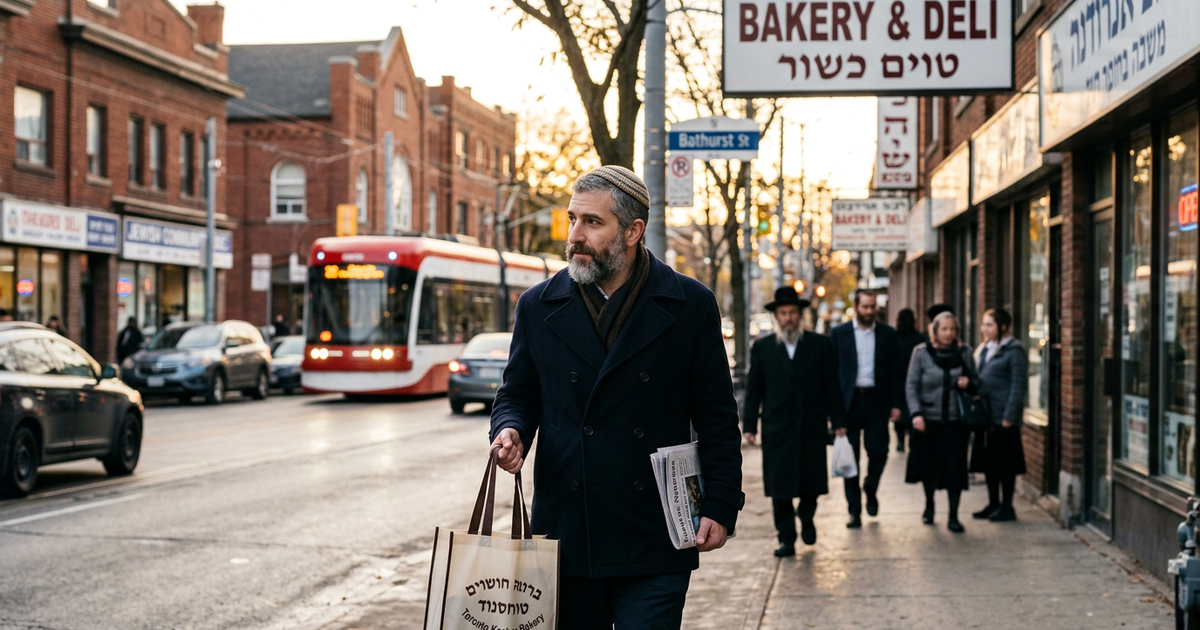
Jewish Toronto runs north up Bathurst Street. That is the line. Forest Hill is the old establishment anchor — Conservative and United Synagogue density, the families who built the post-war fortunes, the addresses every Toronto Jew can recite. Lawrence Park and Lawrence Manor sit one step out — wealthier in some pockets, more recent in others, a mix of Conservative and Modern Orthodox. Bathurst Manor and Wilmington Heights are the middle-class corridors with the broadest religious mix.
Then Bathurst keeps going. Thornhill — technically Vaughan and Markham — is now the largest and densest Jewish residential concentration in the GTA, with Modern Orthodox and Religious-Zionist density along the New Westminster-Bathurst corridor. The community has continued to push north into Maple, Richmond Hill, and the broader York Region. The northward drift has been continuous for two decades.
The dynasties
Toronto Jewish business has been weighted toward real estate, retail, theater, food and consumer goods, and increasingly financial services and technology. The names are concentrated enough that a single dinner party covers most of the country's Jewish industrial map.
The Reichmann family — Olympia & York. At its 1980s peak, one of the largest commercial real estate platforms in the world. Developers of First Canadian Place (Toronto), the World Financial Center (Manhattan), and Canary Wharf (London). The 1992 collapse and subsequent restructuring did not erase the legacy — across Toronto and Israel, the institutional and philanthropic footprint remains substantial.
The Schwartz family — Onex Corporation, founded by Gerry Schwartz in 1984. One of North America's most consequential private equity platforms, with controlling positions across aviation services, food services, packaging, industrial holdings, and historically WestJet. Heather Reisman, Schwartz's wife, built Indigo Books & Music into Canada's dominant bookseller. The HESEG Foundation, funded by the family, has put thousands of Lone Soldiers through Israeli universities.
The Tanenbaum family — multi-generational industrial and real estate holdings. The Mendel and Lawrence Tanenbaum branches each operate substantial foundations. Lawrence Tanenbaum chairs Maple Leaf Sports & Entertainment, the controlling vehicle behind the Maple Leafs, the Raptors, Toronto FC, and Scotiabank Arena.
The Mirvish family — Mirvish Productions runs Canadian commercial theater out of the Royal Alexandra, the Princess of Wales, and the Ed Mirvish Theatre. Honest Ed's was the retail legacy. David Mirvish's partnership with Frank Gehry on the King Street West tower project is the real estate sequel.
The Latner family (Dynacare, real estate). The Sherman family (Apotex, the largest Canadian-owned pharmaceutical company — though Barry and Honey Sherman's 2017 deaths and the still-unsolved investigation reshaped the family's public profile). The Cohen family (Cara Operations historically). The Diamond family (Whitecastle, real estate). The Heffernan family (St. Joseph Communications). The Posluns family (Fairweather, Tip Top Tailors). Toronto Jewish representation across the senior ranks of Canadian banking, asset management, and the major law firms is dense enough to be unremarkable inside the community.
The institutional layer
UJA Federation of Greater Toronto runs one of the highest per-capita annual campaigns of any Jewish federation outside the United States. The Centre for Israel and Jewish Affairs (CIJA) operates a substantial Toronto presence. The day-school network covers the full denominational range at scale — Bialik Hebrew Day School, Associated Hebrew Schools, the Anne and Max Tanenbaum Community Hebrew Academy of Toronto (TanenbaumCHAT), Eitz Chaim Schools, the Toronto Heschel School, Yeshivat Or Chaim, the Bnei Akiva Schools network. The Schwartz/Reisman Centre, the Lipa Green building, the Prosserman JCC. The infrastructure is not improvised. It was built deliberately over four generations.
The synagogue map covers everything. Beth Tzedec (Conservative, the largest Conservative congregation in North America by membership for years). Beth Tikvah. Adath Israel. Holy Blossom Temple (Reform, one of the oldest Reform congregations in Canada). The BAYT — Beit Avraham Yosef of Toronto, the Thornhill Modern Orthodox anchor. Or Chaim and the religious-Zionist cluster. The Ner Yisroel Yeshiva. Multiple Chabad centers. Lubavitch and the broader Charedi institutional presence has grown sharply over two decades — measured by new schools, new shuls, new mikvaot, and population north of Steeles.
Capital flows to Israel
Toronto Jewish philanthropy to Israel moves at high per-capita levels through UJA Federation, the Jewish National Fund Canada, the Canadian Friends of Hebrew University, Weizmann Canada, Canadian Magen David Adom, and a long list of named foundations. The Reichmann Foundation (now multiple foundations across the family branches), the Schwartz Foundation, the Tanenbaum Foundations, the Latner Foundation, the Gerald Schwartz & Heather Reisman Foundation — together they sit among the largest sources of Canadian-anchored Israeli philanthropy.
Investment flows: Toronto Jewish capital has been a consistent presence in Israeli real estate (particularly Jerusalem and Tel Aviv) and Israeli venture LP commitments. The professional services partners across the major Canadian law firms and accounting practices anchor the cross-border Toronto-Israel commercial relationship — and the family-office layer that runs alongside it.
Aliyah: smaller in volume than from the US or UK, but consistent and quality-weighted. Toronto Religious-Zionist olim feed Modi'in, Ra'anana, Efrat, Beit Shemesh, and the Jerusalem corridor. Specific Toronto cluster patterns are visible inside Hashmonaim and the Modi'in Anglo belt.
The post-2023 context
Canada surprised its own Jewish community after October 7. The scale of the campus environment shift, the street protests on Bathurst itself, the firebombing of Jewish schools and synagogues, the political tone in Ottawa and at Queen's Park — none of it matched what the community had assumed about the country. CIJA and the major institutions responded with substantial advocacy and security investment. Security at Jewish schools is now a line item nobody questions.
The community has not begun to leave at scale. But the second-residence and contingency-planning behavior has accelerated — the same pattern documented in The Great Jewish Hedge and in the Israeli real estate inquiry surge from US buyers covered in American Jews Are Calling. They Want Out. Israeli real estate purchases by Toronto Jewish families have continued at sustained pace. The combined US-and-Israel optionality the community has historically maintained — including longstanding Toronto positions in Miami real estate — now matters more, not less.
The strategic implication
Toronto is North America's quiet third Jewish capital. Institutionally dense. Capital-deep. Globally connected. Philanthropic flow to Israel is structurally embedded in the community's institutional life — not optional, not aspirational, simply the way the community operates. The post-2023 pressure is real. The community is not destabilized.
For the Haolam Atlas, Toronto is the case study in what a mid-sized English-speaking Jewish community can build over a century of sustained immigration, integration, and philanthropy. The model is replicable in theory. Almost nowhere has actually replicated it.
The Canada corridor — companion reading
Toronto's community sits on top of a real economic corridor. Read the full cluster:
Toronto: The Israeli Growth Corridor — the patient-capital and AI-research gateway.
Israel–Canada: The Treaty-Built Corridor — CIFTA and the community layer.
Israel–Canada: The Quiet Capital Corridor — CPPIB, Ontario Teachers', OMERS, CDPQ.
The Israel–Canada Mining Corridor — Canadian mining capital, Israeli operational-technology stack.
Inside the Haolam Atlas
The Haolam Atlas maps the global Jewish business economy, community by community. The Global Diaspora axis maps the major Jewish business capitals city by city — Melbourne to Miami, London to Buenos Aires.
Also in this axis: Melbourne, London, Johannesburg, Iranian-Jewish Los Angeles, the Latin American Jewish Holding Groups, Buenos Aires, the Post-Soviet Oligarchs, South Florida, and Sydney.