
The most concentrated Persian Jewish community in the world. 80-100K in Greater LA. Beverly Hills, Pico-Robertson, Tarzana. Nazarian, Younessi, Younai, Sassoon Kadisha. The refugee-to-institutional-titan trajectory in one generation.
By Olam Editorial · Edited Jun 27, 2026
Haolam Atlas — Global Diaspora · The Olam Editorial Team
The Iranian-Jewish community of Los Angeles is the most concentrated Persian Jewish community in the world — and one of the most consequential Jewish business clusters in the United States.
A community of approximately 80,000-100,000 in Greater Los Angeles, built almost entirely by post-1979 refugees from the Iranian Revolution and their American-born children and grandchildren. In the four decades since the exodus, the LA Persian Jewish community has built one of the densest, wealthiest, and most institutionally distinct Jewish business communities in North America.
Persian LA — Named Families and Business Platforms
| Family | Principal platform | Sectors |
|---|---|---|
| Nazarian | Sun Capital Partners; SBE Entertainment Group | Private equity; SLS, Hyatt Andaz hospitality |
| Younessi | Real estate dynasty | Beverly Hills / Westside residential and commercial |
| Younai | Real estate dynasty | LA residential and commercial |
| Soroudi | Real estate dynasty | LA residential and commercial |
| Sassoon Kadisha | Family office | Real estate, finance |
| Pirian, Hakim, Lavian | Multiple platforms | Real estate, fashion, finance |
| David Nahai | Banking; LADWP former president | Finance, water policy |
| Igal Hami | Real estate | LA commercial real estate |
Geography: Beverly Hills · Pico-Robertson · Westwood · Beverlywood · Tarzana · Encino. Institutional anchors: Sinai Temple of Westwood · Nessah Synagogue (largest Persian Modern Orthodox in US) · Iranian American Jewish Federation · 30 Years After.
By the Numbers
Population: estimated 80,000-100,000 in Greater LA. The largest Iranian Jewish concentration in any city worldwide. Religious composition: dominantly Sephardic (Mizrahi) tradition, from Modern Orthodox through traditional-Conservative-equivalent practice. Primary demographic: post-1979 refugees and their American-born descendants. Economic identity: real estate, hospitality, fashion and apparel, finance, increasingly technology.
The geography
Three principal zones anchor the community. Beverly Hills and the Pico-Robertson corridor west into Westwood — the institutional and residential core. Beverlywood, Cheviot Hills, and the broader Westside south of Wilshire — the broader residential footprint. The San Fernando Valley (particularly Tarzana, Encino, and Sherman Oaks) — the secondary concentration that has grown sharply over the past two decades.
Beverly Hills in particular has been reshaped by the Iranian-Jewish community across four decades. The Beverly Hills residential market, the Beverly Hills civic and educational institutions, the local political structure — all reflect the community's deep concentration.
The exodus
The community arrived in two compressed waves. The 1979 Revolution drove an immediate departure of approximately 20,000-30,000 Jews from Tehran, Isfahan, Shiraz, and the smaller Iranian Jewish communities. The Iran-Iraq War years (1980-1988) drove a second, larger wave as the remaining community concluded that no political reversal was coming. By the early 1990s, the principal community of approximately 80,000 had landed in Los Angeles and the smaller New York metro group.
The migration was unusual in that it concentrated a wealthy, professionally-anchored, culturally cohesive Jewish community into a single American city across a five-to-ten-year window. The community arrived with capital, professional credentials in many cases, and a strong existing internal network — the institutional rebuild was faster than most refugee migrations.
The business community
The Persian Jewish business community in LA is concentrated heavily in real estate, hospitality, fashion and apparel, finance and lending, and increasingly technology. The dominant business archetype is the family-controlled holding company operating across multiple sectors with significant real estate exposure.
Named families and business platforms: the Nazarian family (the Sun Capital Partners platform, the SBE Entertainment Group hospitality empire including the SLS hotel brand, the Hyatt Andaz brand operations); the Younessi, Younai, and Soroudi real estate dynasties; the Pirian, Hakim, and Lavian families; David Nahai (banking and water policy); Igal Hami (real estate); the Sassoon Kadisha family. Across the broader community, the cumulative residential and commercial real estate holdings in Beverly Hills, Westwood, the Hollywood corridor, and the broader Westside are substantial.
The fashion and apparel industry has been particularly important — the Persian Jewish presence in the LA fashion district and the broader apparel-manufacturing-and-distribution economy is one of the densest in the country.
The institutional layer
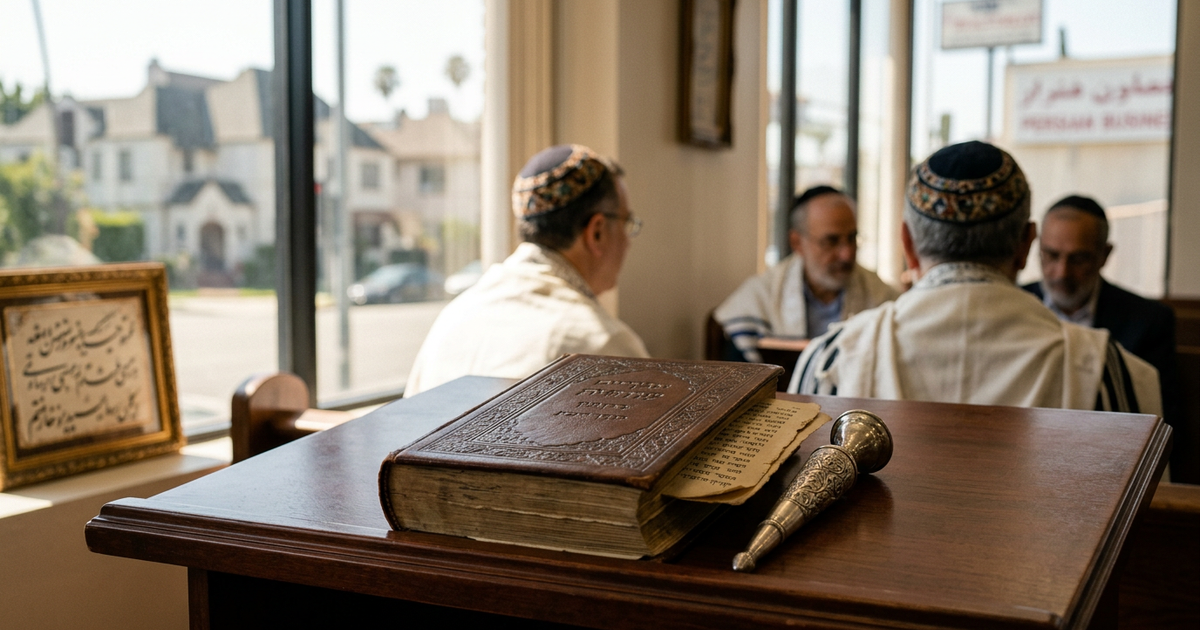
The community has built a dense parallel institutional infrastructure. The Sinai Temple of Westwood (the principal Persian Jewish Conservative congregation), the Nessah Synagogue of Beverly Hills (the largest Persian Jewish Modern Orthodox congregation in the United States), Eretz-Siamak Cultural Center, Magbit Foundation, the 30 Years After organization for second-generation Iranian American Jews, the Iranian American Jewish Federation.
The community's relationship with the broader LA Ashkenazi Jewish community is layered. Institutional cooperation is real (Jewish Federation of Greater Los Angeles, Stephen Wise Temple parallel philanthropy) but the Persian community maintains its own distinct institutional life and cultural identity.
Capital flows to Israel
The Persian Jewish community's relationship with Israel is institutional, philanthropic, and increasingly real-estate-oriented. Persian Jewish capital has been a meaningful share of LA-anchored Israeli philanthropy across multiple decades. Persian Jewish-led Israeli real estate purchases — particularly in Tel Aviv, Herzliya Pituach, and Jerusalem — have run at consistent pace.
Aliyah from the LA Persian Jewish community has been smaller in volume than from the Ashkenazi Modern Orthodox community of Pico-Robertson, but the second-residence and Israeli-property pattern has been strong. The community is increasingly bicoastal between LA and Israel at the senior end.
The post-2023 context
The post-October 7 environment has reinforced the community's Israel orientation. The cultural and political distance between Iranian Americans and the post-1979 Iranian regime has always been a defining feature of the community — the LA Persian Jewish identity is built around opposition to the Islamic Republic. Post-October 7, that orientation has intensified.
The community has been visibly active in pro-Israel advocacy, philanthropy, and political engagement at the federal and California state levels. The cohesion of the community's response to the post-Oct 7 environment has been one of the most visible institutional responses of any single Jewish community in North America.
The strategic implication
Iranian-Jewish Los Angeles is the strongest example in the contemporary diaspora of a refugee Jewish community rebuilding institutional and economic capacity at concentration within a single host city across a single generation. The community arrived four decades ago and is now one of the most consequential Jewish business communities in the United States.
It is also distinct. The Persian Jewish institutional life, religious tradition, family structure, and cultural identity are not Ashkenazi-American. The community participates in the broader American Jewish world but maintains its own — and that distinct identity is the structural feature that defines its presence in the Haolam Atlas.
Inside the Haolam Atlas
The Haolam Atlas maps the global Jewish business economy, community by community. The Global Diaspora axis maps the major Jewish business capitals city by city — Melbourne to Miami, London to Buenos Aires.
Also in this axis: Melbourne, London, Johannesburg, the Latin American Jewish Holding Groups, Toronto, Buenos Aires, the Post-Soviet Oligarchs, South Florida, and Sydney.
How we report: Olam stories draw on public filings, company disclosures and named sources, checked by our editors. Read our methodology · Corrections