Why Rabat Buys: The $25 Billion Algerian Defense Budget That Built the Israel-Morocco Corridor
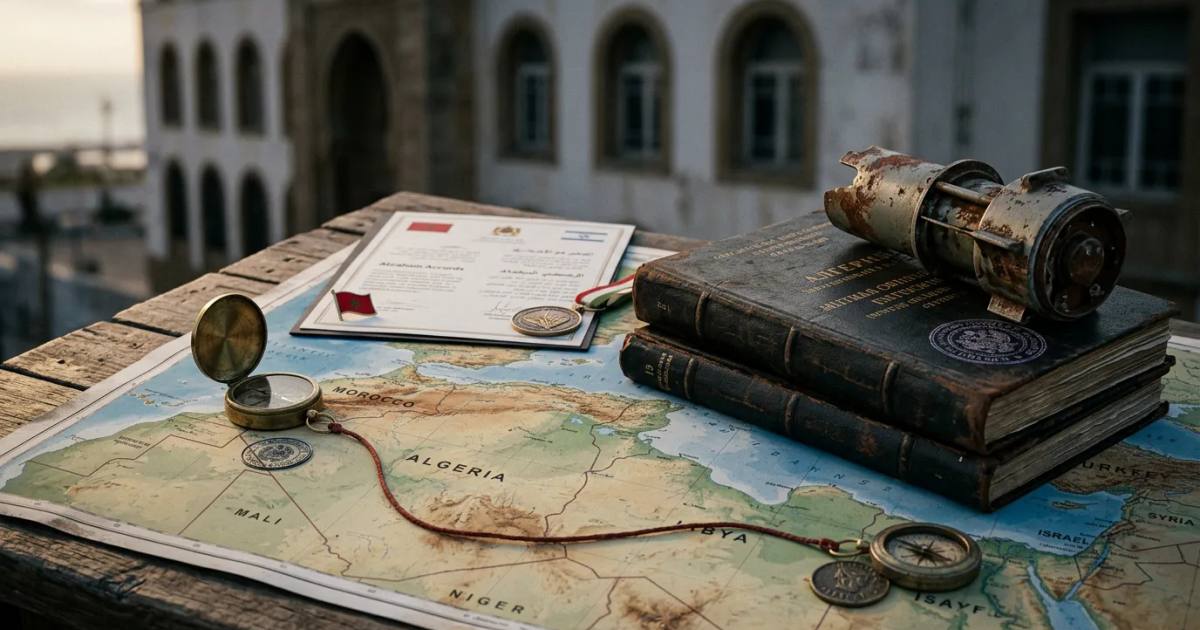
Morocco's $1.5B Israeli defense procurement began as a strategic response to Algeria's $25B Russian-supplied military. The Accords made the trade legal. The Algeria factor made it necessary. Understanding one requires the other.
Why Rabat Buys: The $25 Billion Algerian Defense Budget That Built the Israel-Morocco Corridor
Morocco's $1.5 billion in Israeli defense procurement did not begin as an arms deal. It began as a strategic response to Algeria. The Accords made the trade legal. The Algeria factor made it necessary. Understanding one requires the other.
The corridor's origin story is usually told as diplomatic — the December 2020 Trump-brokered normalization, the US recognition of Moroccan sovereignty over Western Sahara, the reopening of the Israel-Morocco liaison office. All of that is true. None of it explains why the trade grew.
The trade grew because Algiers spends $25 billion a year on defense — Africa's largest budget, per Jerusalem Post's comparative reporting — and because everything Algeria buys, Morocco must be able to counter.
The Algerian order of battle
Algeria has been the largest arms importer in Africa for two decades. SIPRI ranked Algeria among the world's top 15 arms importers as recently as its 2024 update. The supplier concentration is the story: Russia has historically provided roughly 70–80% of Algeria's imported hardware, per multiple SIPRI-based analyses.
The equipment is Cold War-derived, updated in generational cycles:
- T-90 main battle tanks — the current core of Algerian armored formations, with older T-72 variants held in reserve
- Su-30MKA multirole fighters — the primary Algerian air-superiority platform
- S-300 and S-400 air-defense systems — long-range, high-altitude engagement of Israeli-supplied loitering munitions is a specifically stated Algerian doctrine
- Iskander-E ballistic missiles — 300-kilometer conventional short-range ballistic capability, per Ainvest's comparative analysis of Morocco's countermeasures
- Kilo-class submarines — anti-access capabilities across the Mediterranean
That is a specific counter-threat profile. It is not a general-purpose military. It is a Mediterranean and Sahel-facing force sized against Morocco.
The Ukraine war problem
Algeria's supply architecture has one binding constraint. Russia manufactures the equipment. Russia is at war.
Per multiple defense-industrial analyses, Russian arms exports declined more than 50% between 2019 and 2024, with priority allocation shifted to the Ukraine theatre. Deliveries to third-country customers have slowed. Maintenance contracts have become uncertain. The Iskander-E backlog to non-Russian customers has extended beyond stated timelines.
For Algiers, that means a decade-long strategic bet on Russian supply has become materially riskier. The Jerusalem Post's country comparison framed the arithmetic explicitly: Algeria is running "Cold War-era attrition models financed through deficit spending" against an adversary now buying network-enabled, precision-strike, Israeli-designed systems from a supplier not distracted by a European land war.
The gap widens every quarter.
Western Sahara — the operational trigger
Morocco's Western Sahara claim is the specific policy question that made Israeli capability urgent. The territory, occupied by Morocco since 1975 after Spanish withdrawal, has been the subject of a UN-recommended self-determination referendum that has never been held. The Polisario Front — the Sahrawi independence movement, historically Algerian-backed — declared a ceasefire in 1991 that collapsed in November 2020.
Trump's December 2020 recognition of Moroccan sovereignty over Western Sahara — the US quid pro quo for Morocco's signing of the Abraham Accords — did not resolve the dispute. It formalized US backing of Morocco's position. It did not end the low-intensity conflict on the ground.
That conflict is still active. Polisario forces continue targeting Moroccan Royal Armed Forces installations. Moroccan operations run continuous surveillance, counter-drone, and precision-strike missions across the disputed territory. Per multiple regional analyses, Israeli capability entered the Moroccan order of battle first through Western Sahara operations — and only later through broader force modernization.
That sequencing matters. It explains why counter-drone systems, loitering munitions, and electronic warfare have led the Israeli procurement column. Those are Western Sahara operational categories.
The Morocco 2030 doctrine
Morocco's stated national defense strategy — reiterated by Defense Minister Abdellatif Loudyi in his November 2023 Parliament address — is to overtake Algeria as Africa's leading military power by 2030. That is not aspirational language. It is a resource allocation directive.
The 2026 Moroccan defense budget: roughly $15.7 billion per Global Defense Corp (some higher estimates cite $19 billion per Jerusalem Post when broader security allocations are counted). The 2025 figure was materially lower. The trajectory is a compounding annual increase against a flat Algerian baseline.
If both trajectories hold — Algerian budget capped at $25B by fiscal constraints, Moroccan budget compounding through 2030 — the two spending profiles cross sometime in the late 2020s. Not on absolute value. On capability-per-dollar, which is where Israeli sourcing gives Morocco disproportionate leverage.
The math is why Rabat cares about Israeli hardware specifically. Loitering munitions and counter-UAS systems produce battlefield effects per dollar that Russian-legacy systems on the Algerian side cannot match.
The four sourcing lanes
Morocco is triangulating its industrial base across four suppliers, deliberately, to avoid the single-source dependency that has become Algeria's structural weakness:
- Israel — BlueBird / IAI loitering munitions in Benslimane, Elbit artillery and electronic warfare in Casablanca. See our reporting on Benslimane and the $1.5B corridor.
- Turkey — Baykar TB2 and Akıncı heavy strike UAVs, with local Moroccan production
- India — Tata Advanced Systems Maroc, part of India's Atmanirbhar Bharat defense-export push
- United States — 18 HIMARS multiple-launch systems signed in 2024, plus 112 ground-to-ground missiles at ranges of 82–305 km per Al-Estiklal reporting. Ongoing Abrams tank support contracts.
That is not an arms-buyer strategy. That is a diversified industrial-base strategy. Four suppliers, four assembly footprints, four generations of doctrine — each interoperable, each surviving the loss of any single lane.
Algeria has one lane. Morocco has four. The asymmetry is the point.
Trump's Western Sahara declaration — the political engine
The December 10, 2020 US proclamation recognizing Moroccan sovereignty over Western Sahara was the Trump administration's structural gift to Rabat. It did three things:
- Locked US diplomatic backing for Morocco's territorial claim
- Established the Accords quid pro quo — Rabat gets sovereignty recognition, signs normalization
- Cleared US export-control barriers to Israeli defense hardware moving from Israel to Morocco under the standard EAR/ITAR framework
That third piece is under-discussed. Israeli defense exports contain US components, US-developed IP, and US licensed technology. Without US comfort with Israel-Morocco defense trade, that pipeline would face export-control friction inside Washington. Trump's Western Sahara declaration cleared that friction.
The Biden administration did not reverse the declaration. The current Trump second-term administration has doubled down on it. Bipartisan continuity is now the operating baseline for the Israel-Morocco trade.
The African hedge
Morocco's Israeli procurement carries a second strategic implication that the master corridor read has flagged: African distribution.
The BlueBird SpyX facility in Benslimane is positioned as a potential hub for African export markets — Egypt, Nigeria, Kenya, Senegal, and the growing continent-wide UAS procurement pipeline. Per Jerusalem Post's April 2026 reporting from the African Land Forces Summit in Rome, General Christopher Donahue announced US Army plans to establish Africa's first dedicated drone training center in Morocco. That is not incidental. It is a signal that Washington sees Rabat as the anchor of a broader Africa defense-doctrine ecosystem — and that Israeli hardware, assembled in Morocco and doctrine-trained by the US Army, is the emerging package.
Algeria has no equivalent play. Russia does not offer African defense-doctrine integration at scale. The vacuum is Morocco's opportunity.
The Israel-Morocco 2030 base case
Ten-year projection, running the compounding arithmetic:
- Moroccan defense budget — compounding roughly 8–12% annually from a $15.7B baseline, reaches $30B+ by 2030
- Israeli share of Moroccan procurement — 11% (SIPRI current) → 20–25% by 2030 if France continues to lose share
- Absolute Israeli defense trade to Morocco — from an estimated $1.5B cumulative 2020–2025 to potentially $8–10B cumulative 2025–2030
- Moroccan defense manufacturing output — from the single Benslimane facility to a multi-plant, multi-partner ecosystem: Elbit Casablanca sites, Rafael Delilah production if closed, plus Baykar and Tata parallels
- Algerian budget — capped at $25B by fiscal constraints, with rising maintenance burden absorbing the marginal dollar
If those variables hold, Morocco crosses Algeria in operational capability by 2030 without ever matching absolute defense spending. That is Rabat's stated goal. That is the calculation driving every Israeli procurement decision.
What the trade is really about
The Israel-Morocco defense corridor is not a story about Israel selling weapons. It is a story about Morocco solving a specific national-security problem that had no cost-effective solution in the 2015–2020 window.
The problem: Algeria's $25B budget, Russia's supply pipeline, Western Sahara's operational demands. The gap between Moroccan capability and Algerian capability had widened for a decade.
The Accords opened Israeli capability as a legal procurement channel. That was the enabling event.
Since then, three separate mechanisms have compounded the trade:
- Russian supply degradation during the Ukraine war
- French supplier failures across artillery, satellites, and ground platforms
- Moroccan industrial-base expansion through technology transfer and co-production
Each of those runs on independent logic. Together they made the Israeli option not just competitive but structurally advantaged. That structural advantage is now compounding into the industrial layer — Benslimane, Casablanca, and whatever comes next.
Algeria built the case for the trade. Israel supplied the capability. Morocco is scaling the industrial architecture. All three variables continue in the same direction.
The trade will get bigger before it gets smaller. Every quarter Russia loses more of Africa. Every quarter Elbit, IAI, and Rafael pick up more of the Sahel-facing procurement pipeline. Every quarter Rabat builds another node of its multi-supplier industrial base.
Three facts. One corridor. Ten years of compounding to watch.