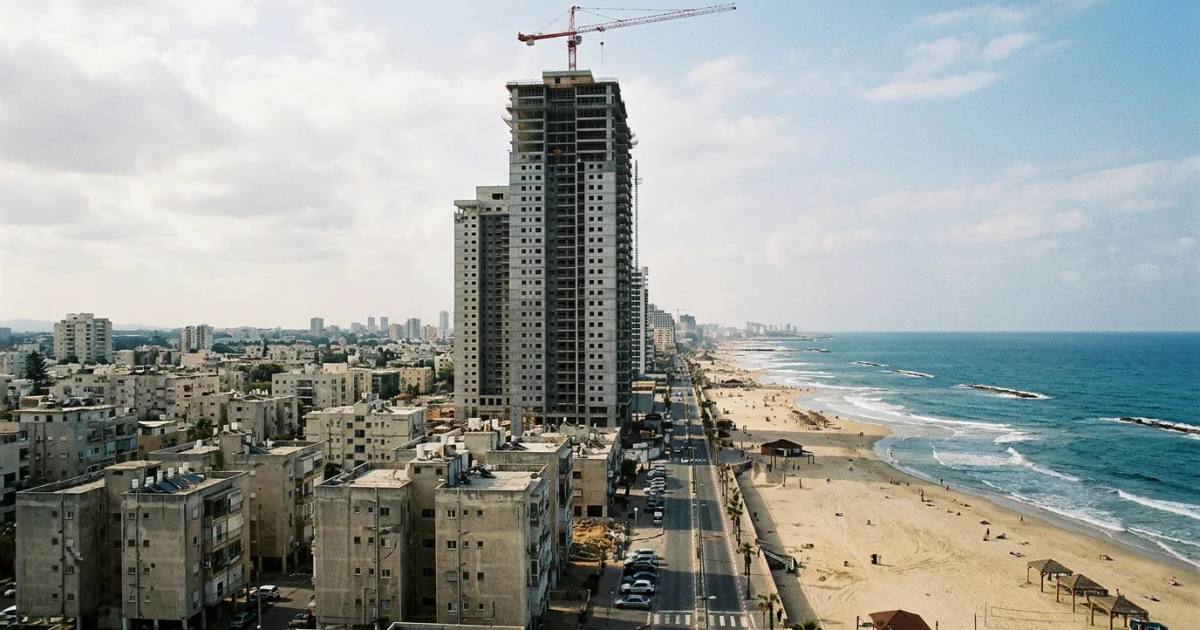

Ashtrom Group (TASE) is executing the single largest beachfront pinui-binui on the Tel Aviv metropolitan coast — a multi-tower complex under Bat Yam's TABA 3700 masterplan, anchored at the former Cliff Hotel. The old horizontal Bat Yam coastline gives way to a wall of high-rises.
Ashtrom Group (TASE) is executing the largest beachfront pinui-binui on the Tel Aviv metropolitan coast — a multi-tower complex under Bat Yam's TABA 3700 masterplan, replacing 1960s housing and the shuttered Cliff Hotel with high-rise residential towers.
Ashtrom Group: the diversified builder
Ashtrom Group Ltd. trades on the Tel Aviv Stock Exchange and operates across three interlocking businesses: infrastructure construction, real-estate development, and industrial products. The group has built major segments of Israeli highway, rail, and utility infrastructure — including sections of the Cross-Israel Highway 6 and the Tel Aviv light-rail Red Line construction — while running a parallel real-estate pipeline concentrated in Tel Aviv, Jerusalem, and Israel's coastal cities. Ashtrom is one of a small number of Israeli developers with the balance sheet and the execution capacity to run a multi-tower coastal pinui-binui as a single integrated project rather than as a stack of separate towers.
The Bat Yam beachfront is a stress test for that capacity. The project sits on land where the compensation cost is high — beachfront apartments carry more market weight than interior ones, and original owners negotiate accordingly — and where the construction complexity is elevated by proximity to the sea, seismic considerations, and the municipal restrictions on height and setback along the coast. Ashtrom's advantage is that it does all of that anyway on other projects. The Bat Yam beachfront is a larger version of what it already does.
The TABA 3700 masterplan
Bat Yam's TABA 3700 is the outline plan that formalized the city's densification doctrine. It designates the beachfront strip as a high-rise residential zone, allows building heights that were previously unimaginable in Bat Yam, and channels new development into a small number of large-plot pinui-binui projects rather than scattered small-block replacements. The masterplan explicitly targets doubling the city's residential population to roughly 250,000 residents by the mid-2030s, with the beachfront and the Ben Gurion Boulevard corridor absorbing the bulk of the new units.
Ashtrom's beachfront project is the first-mover implementation of TABA 3700 on the coastal strip. The complex replaces a series of aging four-story apartment blocks that occupy some of the most valuable land in the metropolitan area — direct Mediterranean frontage, walking distance from central Bat Yam, twenty minutes to south Tel Aviv by car. The compensation logic writes itself: original owners receive new apartments in modern high-rise towers with sea views, structured parking, and elevator access; Ashtrom sells the incremental units at Tel Aviv-adjacent prices.
The Cliff Hotel line
Anchoring the northern end of the Ashtrom Bat Yam coastal build is the former Cliff Hotel site — a shuttered coastal hotel that stood empty for years before the pinui-binui process reassigned it into the beachfront rebuild. The Cliff redevelopment is the visual signature of the project: it converts a decaying hospitality asset on prime beachfront land into new residential capacity. The pattern extends south along the coast, with additional Ashtrom towers absorbing adjacent parcels as ownership consents close.
The visible outcome, when the complex is complete, is a continuous run of high-rise residential towers along the Bat Yam coastline — replacing the horizontal, weathered, four-story character that defined the city for six decades. The Bat Yam skyline that a generation of Israelis grew up with disappears. A denser, taller, higher-value coastline replaces it.
Financing and execution scale
Multi-tower coastal pinui-binui at this scale requires financing structures that most Israeli developers cannot access. Ashtrom's advantage is its integrated balance sheet: the group generates cash from infrastructure contracts and industrial products, which supports development-cycle financing on residential projects without the developer being dependent on presales or short-cycle bridge lending. The result is that Ashtrom can commit to a multi-year, multi-tower coastal build with a delivery timeline that specialists can quote and buyers can trust.
Israeli residential presale demand has been strong through the past decade even during interest-rate volatility, and Bat Yam beachfront units in particular presell into a mixed pool of local upgraders, Tel Aviv commuters, and — historically — French and other diaspora buyers. Ashtrom's price positioning in Bat Yam sits below Tel Aviv beachfront comparables and above interior Bat Yam pricing, which is precisely the pinui-binui developer's target zone.
What the coastal rebuild changes
Bat Yam's beachfront rebuild changes three things at once. First, the city's tax base — new high-value residential density generates municipal property-tax revenue that funds the infrastructure upgrades the masterplan promises. Second, the character of the population — new units attract younger, higher-income residents than the aging beachfront blocks they replace, shifting Bat Yam's demographic profile toward the Tel Aviv commuter model. Third, the political framing of the city — Bat Yam becomes a place where beachfront apartments carry Tel Aviv-adjacent price tags, rather than a discount alternative for buyers priced out of Tel Aviv proper.
The transformation cuts both ways. Original beachfront residents receive new apartments they could not otherwise afford. Long-standing renters, informal residents, and lower-income households on the coast get pushed inward as the coastal strip repositions. That distributional consequence is not unique to Bat Yam or to Ashtrom, but it is where the pinui-binui doctrine meets its social critique.
Why it matters
Ashtrom's beachfront project is the single most physically dramatic piece of Bat Yam's rebuild — and the visible test of whether TABA 3700 can deliver its promise of doubling the city's population inside a decade. If the coastal rebuild works, the interior of the city follows. If it stalls, the whole masterplan slows. Ashtrom is one of the few Israeli developers with the scale to make the coastal rebuild not stall.
The old Bat Yam coastline was a horizontal city. The new one is a wall.
Primary Sources
- Ashtrom Group Ltd. — TASE filings and annual reports
- Bat Yam Municipality — TABA 3700 masterplan and coastal-strip zoning documentation
- Israel Land Authority — beachfront pinui-binui project registry
- Ministry of Construction and Housing — coastal urban renewal pipeline
- Ministry of Interior — municipal boundary and coastal-strip planning framework
Olam coverage
Part two of Olam's Bat Yam real-estate series. Part one covered Aura Sky Bat Yam and the Aura Investments citywide pinui-binui portfolio. Part three covers Bat Yam's aggregate pinui-binui inventory and why the city leads Israel in urban-renewal density.