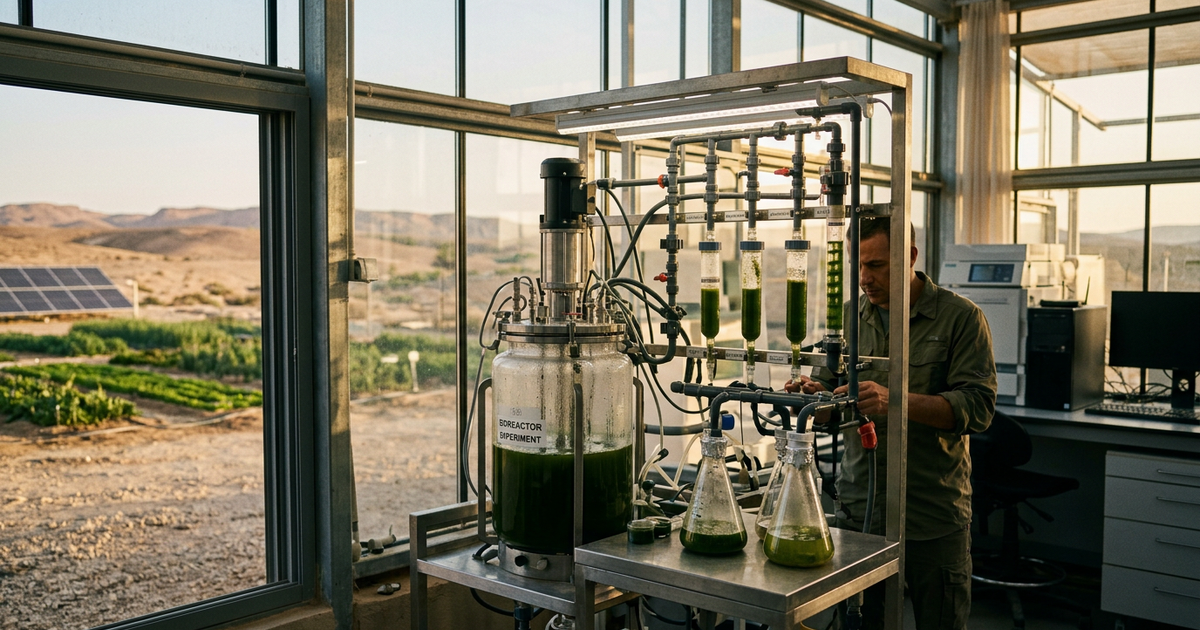

A country that imports most of its food built one of the world's most ambitious alternative-protein industries — deliberately, as national strategy.
Israel grows little of what it eats. It imports the majority of its calories, has almost no grazing land, and sits in a region where food supply is a standing security question. By the logic of conventional agriculture, it should be a food-tech afterthought. Instead it built the second-largest alternative-protein industry on earth, behind only the United States — and it did so deliberately, as a matter of national policy.
Israel is home to more than 80 active alternative-protein companies, with a national strategy targeting over 200 by 2030. The sector has drawn more than $1.3 billion in venture funding. Redefine Meat in 3D-printed plant-based cuts. Aleph Farms in cultivated beef (Israel's first regulatory approval). Remilk and Imagindairy in precision-fermented dairy. This is not a cluster of startups that happened to share a country. It is an industrial bet placed by a state.
Why a state builds this
Food security, not fashion. A country that cannot feed itself from its own land, in a region prone to blockade and conflict, has a strategic interest in technologies that manufacture protein from inputs it controls — crops, sugar feedstock, microbes, cells — rather than from herds and arable acreage it lacks. Food-tech is, for Israel, an extension of the same resource-security logic that produced its water industry. See: Israel Solved Water. Now It Sells the Answer.
The reset is the real story
The sector has been through a brutal correction. Israeli alternative-protein investment fell roughly 78% in 2023. In December 2025, Believer Meats — formerly Future Meat, once the best-funded cultivated-meat company in the country — ceased operations. The hype capital has left. What remains are companies with regulatory approvals, commercial partnerships, and a path to cost parity — the survivors of a cull, backed by a government whose support held steady while private money fled.
The agritech layer underneath
Alternative protein sits on top of an older Israeli strength: precision agriculture. The country that commercialized drip irrigation also built Taranis (aerial crop analytics), Prospera (greenhouse vision systems, acquired by Valmont), and Phytech (plant-based irrigation control). Together with the water industry, they make Israel a full-stack agriculture-and-food technology exporter — from the irrigation line to the bioreactor. Full coverage: Netafim: The Drip Pioneer in Reported Sale Talks.
Related — Israeli Agriculture & Food Tech
How we report: Olam stories draw on public filings, company disclosures and named sources, checked by our editors. Read our methodology · Corrections