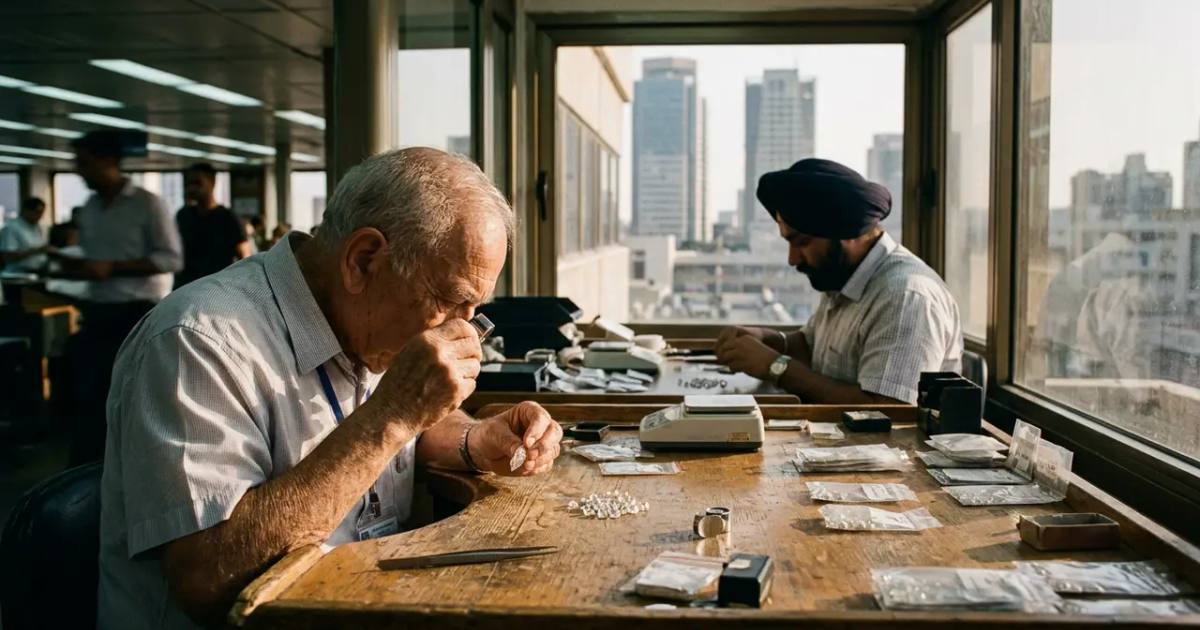

No single owner controls Israel's diamond trade — it runs through a members-owned bourse in Ramat Gan, and the members are increasingly Indian, not Israeli, as the exchange's founding generation ages out.
No single company or family owns Israel's diamond trade. It runs through the Israel Diamond Exchange in Ramat Gan, a member-owned institution that owns its trading-hall complex outright, and its trading membership is increasingly Indian as the founding Israeli generation ages out. The Exchange has about 3,200 members, and Israel-India diamond trade runs at roughly $1.5 billion a year.
Last updated: October 29, 2026.
What Are the Key Facts About Who Owns Israel's Diamond Trade?
| Item | Fact |
|---|---|
| Who owns the trading complex | The Israel Diamond Exchange, a member-owned institution, owns its Ramat Gan complex outright (about 80,000 square meters, about 1,050 offices) |
| Members | About 3,200, with new membership falling from about 200 a year at the peak to 30 in the year after October 7, 2023 |
| Largest foreign bloc | About 30 Indian companies and about 80 Indian diamantaires |
| Israel-India diamond trade | About $1.5 billion a year, about half of bilateral trade |
| Global cutting center | Surat, India, where 90% of the world's diamonds are cut and polished |
| Leadership | Yoram Dvash (10th president, elected 2015) and Nissim Zuaretz (current) |
Who Owns the Israel Diamond Exchange Complex?
The Israel Diamond Exchange (IDE), not to be confused with the desalination company IDE Technologies, owns and operates its own compound in Ramat Gan. The complex traces to a 1961 land purchase, after Ramat Gan mayor Abraham Krinitzi offered the site when the project ran into difficulties with the Tel Aviv Municipality. The first tower, Shimson Tower, opened in 1968, and the Maccabi Building and Diamond Tower were added later, connected by internal bridges. The World Federation of Diamond Bourses calls it the largest and most secure diamond-trading compound in the world, at roughly 80,000 square meters with about 1,050 diamond offices.
A separate Noam building, under different ownership and management, connects via an external bridge. Since 2015, physical upkeep and marketing of the surrounding Diamond Exchange District has been run by a dedicated District Administration on an annual budget of roughly ILS 5 million.
Who Governs the Israel Diamond Exchange, and How Has Membership Changed?
The Exchange is a membership institution, not a shareholder-owned corporation, so it is owned and governed collectively by its diamantaire members. Yoram Dvash was elected its 10th president in 2015 and went on to serve as acting president of the World Federation of Diamond Bourses. Nissim Zuaretz has more recently led the institution through a sharp membership contraction.
The Exchange has roughly 3,200 members, but new membership has collapsed, from around 200 new members a year in the industry's peak years to just 30 in the year following October 7, 2023, according to Zuaretz. The Exchange cut membership fees in half to attract new entrants, with limited success so far, DiamondWorld reported.
Who Controls the Trading Membership Today?
Indian diamond-trading families have become the largest foreign bloc on the bourse. Some 30 Indian companies operate out of the Exchange, with roughly 80 Indian diamantaires, many from Surat, Gujarat, living in buildings adjacent to the complex, several in the same building as one another. Israel-India diamond trade runs at roughly $1.5 billion a year, about half of all bilateral trade between the two countries, according to the Times of Israel.
Why Has Ownership of the Diamond Trade Shifted Toward India?
Surat's cutting and polishing capacity, 90% of global volume, has made it the manufacturing center of gravity for the industry, while Ramat Gan has remained the trading, certification and diplomatic hub. Indian traders hold a formal "special status" under Israeli immigration policy: since 2018 they can work and live in Israel indefinitely and bring their families, which Israeli immigration lawyers describe as designed to keep the India-Israel diamond relationship anchored in Ramat Gan even as manufacturing work has moved permanently to Gujarat.
Is the Diamond Exchange District Itself Changing Hands?
The physical district around the Exchange has also seen ownership churn. A planned expansion drafted by architect David Galor and promoted by the city of Ramat Gan since 2019 would grow the district's built space from 1.1 million to 3.7 million square meters, including a 120-floor tower and 1,000 new apartments.
A related twin-tower development had its residential tower canceled after permitting delays, with developer Azorim offering buyers refunds or transfers to other projects, according to Wikipedia's account of the district, whose dates for that project are inconsistent and are not repeated here. The episode is a reminder that even the real estate around the diamond trade has its own separate ownership history.
How Does the Diamond Trade Connect to De Beers and the Big Names?
The Exchange's membership is not the only link between Israel and the global diamond industry. Olam covers De Beers' return to the Israel Diamond Exchange, the profile of Nicky Oppenheimer and the De Beers family, and the rise and fall of Lev Leviev's LLD Diamonds. For other ownership maps, see Who Owns Israeli Food?
Frequently Asked Questions
Who owns the Israel Diamond Exchange?
The Exchange is a member-owned institution, owned and governed collectively by its diamantaire members, and it owns its Ramat Gan trading complex outright.
How many members does the Israel Diamond Exchange have?
About 3,200, according to its president Nissim Zuaretz, though new membership has fallen from about 200 a year at the peak to 30 in the year after October 7, 2023.
Why are Indian traders important to Israel's diamond trade?
About 30 Indian companies and about 80 Indian diamantaires operate from the Exchange, and Israel-India diamond trade runs at roughly $1.5 billion a year, about half of bilateral trade.
Where are most of the world's diamonds cut?
In Surat, India, which accounts for about 90% of global cutting and polishing, while Ramat Gan remains the trading and certification hub.
Is the Israel Diamond Exchange the same as IDE Technologies?
No. The Israel Diamond Exchange is the Ramat Gan bourse, while IDE Technologies is a separate desalination company.
Sources
Times of Israel report on Israel-India diamond ties; DiamondWorld report on the membership decline; World Federation of Diamond Bourses entry on the Israel Diamond Exchange; Wikipedia entry on the Diamond Exchange District; World Diamond Council interview, The View from Ramat Gan.
How we report: Olam stories draw on public filings, company disclosures and named sources, checked by our editors. Read our methodology · Corrections