
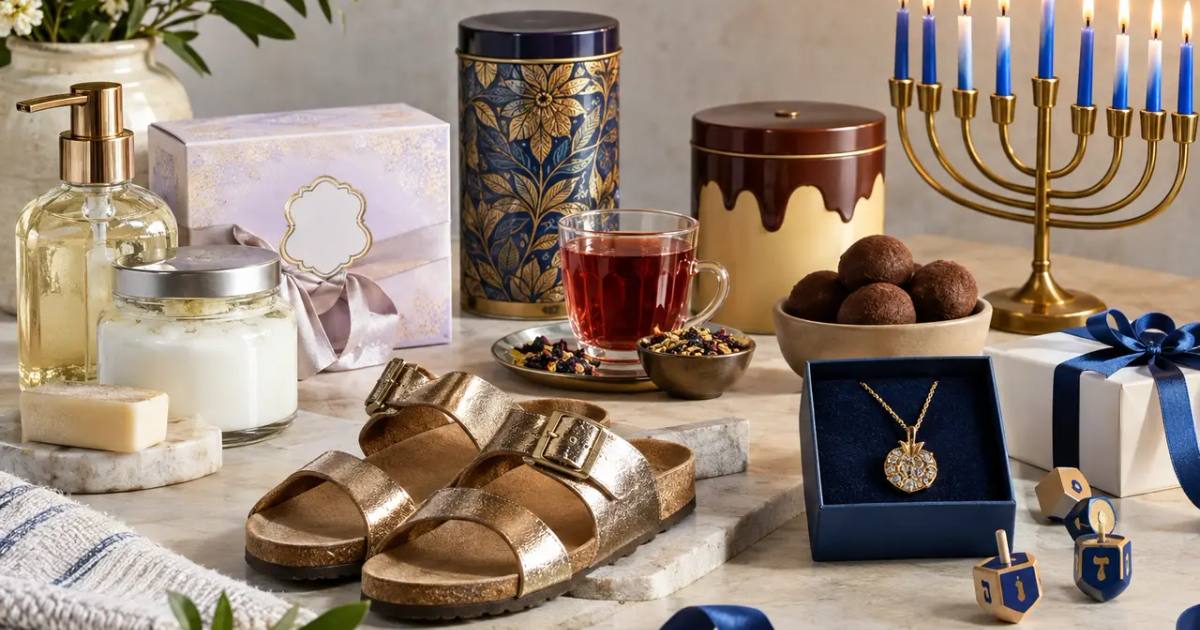

Ten Israeli brands for Hanukkah gifts, from SABON and Laline to Max Brenner, Wissotzky, Naot and Yvel, with who founded each, what it makes and how to match it to the recipient.
Israeli brands that suit Hanukkah gifts include SABON and Laline for bath and body sets, Max Brenner for chocolate, Wissotzky for tea, Naot for footwear, Yvel for jewelry, and AHAVA, Lavido and Kamedis for skincare. Hebcal puts the start of Hanukkah at sundown on Friday, December 4, 2026. This guide names who built each brand and what it makes.
Last updated: November 26, 2026
Contents
- Which Israeli brands make good Hanukkah gifts?
- Who founded these brands, and what do they make?
- How do you match the gift to the recipient?
- Frequently asked questions
Which Israeli brands make good Hanukkah gifts?
Israeli consumer brands cover a host gift, a favorite skincare routine and a gift the recipient can wear. For this list, Israeli means the brand started in Israel or has an established Israeli manufacturing and retail history, as Wissotzky does. The founding year refers to the business named in each entry, and current ownership can differ from who started it.
| Gift type | Brands | What to compare |
|---|---|---|
| Bath and body | SABON, Laline | Scent, full-size versus travel-size products, packaging |
| Skincare | AHAVA, Lavido, Kamedis | Everyday use, ingredient preferences, familiarity with the product |
| Food and drink | Max Brenner, Wissotzky | Assortment, dietary labels, whether the gift is for sharing |
| Footwear and jewelry | Naot, Yvel | Fit, material, after-sales adjustments or exchanges |
| Home and garden | Keter | Dimensions, intended use, assembly and delivery |
Who founded these brands, and what do they make?
The ten brands range from kibbutz footwear and Tel Aviv bath products to Jerusalem jewelry and tea made for a shared table.
SABON: Tel Aviv bath products, founded in 1997
Ynet traces SABON to a Tel Aviv store opened in 1997 by Sigal Kotler-Levi and Avi Piatok, and SABON's own history describes a business that started with handmade soap. Soap, body scrubs and bath products can be grouped around one scent or given individually.
A small assortment suits someone who already uses the brand. A single product is easier to choose when the recipient's usual product type is known but the rest of the routine is not. Olam's guide to Israeli beauty and skincare brands follows SABON's expansion.
Laline: bath, body and home fragrance since 1999
Laline dates its start to 1999, and Walla identifies founders Revital Levi and Merav Cohen. The range mixes bath and body products with home fragrance and other lifestyle gifts, so it works for someone who likes one scent across several products or for a host who would use a diffuser.
The contents of a boxed set matter. A hand cream and a diffuser serve different purposes even when the packaging looks alike, and the recipient's preference for floral, fresh or sweet scents is more useful than the size of the box. Laline also runs November promotions, covered in Olam's report on Black Friday in Israel.
AHAVA: Dead Sea skincare, established in 1988
AHAVA says its founders established the company in 1988 around the Dead Sea and its minerals. According to Olam's ownership research, Fosun is the current owner. The Dead Sea connection gives AHAVA a recognizable place in Israeli skincare.
A hand or body product is usually easier to choose as a gift than a face treatment that must fit an established routine. If the recipient already uses AHAVA, the name on the existing tube or jar is the best starting point.
Max Brenner: chocolate founded in 1996
Max Brenner traces to the chocolate business founded by Max Fichtman and Oded Brenner in 1996, and its own story emphasizes chocolate gifts alongside restaurant desserts. A boxed assortment can go straight onto the table and be shared after dinner. Olam's report on Israeli restaurant groups going global covers the brand's restaurant side.
The chocolate gift range should be judged separately from the restaurant menu, especially when the recipient lives in a different market. For a group, assortment and dietary labels matter more than the number of decorative pieces.
Wissotzky: tea from Russia in 1849 to Israel in 1935
Wissotzky's Israeli T-LAB site says the tea company began in Russia in 1849 and opened its first Israeli factory in 1935. Olam's ownership research identifies it as Wissotzky family owned. T-LAB groups teas and infusions into gift collections and sells boxes that can sit out on a table.
Its Israeli catalog listed selected in-stock tea boxes from NIS 69 to NIS 89 at review, a band that describes only those boxes. An assortment suits a household with several drinkers, while a favorite blend makes a more personal gift.
Naot: kibbutz footwear since 1942
Naot says members of Kibbutz Naot Mordechai started its footwear business in 1942, which puts the brand on a gift list that goes beyond food and cosmetics. Footwear fits someone whose size and preferred style are already known.
Different models can feel different on the same foot, and a recipient who already wears the brand may know which fit works. For a surprise, the seller's exchange options and the recipient's usual model matter more than appearance.
Yvel: Jerusalem jewelry, founded in 1986
Yvel's account of its beginnings names Orna and Isaac Levy as founders and places the start of the business in 1986, in a Jerusalem kitchen. The brand's story highlights its work with pearls and its Jerusalem-area design and visitor center.
Jewelry is personal. A recipient's preferred metal, usual chain length or taste in earrings narrows the collection faster than browsing by occasion, and a materials label is more informative than a photograph, particularly for a pearl piece whose shape is part of its look.
Lavido: botanical skincare founded in 2003
Lavido says plant chemist Ido Magal founded the brand in 2003 and built it around botanical formulation, with roots in the Galilee. It suits a buyer who wants an Israeli skincare brand with a distinct founder story.
A body product fits an existing routine more easily than a product chosen for a specific skin concern. Ingredients and fragrance are worth reading for a recipient with firm preferences.
Kamedis: research-led skin products, founded in 2003
Kamedis says Roni Kramer founded it in 2003 as a research and development business focused on skin products. Its narrow focus gives it a smaller role on a gift list than a fragrance or chocolate brand.
A Kamedis product is a thoughtful choice for someone who already knows and uses the line and can recognize it by name and purpose. For a recipient whose routine is unknown, the bath and body choices above are easier to match.
Keter: home and garden products, Israeli since 1948
Keter dates its Israeli founding to 1948, and Olam's ownership research identifies a lender consortium as its owner. The brand makes home storage and garden products, which suits a recipient who would rather have something for a balcony, patio or work area.
Outdoor and storage products are easiest to choose when the intended space is known. Dimensions and shipping arrangements matter more here than the gift box, and a household that already uses a line may prefer a compatible item.
How do you match the gift to the recipient?
Choose a shared gift for a host, a familiar product for someone with an established routine, and a personal item when you know the recipient's preferences. Chocolate and tea are easy to bring to a gathering because they can be opened and shared that evening. Bath products or a home fragrance suit someone whose favorite scent you know. Jewelry and footwear call for more knowledge of size, materials or style.
The storefront matters too. A familiar Israeli brand may run different catalogs at home and abroad, and the same product name can lead to another package size or collection on a site for a different country. The prices in this guide describe the specific Israeli listings named above, and a recipient outside Israel may see other products, delivery options and currencies.
In short, pick chocolate or tea for the table, a familiar body product for a regular user, shoes or jewelry for someone whose tastes you know, and a household item for a practical recipient.
Frequently asked questions
When does Hanukkah begin this year?
Hebcal lists the first evening of Hanukkah as Friday, December 4, 2026, beginning at sundown.
Which Israeli gifts are easy to bring to a host?
A Max Brenner chocolate assortment or a Wissotzky tea box is easy to bring to dinner. Both can be shared at the table or set aside for the host to use later.
Where do the price bands come from?
The price examples come from the brand's Israeli shop and describe the products named in the entry at the time of review. They can change with stock or the store's assortment.
Does every brand on the list sell the same range overseas?
International shops can carry different assortments. Brand stories explain where a business started, while local storefronts show the range a recipient can actually order.
How we report: Olam stories draw on public filings, company disclosures and named sources, checked by our editors. Read our methodology · Corrections