
Nostromo Energy stores cold in ice instead of batteries, backed by a $305 million DOE loan and installed at the Beverly Hilton and Waldorf Astoria.
Nostromo Energy, an Israeli company traded on the Tel Aviv Stock Exchange, stores energy as ice instead of electricity, freezing water at night when power is cheap and using it to cool commercial buildings during the afternoon demand spike. The company's IceBrick system has secured a conditional $305.54 million loan commitment from the U.S. Department of Energy and already operates at landmark sites including the Beverly Hilton and Waldorf Astoria. Air conditioning drives the biggest swings in grid demand on hot afternoons, and Nostromo's bet is that storing cold is cheaper and safer than storing electrons to solve that problem.
How does Nostromo's IceBrick store energy?
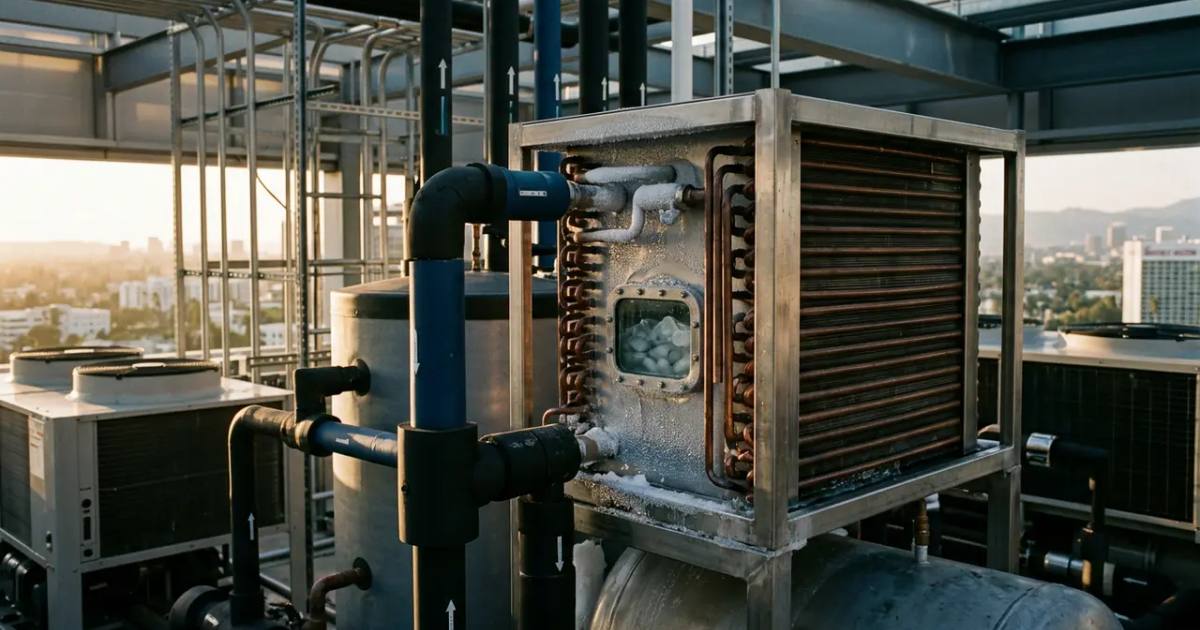
Each IceBrick unit contains capsules filled with a water and glycol solution that freezes during off-peak hours, then thaws during the day to cool a building's circulated water without drawing electricity from the grid at peak times. The system was founded by Yaron Ben Nun, an Israeli designer and former fighter pilot who moved into energy storage after a decade in environmental advocacy and industrial design.
The modular design lets IceBrick units be installed on rooftops, in mechanical rooms, or along exterior walls, described by the company as "Lego-like" for how it adapts to tight urban spaces. Unlike lithium-ion batteries, the system is entirely water-based, non-toxic, and non-flammable, and its only wearing parts are pumps and valves that can last decades.
What did the $305 million DOE loan fund?
The U.S. Department of Energy's Loan Programs Office issued a conditional commitment of up to $305.54 million to IceBrick Energy, a Nostromo subsidiary, in December 2024, according to Energy-Storage.News' coverage of the loan announcement. The financing supports Project IceBrick, a virtual power plant made up of up to 193 cold thermal energy storage installations across commercial buildings in California.
At full scale, Project IceBrick could provide roughly 170 megawatts and 450 megawatt-hours of behind-the-meter storage capacity. The loan requires at least 20% of the installations to serve disadvantaged communities under the DOE's Justice40 initiative, and the guarantee builds on an earlier $176 million loan negotiation the company entered in 2023.
Where is Nostromo's technology already running?
Nostromo's IceBrick system operates at two of California's most recognizable hotels, the Beverly Hilton and Waldorf Astoria, as part of a shared 1.4 megawatt-hour system credited with cutting more than 200 metric tons of carbon emissions annually. The technology has also been installed at Manhattan's Eleven Madison office tower, where hundreds of thousands of pounds of ice are produced nightly four floors underground to cool the building the following day.
In 2023, IceBrick became the first thermal storage technology to qualify as a demand-response resource under the California Public Utilities Commission. In Israel, Nostromo has signed a cooperation agreement with the national electric utility and operates a system on the roof of Medinol, a medical device company in Jerusalem.
| Milestone | Detail | Date |
|---|---|---|
| DOE conditional loan commitment | Up to $305.54M for Project IceBrick (up to 193 installations) | December 2024 |
| Full-scale project capacity | ~170 MW / 450 MWh behind-the-meter storage | Projected |
| Beverly Hilton and Waldorf Astoria | Shared 1.4 MWh system, 200+ metric tons CO2 cut annually | Operating |
| CPUC demand-response qualification | First thermal storage tech to qualify | 2023 |
How does Nostromo's service model avoid upfront costs?
Rather than selling IceBrick units outright, Nostromo installs and maintains the systems and collects monthly service fees over a 20-year period, based on a share of the building's energy savings and grid-participation revenue. In markets with favorable time-of-use electricity rates, this approach can save building owners between $235,000 and $345,000 annually, with projected lifetime savings of $9.4 million per installation, according to Ynetnews' reporting on the company's U.S. expansion.
CONCLUSION
Nostromo turned a phase-change property of water into a financeable, federally-backed alternative to battery storage, then proved the model at trophy properties before scaling toward a 193-site virtual power plant. Companies evaluating behind-the-meter storage vendors now have a publicly listed Israeli case study with a nine-figure federal commitment to check.
How we report: Olam stories draw on public filings, company disclosures and named sources, checked by our editors. Read our methodology · Corrections