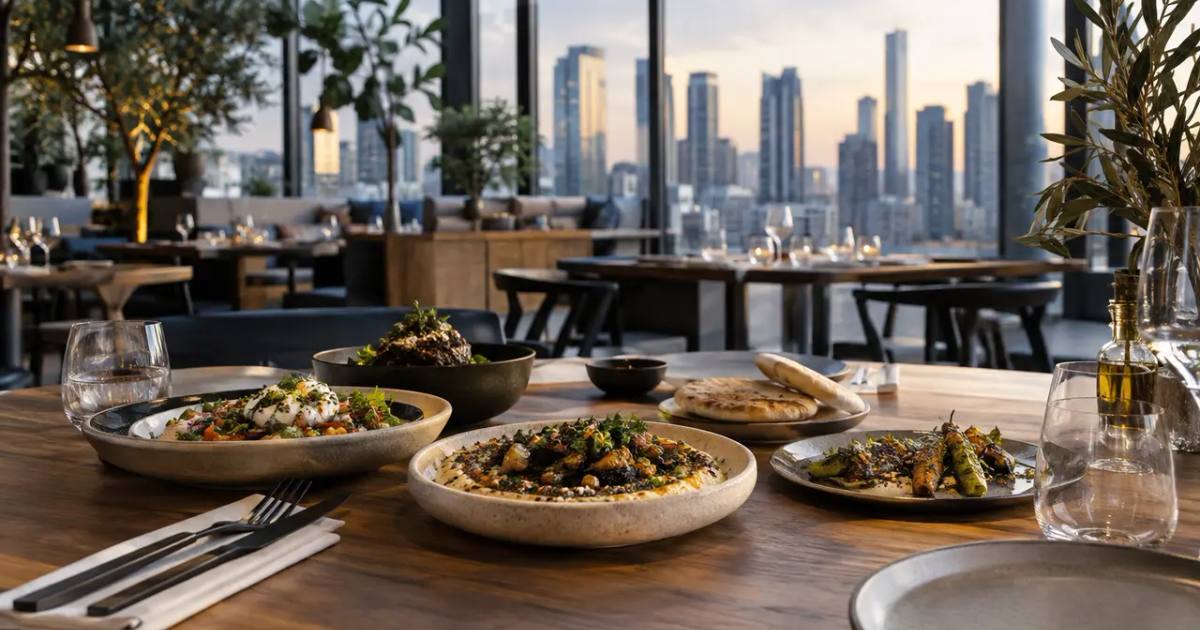

Ten Israeli-founded restaurant businesses have built or announced operations outside Israel: Eyal Shani and Shahar Segal's group behind Miznon, Assaf Granit's Machneyuda Group, Haya Molcho's NENI, Cofix, The Entourage Group, Yotam Ottolenghi's company, Honey & Co, Meir Adoni, Yuval Ben Neriah and Max Brenner. Their markets include Paris, London, Vienna, Singapore, Dubai and Melbourne, and their models range from Michelin-starred dining to franchised coffee.
Last updated: October 31, 2026
Israel was long better known internationally for technology, agriculture and diamonds than for restaurant development. Today, Israeli chefs and restaurateurs operate in some of the most competitive hospitality markets in the world, and their customers are local residents, tourists, business travelers and diners drawn to distinctive food concepts rather than only Israeli expatriates.
The companies also work under very different business models. Some emphasize fine dining and internationally recognized chefs. Others use franchising, partnerships or casual formats built for expansion, and a few have created brands that can operate in several countries without depending on the founder's daily presence. The ten businesses below have established international operations or documented expansion projects. They are tracked alongside other Israeli founders and companies covered by The Olam.
1. Eyal Shani and Shahar Segal: How Miznon Went Global
Eyal Shani and Shahar Segal run The Good People Group, also associated with The Better Guys, an international restaurant operation whose most scalable brand is Miznon. The group's concepts include Miznon, HaSalon, Port Said, Shmoné and others, with operations in France, Britain, Austria, Singapore, the UAE, Australia and North America.
Shani is among the most internationally recognizable Israeli chefs, but his business is larger than the celebrity-chef image suggests. Miznon was founded in Tel Aviv in 2011 and reimagines Mediterranean street food around pita bread, vegetables and meat, with whole-roasted cauliflower among its best-known dishes. It has established operations in Paris, London, Vienna, Singapore and Melbourne, and the wider group has developed businesses in Dubai and other markets.
In 2025, Restaurant Business reported that Shani's group operated approximately 60 restaurants worldwide. That figure covers the broader group, not Miznon alone. Miznon serves the fast-casual market, HaSalon focuses on high-energy dining, and other restaurants use more elaborate menus, which lets the group serve customers across several price points.
Miznon's expansion also shows the need to adapt menus to local markets. A restaurant in Singapore cannot assume the same suppliers, ingredients or customer expectations as one in Paris, so the brand has to stay recognizable while allowing flexibility.
The business lesson: a distinctive, relatively simple food concept can become an international brand when strong operations and adaptable menus support it.
2. Assaf Granit and Machneyuda Group: A Chef-Led European Network
Machneyuda Group is the restaurant company led by chef Assaf Granit and his business partners, which grew from a single Jerusalem restaurant into operations in France, Britain, Germany and other markets. Its major restaurants include Machneyuda, Shabour, Tekés and Coal Office, and its expansion model is distinctive chef-led restaurants.
The business began with Machneyuda in Jerusalem, which opened in 2009 and became known for creative cooking and an energetic atmosphere. Granit and his partners later opened restaurants in London, Paris and other European cities. One of the most significant achievements came in Paris, where Shabour earned a Michelin star and established Granit's reputation in one of the world's most demanding restaurant markets. The group also developed Tekés and other Paris restaurants, and its London operations have included Coal Office.
The group has not relied on replicating one restaurant. It has built different concepts for different locations, which creates room for creative differentiation but raises operational complexity, since each restaurant may need its own management team, menu, suppliers and brand identity.
In August 2026, Ynet reported that Granit was preparing to open a gelateria in Paris called Licouk, extending the business into a new food category.
The business lesson: a restaurant group can expand internationally through multiple distinctive concepts rather than by simply franchising its original restaurant.
3. Haya Molcho and NENI: A Family Restaurant Network in Europe
NENI is the restaurant brand founded by Israeli-born chef Haya Molcho and her family, and it is one of the clearest examples of an Israeli-connected concept building a broad European presence. Its major markets include Austria, Germany, France, Denmark, the Netherlands, Switzerland and Spain, and its model combines restaurants, hospitality partnerships and branded food products.
The name comes from the first letters of her four sons: Nuriel, Elior, Nadiv and Ilan. The first NENI restaurant opened at Vienna's Naschmarkt in 2009, combining Middle Eastern and Mediterranean influences with a casual, family-oriented dining experience built around hummus, falafel and grilled dishes.
NENI's official restaurant directory lists locations in Vienna, Berlin, Hamburg, Munich, Cologne, Paris, Amsterdam, Copenhagen, Zurich and Mallorca. Its relationship with the 25hours hotel group has been particularly important, because hotel partnerships give a restaurant company access to established properties, international travelers and existing hospitality infrastructure without developing every location independently. That makes NENI a useful comparison for readers following Israeli hotels and hospitality.
The business lesson: partnerships with established hotel operators can accelerate restaurant expansion into new countries.
4. Cofix: The Israeli Coffee Chain Across Eastern Europe
Cofix is an Israeli coffee and convenience-food chain, founded in 2013, that expanded into Russia, Belarus, Armenia, Poland and Spain through franchising and a fixed-price model. It competes on affordability rather than on Michelin stars or celebrity chefs.
The company launched in Israel with a basic offering priced at five shekels, built on a simplified operating model. It then entered international markets, particularly Russia and Eastern Europe, relying heavily on franchise partners who invest in local operations while Cofix provides brand identity, operating systems and support.
The company's figures need to be read carefully. In a June 2024 announcement, Cofix reported more than 400 stores across its international network and outlined plans to reenter Kazakhstan, but those targets should not be confused with completed openings. More concrete numbers appear in its 2025 financial reporting: as of June 30, 2025, Cofix reported 346 coffee shops outside Israel, including 282 in Russia, 51 in Belarus, seven in Armenia, five in Poland and one in Spain.
Franchising allows rapid growth, but it also exposes the network to local partners, economic conditions, currency fluctuations and political developments.
The business lesson: a simple value proposition combined with franchising can support expansion across multiple countries.
5. Yossi Eliyahoo and The Entourage Group in Amsterdam
The Entourage Group is the Amsterdam hospitality company founded by Israeli restaurateur Yossi Eliyahoo, built on premium restaurants and lifestyle hospitality in the Netherlands and other European markets. Its concepts include MOMO, The Duchess, Mr Porter, Izakaya and The Butcher.
Eliyahoo is a less familiar name to many Israeli readers, but he has played a significant role in Amsterdam's international restaurant scene. After gaining experience in hospitality and real estate, he developed several distinct establishments: MOMO combined Asian-inspired food with contemporary hospitality, The Duchess emphasized luxurious interiors, Mr Porter was a steakhouse aimed at an international clientele, and The Butcher pursued a more accessible burger format.
In a December 2015 interview with Time Out Tel Aviv, Eliyahoo discussed operating six restaurants in Amsterdam. His strategy differs from conventional franchising. Rather than building one brand with identical locations, he developed several distinct concepts that share management and operational resources, a common approach among premium hospitality groups. The challenge is keeping quality high while each business holds a clear identity.
The business lesson: international restaurant entrepreneurship does not require exporting a national cuisine. It can mean creating locally relevant hospitality concepts for global customers.
6. Yotam Ottolenghi: From a London Deli to a Global Food Brand
Ottolenghi is the London-based food business founded by Israeli-born chef Yotam Ottolenghi and his business partners, combining restaurants, delis, cookbooks and branded products. Its principal market is Britain, but its consumer reach is international.
The first Ottolenghi deli opened in Notting Hill in 2002, offering Mediterranean ingredients, colorful vegetable dishes and distinctive baked goods. The company later expanded to additional London locations and restaurant concepts including NOPI and ROVI. Ottolenghi also became internationally known through bestselling cookbooks, which extended the brand far beyond the physical restaurant network.
The model has several revenue channels. The restaurants build culinary credibility, the books introduce the brand to international audiences, and food products reach customers who may never visit London. The business is based primarily in Britain rather than operating a large network across Asia and the Middle East, but its international consumer reach makes it an important example of Israeli-founded culinary entrepreneurship.
The business lesson: restaurants can become the foundation for a broader consumer brand through publishing, products and media.
7. Sarit Packer and Itamar Srulovich: The Founders of Honey & Co
Honey & Co is the London hospitality brand founded by the Israeli-born couple Sarit Packer and Itamar Srulovich, with an international reach through cookbooks, food products and culinary media. Its primary market is London.
The couple worked in professional kitchens before opening their own business, which became known for its interpretation of Middle Eastern cooking drawing on ingredients and traditions familiar across Israel and the wider region. The company expanded beyond its original restaurant through additional hospitality concepts and publishing, and its cookbooks introduced the brand to readers internationally.
Like Ottolenghi, Honey & Co shows that a restaurant business can reach a global audience without opening dozens of overseas locations. International influence and international restaurant ownership are not the same thing: a restaurant may serve one city while its books and products reach consumers worldwide. Founder-led hospitality also builds loyalty, because customers associate the brand with its creators, but it requires the founders to maintain quality and identity as the business grows.
The business lesson: a focused restaurant business can create international commercial opportunities through intellectual property, publishing and branded products.
8. Meir Adoni: Chef-Led Restaurant Partnerships Abroad
Meir Adoni is an Israeli fine-dining chef who has built international restaurant ventures in partnership with local investors and operators, with major markets including Germany, Spain and Singapore and a Prague opening announced for November 2026. His notable concepts include Layla in Berlin, Samna in Spain and Aniba in Singapore.
Adoni established his reputation in Israeli fine dining and then pursued international opportunities, including ventures in New York, Berlin, Singapore and Spain. Not all of those restaurants remain open, and a chef's historical portfolio should not be confused with current operations when assessing the scale of an international business.
In October 2026, reports described plans to open a Samna restaurant in Prague on November 5. As of this article's last update, that opening was scheduled rather than completed.
Adoni's model lets the chef provide the culinary concept and brand identity while local partners manage real estate, staffing and operations. That reduces the capital a chef must raise alone and adds local market knowledge, but results depend on how responsibilities are divided.
The business lesson: local partnerships can help chefs enter international markets, but each venture must be judged on its own commercial performance.
9. Yuval Ben Neriah: A Planned €10 Million Vienna Venture
Yuval Ben Neriah, the Israeli chef behind Taizu in Tel Aviv, has announced a Japanese fast-casual restaurant venture for European markets with a reported investment of approximately €10 million. The initial target market is Vienna, and the project is an announced expansion rather than an established international chain.
Ben Neriah is one of Israel's prominent chefs specializing in Asian-inspired cuisine. In August 2026, Ynet reported that he was preparing his first international venture, developed with Alon Armer and international partners. According to the report, Japanese partners are also involved in securing high-quality ingredients, and the model emphasizes rice-based dishes, compact locations and takeaway orders.
This is a departure from fine dining. A high-end restaurant depends heavily on its chef, atmosphere and elaborate service, while a fast-casual chain depends on efficiency, repeatability, standardized preparation, food-cost control and supply chains.
As of October 31, 2026, the publicly reported venture remained in development, and its success will depend on execution, customer demand and the economics of operating in European cities.
The business lesson: moving from fine dining into international fast-casual restaurants requires a fundamentally different operating model.
10. Max Brenner: The Israeli Chocolate Restaurant Brand
Max Brenner is an Israeli-founded chocolate restaurant and café brand, established by Max Fichtman and Oded Brenner, that has operated in Australia and the United States alongside its Israeli locations. Its model combines chocolate restaurants, cafés and branded products.
The company did not operate solely as a confectionery maker. It built a restaurant and café experience around chocolate desserts and drinks, treating chocolate as an experience rather than a packaged product. Australia became an important market, and the company also developed operations in the United States.
Chocolate is familiar to consumers worldwide, which makes the core product easy to understand across cultures. The challenge is creating an experience customers cannot easily reproduce at home, which the brand pursues through presentation, restaurant settings and distinctive menu items. Its international history has included ownership changes and operational challenges, so its past expansion should not be read as continuous growth in every market.
The business lesson: a familiar product can support international restaurant expansion when a company builds a distinctive customer experience around it.
Which Israeli Restaurant Businesses Have the Largest International Footprints?
The largest international footprint among the ten businesses belongs to Cofix by outlet count, with 346 coffee shops outside Israel as of June 30, 2025. The businesses vary considerably in scale: some run large networks, others concentrate on a handful of premium restaurants, and a few are based in one country but reach consumers through publishing and products.
| Business | Principal international markets | Business model | Expansion status |
|---|---|---|---|
| Eyal Shani and Shahar Segal | Europe, Singapore, Dubai, Australia, North America | Multiple restaurant concepts | Established international operations |
| Machneyuda Group | France, Britain, Germany and other markets | Chef-led restaurants | Established international operations |
| NENI | Multiple European countries | Restaurants and hotel partnerships | Established European network |
| Cofix | Russia, Belarus, Armenia, Poland, Spain | Franchise coffee chain | Established international network |
| The Entourage Group | Netherlands and European markets | Premium and casual restaurant concepts | Established hospitality group |
| Ottolenghi | Primarily Britain; international product reach | Restaurants, books and food products | Established brand |
| Honey & Co | Primarily Britain; international publishing reach | Restaurants, books and products | Established brand |
| Meir Adoni | Germany, Spain and other markets | Restaurant partnerships | Selected operations and new projects |
| Yuval Ben Neriah | Austria planned | Japanese fast-casual chain | Announced development |
| Max Brenner | Australia, United States and Israel | Chocolate restaurants and retail | Established international brand |
The largest international restaurant businesses are not necessarily the most prestigious. Cofix has operated hundreds of outlets, Machneyuda has developed Michelin-recognized dining, and Ottolenghi has built a consumer brand through restaurants and publishing. Each represents a different approach to growth.
Why Are Israeli Restaurant Concepts Expanding Internationally?
Israeli restaurant concepts are expanding abroad for five main reasons: broad appeal of Mediterranean food, distinctive guest experiences, partnerships that lower entry barriers, scalable fast-casual formats and a shift from single restaurants to brands.
Mediterranean Food Has Broad International Appeal
Mediterranean-inspired food travels well because hummus, tahini, roasted vegetables, grilled meats and fresh salads are familiar to consumers in many countries. These ingredients fit casual dining as easily as elaborate fine-dining menus, which makes the cuisine versatile for international expansion.
Israeli Entrepreneurs Build Distinctive Experiences
Food alone is not enough to establish a restaurant brand, because atmosphere, service and design also matter. Eyal Shani's restaurants are known for energetic dining, Machneyuda combined creative food with theatrical hospitality, and NENI emphasizes communal dining. Customers get a particular experience, not only a meal.
Partnerships Reduce Expansion Barriers
Local and hotel partnerships lower the barriers to opening abroad. International development requires capital and local knowledge for finding locations, obtaining licenses, hiring staff and sourcing ingredients. NENI's hotel relationships and Meir Adoni's investor partnerships are two examples, though both approaches require clear agreements and operational oversight.
Fast-Casual Concepts Offer Scale
Fast-casual restaurants are easier to replicate than fine dining. A restaurant built around one chef's presence may not translate into dozens of locations, while standardized menus and efficient operations make expansion more practical. Miznon and Cofix are different versions of this strategy, and Yuval Ben Neriah's proposed European venture follows similar thinking.
Entrepreneurs Are Building Brands, Not Just Restaurants
A restaurant brand can earn revenue from multiple locations, licensing, products and partnerships, while a single restaurant earns only from diners at one site. Ottolenghi's publishing business and NENI's hospitality relationships show this shift, and the most commercially significant operators increasingly think beyond a single dining room.
What Does International Restaurant Expansion Cost?
International restaurant expansion costs far more than a translated menu, because the business must account for rent, wages, food costs, taxes and local regulations. A successful Tel Aviv restaurant may need significant changes before entering Paris or Singapore, and consumer expectations vary by market.
Investors typically look at seven financial measures.
| Measure | What it shows |
|---|---|
| Average transaction value | How much customers spend per visit |
| Food costs | The share of revenue consumed by ingredients |
| Labor costs | Staffing expenses, which vary significantly across countries |
| Occupancy costs | Rent and related property expenses |
| Restaurant-level profitability | The amount remaining after direct operating expenses |
| Capital expenditure | The investment required to open or renovate a location |
| Payback period | How long the business takes to recover its initial investment |
Expansion becomes more attractive when a concept delivers consistent results across locations, which is why standardized operating systems matter. A brand can have excellent food and still struggle commercially if costs are too high.
The challenge is greatest in fine dining, where skilled employees, expensive ingredients and substantial service produce high average spending but also high operating costs. Casual concepts usually depend on serving more customers at lower average transaction values. Neither model guarantees profitability, and the right strategy depends on the market, location and brand.
Which Markets Are Next for Israeli Restaurant Entrepreneurs?
Europe remains the main destination for Israeli-founded restaurant businesses, with London, Paris, Vienna, Berlin and Amsterdam offering large international customer bases and established dining cultures. Asia offers different opportunities, and Singapore stands out for its international population, sophisticated dining scene and position as a regional business center.
The Middle East also presents opportunities, particularly in cities such as Dubai. Expansion into these markets requires careful planning because ingredient sourcing, consumer preferences, staffing and regulatory requirements differ, and political developments can affect business conditions and customer perceptions. Operators need to understand those risks without assuming a concept that works in one market will succeed in another. Similar cross-border dynamics shape the luxury and ultra-high-net-worth hospitality market, where Israeli brands also compete for international customers.
Frequently Asked Questions
Which Israeli restaurant group operates Miznon?
Miznon was developed by Israeli chef Eyal Shani and business partner Shahar Segal, and it forms part of their wider international restaurant operations.
Where does Miznon operate internationally?
Miznon has established restaurants in cities including Paris, London, Vienna, Singapore and Melbourne, alongside operations in North America.
Which Israeli restaurant group has a Michelin-starred restaurant in Paris?
Machneyuda Group, associated with chef Assaf Granit, developed Shabour in Paris, which earned a Michelin star.
Is NENI an Israeli restaurant brand?
NENI was founded in Vienna by Israeli-born chef Haya Molcho and her family, and its cuisine draws heavily on Israeli and wider Mediterranean influences.
Which Israeli coffee chain expanded into Russia?
Cofix expanded into Russia and other international markets through a franchise-based business model.
Are there Israeli-founded restaurants in Singapore?
Yes. Israeli restaurant entrepreneurs have developed concepts in Singapore, including businesses associated with Eyal Shani and Meir Adoni.
Are Israeli chefs opening restaurants in Dubai?
Israeli-founded restaurant concepts have operated in Dubai, including ventures associated with Eyal Shani's international restaurant business.
Is Ottolenghi an Israeli company?
Ottolenghi is a British-based culinary business founded by Israeli-born chef Yotam Ottolenghi and his partners, with international influence through restaurants, books and food products.
Which Israeli chef is planning a €10 million restaurant expansion in Europe?
Yuval Ben Neriah announced plans in 2026 for a Japanese fast-casual venture in Europe, with Vienna identified as the initial market.
What Does the Evidence Show About Israeli Restaurant Expansion?
The evidence shows that Israeli restaurant expansion now spans scalable chains, internationally recognized fine dining and consumer brands that extend into publishing and food products. Israeli business influence is no longer limited to technology, finance and industrial exports, and it can be found in restaurants, cafés and hospitality concepts in major cities worldwide.
Successful expansion depends on management, financing, distribution, local partnerships and operational consistency, combined with distinctive products and customer experiences. The numbers show how different the models are: Cofix reported 346 coffee shops outside Israel as of June 30, 2025, while Restaurant Business reported in 2025 that Shani's group operated about 60 restaurants worldwide.
Primary Sources
The strongest sources for this article are Hebrew-language reporting and official company disclosures.
- Time Out Tel Aviv, reporting on Israeli chefs succeeding abroad and on Israeli restaurant expansion
- Time Out Tel Aviv, December 2015 interview with Yossi Eliyahoo on his Amsterdam restaurant business
- Ynet, August 2026 reporting on Assaf Granit's Paris expansion
- Ynet, August 2026 reporting on Yuval Ben Neriah's European expansion and Vienna launch
- Restaurant Business, 2025 report on Eyal Shani's restaurant group
- Miznon, official global locations page
- Machneyuda Group, official company history and restaurant operations
- NENI, official European restaurant directory
- Cofix, international expansion announcements and 2025 financial reporting on overseas outlet counts
How we report: Olam stories draw on public filings, company disclosures and named sources, checked by our editors. Read our methodology · Corrections