
Israel's wealthiest municipality was built by South African Jews in 1955. Savyon ranks 10/10 on the CBS socioeconomic index. Villas sell for NIS 13–22 million. The story of diaspora capital as town-building.
Founded 1954–55 · Africa Israel Investments · South African immigration · CBS 10/10 socioeconomic ranking · 4,405 residents (2024) · NIS 13–22 million villas · Lithuanian Jewish origins · The SA–Israel capital corridor.
Israel's wealthiest municipality is not in Tel Aviv. It is not on the Herzliya Pituach coastline. It is a 3,746-dunam town of 4,405 people, bordered by Kiryat Ono and Yehud, that most Israelis can identify by reputation but have never visited.
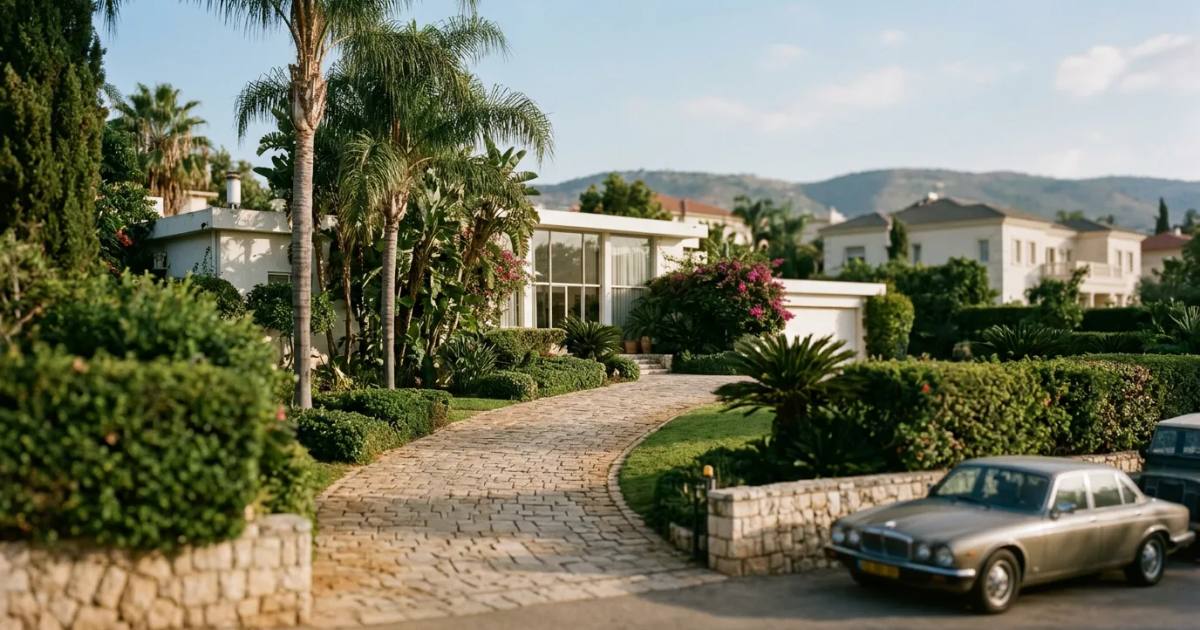
Savyon ranks 10 out of 10 on the Israeli Central Bureau of Statistics socioeconomic index — the highest possible score, shared with only a handful of localities including Kfar Shmaryahu and Omer, according to the CBS's municipal rankings (most recently confirmed in a Haaretz report on the 2009 CBS release, which placed Savyon first). Average wages for salaried employees in Savyon run approximately twice the national average: NIS 17,500 per month versus NIS 8,500 nationally, according to municipal and CBS data cited by Yokra Estate, a Savyon-specialist real estate firm. The homes are villas — not apartments. The plots are measured in dunams, not square meters. The streets have no sidewalks because no one walks. There are no commercial storefronts, no shopping malls, no office buildings. Savyon is a residential enclave — gated by price, not by walls — and it was built, from the ground up, by South African Jews.
Savyon sits just east of Ramat Gan's 72-floor Vertical City tower development and the Diamond Exchange District — but occupies the opposite end of the Israeli residential spectrum. Ramat Gan is going vertical: skyscrapers, pinui-binui, density. Savyon remains horizontal: villas on dunams, no high-rises permitted, no commercial zoning. Two models of Israeli wealth, two kilometers apart.
The Founding: Africa Israel and the Garden Suburb, 1954–1955
Savyon was founded in 1954–1955 by Africa Israel Investments — then an investment arm of the Jewish National Fund — as a planned residential community for affluent immigrants from South Africa. According to the Encyclopaedia Judaica's entry on Savyon and the municipal history recorded by Ze'ev Vilnai in the Ariel Encyclopedia (1978), the settlement was designed as a "garden suburb" modeled on the residential patterns its South African founders were accustomed to: large detached houses on generous plots, each with private gardens, swimming pools, and setback distances that replicated the suburban typology of Johannesburg's northern suburbs — Houghton, Saxonwold, Hyde Park.
The name Savyon comes from a common Israeli wildflower — Senecio vernalis, the eastern groundsel — though Vilnai noted that the first syllable, sav, meaning "grandfather" in Hebrew, was apt for the initial residents, who skewed older and affluent. The first households were South African Jews of means — business owners, professionals, and retirees who had made aliyah with capital and no interest in the austerity-era housing blocks (shikunim) that defined Israeli residential construction in the 1950s.
The founding was deliberate and self-conscious. This was not a transit camp (ma'abara). It was not an absorption center. It was a purpose-built community for immigrants who arrived with money, who intended to live as they had lived, and who had the resources to do so. A 1963 Government Press Office photograph, archived in the GPO collection, shows a street of detached villas with mature gardens — already indistinguishable from a prosperous suburb anywhere in the English-speaking world. Savyon was, from its first dunam, a statement: diaspora capital could build its own Israel.
In 2004, the adjacent Moshav Ganei Yehuda — itself founded in 1950 — was merged into Savyon's municipal jurisdiction by the Ministry of Interior, adding land and population. The merger created what residents distinguish as "old Savyon" (the original South African section, with plots of 1.25 to 5 dunams) and "new Savyon" (the Ganei Yehuda area, with smaller plots of 500–1,000 square meters).
The South African Jewish Community: Lithuanian Roots, 120,000 to 52,000
South African Jewry peaked at approximately 118,000–120,000 people in the early 1970s, according to the Kaplan Centre for Jewish Studies at the University of Cape Town. The community was overwhelmingly Lithuanian in origin — between 80% and 90% were Litvaks, according to the SA Jewish Report and community historians including the late Mendel Kaplan (Jewish Roots in the South African Economy, 1986).
By the 2019 Kaplan Centre national survey, the Jewish population had fallen to an estimated 52,300 — a decline of more than 55%. The SA Jewish Board of Deputies has offered higher estimates, closer to 75,000. The decline was driven almost entirely by emigration.
Emigration destinations (Kaplan Centre survey, SA Jewish Report): Israel 26%, United States 21%, Australia 20%, United Kingdom 20%.
The emigration came in waves. The first (1960s–1970s) followed the Sharpeville massacre. The second (1980s) accelerated with sanctions and political instability. The third (1990s–2000s) followed the democratic transition — rising crime, BEE policies, economic volatility. The fourth (2010s–2020s) has been driven partly by the ANC's hostile posture toward Israel, including South Africa's genocide case at the ICJ filed December 2023.
What South African Jews Built Before They Left
A community that never exceeded 0.2% of South Africa's population produced an extraordinary concentration of founders and industry creators.
Ernest Oppenheimer founded Anglo American in 1917 and took control of De Beers in 1929. His grandson Nicky Oppenheimer ($12.3B net worth per Bloomberg 2025) sold the family's 40% De Beers stake to Anglo American in 2012 for $5.1B. The Oppenheimers later converted to Anglicanism, but their commercial origins were Jewish.
Sol Kerzner (1935–2020, Durban, Russian Jewish immigrants) built Sun International and the Southern Sun Hotel Group — Sun City, the Lost City, Atlantis Bahamas and Dubai.
The Investec founders — Ian and Bernard Kantor, Larry Nestadt, Errol Grolman, Stephen Koseff — built a Johannesburg leasing company into a dual-listed (JSE/LSE) banking group exceeding R100 billion market cap by 2025. All Jewish.
Raymond Ackerman (1931–2024) built Pick n Pay. Barney Barnato and Alfred Beit shaped Kimberley's diamond economy. Sammy Marks was among the Transvaal's most influential industrialists.
The Capital Migration Pattern: Networks, Not Random Dispersal
When South African Jews left, they brought capital — and concentrated it. Israel: Savyon, Ra'anana, Jerusalem's Talbiyeh and Rehavia, Herzliya Pituach. Australia: Melbourne's Caulfield and St Kilda East, Sydney's Dover Heights and Bondi. London: St John's Wood, Hampstead, Golders Green.
When a community leaves, its capital clusters — because trust, deal flow, and professional networks travel with the people. The SA Jewish Report's 2019 survey found 32% of respondents had given "serious thought" to emigrating, with Israel (51%) the preferred destination.
In 2020, 11,381 South Africans were recorded as living in Israel (CBS data). The actual number with South African Jewish heritage across multiple generations is significantly higher.
Savyon Today: The Real Estate Market
Population 4,405 (2024 CBS). 3,746 dunams. Density ~1,176/km² — a fraction of neighboring Kiryat Ono. Head of municipality: Motti Landau (since 2013, re-elected Feb 2024 with 73%).
According to Yokra Estate, old Savyon villas transact at NIS 13–22 million ($3.5–6M). New Savyon half-dunam plots: NIS 6.8 million ($1.8M). A 2023 Times of Israel feature by Danielle Nagler described the market as one where "there are no 'for sale' signs" and homes "change hands quietly and discreetly."
The current population is predominantly young Israeli families — tech entrepreneurs and executives. The South African founding community has been substantially diluted, but the physical template — villas, pools, no apartment buildings — remains.
Savyon as Model: Diaspora Capital and Town-Building
Savyon is a case study in diaspora communities building entire physical environments with imported capital. The German Jews of the 1930s built Nahariya. The Yemenite Jews built Rosh Ha'Ayin. Moroccan Jews shaped the periphery — Kiryat Shmona, Sderot, Ofakim. Savyon is the most extreme example: capital-rich South Africans who built a town that looked like Johannesburg's northern suburbs and retained its socioeconomic position for seven decades.
The Florida–Israel corridor — documented in Olam's three-part series (Florida Is Israel's New American Address, Florida–Israel Tech: 429 Companies, $7.3B Corridor, and Florida–Israel Real Estate) — is the contemporary version: Israeli capital flowing into South Florida. The mechanism is identical. The difference is scale and direction.
The Broader SA–Israel Corridor
Notable Israelis of South African origin: Abba Eban (Cape Town, foreign minister 1966–1974), Morris Kahn (billionaire, Amdocs chairman, SpaceIL Beresheet funder), Maxine Fassberg (CEO of Intel Israel).
The SA–Israel professional network extends into law, medicine, finance, and technology — disproportionate to the 11,000-person official count. Ra'anana has multiple South African-origin congregations and community organizations.
Frequently Asked Questions
What is Savyon? An affluent residential town ranked 10/10 on the CBS socioeconomic index. Population 4,405 (2024).
Who founded Savyon? Africa Israel Investments in 1954–55, for affluent South African Jewish immigrants. Source: Encyclopaedia Judaica; Vilnai, Ariel Encyclopedia (1978).
Why is Savyon Israel's wealthiest town? Villa plots of 1.25–5 dunams, no apartments, no commercial zoning. Properties: NIS 13–22M. Source: Yokra Estate; Times of Israel (2023).
How many South African Jews live in Israel? 11,381 recorded in 2020 (CBS). Multi-generational heritage count is significantly higher.
How large was the SA Jewish community at peak? ~118,000–120,000 in the early 1970s. 2019 Kaplan Centre survey: 52,300. Source: Kaplan Centre, UCT.
Where did SA Jews emigrate? Israel 26%, US 21%, Australia 20%, UK 20%. Source: 2019 Kaplan Centre survey / SA Jewish Report.
What companies did SA Jews build? Anglo American/De Beers (Oppenheimer), Sun International (Kerzner), Investec (Kantor/Koseff/Nestadt), Pick n Pay (Ackerman).
Old vs. new Savyon? Old: original SA section, plots 1.25–5 dunams. New: post-2004 Ganei Yehuda merger, plots 500–1,000 sqm.
South African Jewish Business Diaspora on Olam
This article is the first in Olam's series on the South African Jewish business diaspora:
Investec: The Jewish-Founded Bank From Johannesburg to the LSE (forthcoming) · Sol Kerzner: The Resort Empire From Sun City to Atlantis (forthcoming) · The Oppenheimer Dynasty: Anglo American, De Beers, and South Africa's Mining Economy (forthcoming) · The South African Jewish Emigration Map: 120,000 to 52,000 (forthcoming)
Related on Olam
Ramat Gan's 72-Floor Tower · Gindi Holdings: Sarona Market · Amos Luzon in Netanya · Florida Is Israel's New American Address · Florida–Israel Tech: 429 Companies · Florida–Israel Real Estate · The Jewish Diamond Trade
How we report: Olam stories draw on public filings, company disclosures and named sources, checked by our editors. Read our methodology · Corrections