
Eco Wave Power converts ocean waves into electricity at Israel's Jaffa Port and the Port of Los Angeles, backed by a 404.7 MW global pipeline.
Eco Wave Power, an Israeli company trading on Nasdaq under the ticker WAVE, converts ocean and sea waves into electricity using floaters that compress hydraulic pistons on shore rather than underwater turbines. The company operates Israel's first grid-connected wave energy station at Jaffa Port, sells that electricity to the Israeli national utility under a power purchase agreement, and has since launched a pilot at the Port of Los Angeles with Shell Marine Renewable Energy. Wave energy has stayed a niche renewable for decades because most systems are expensive to maintain at sea, and Eco Wave Power's onshore design is the argument for why that changes.
How does Eco Wave Power generate electricity from waves?
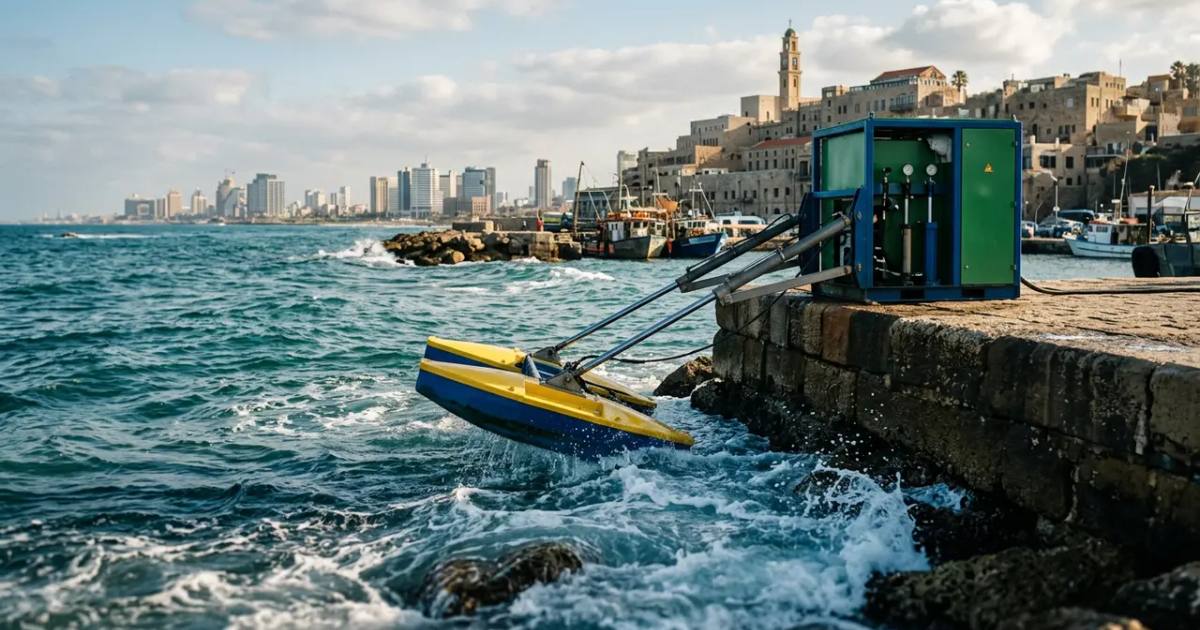
Eco Wave Power's system uses floaters positioned at existing coastal structures like breakwaters and piers, which rise and fall with incoming waves and compress hydraulic pistons in response. Those pistons push hydraulic fluid into onshore accumulators, building pressure that drives a hydraulic motor connected to a generator, producing grid-ready electricity.
Keeping the power-generation components onshore instead of underwater is the core design choice. It avoids the saltwater corrosion and maintenance-access problems that have limited earlier wave-energy technologies, since technicians can service the hydraulic system without diving equipment or marine vessels.
Where is Eco Wave Power generating power today?
Eco Wave Power's Jaffa Port installation, switched on in December 2024, is the only operating wave power plant in the Middle East, selling its output to the Israeli Electric Corporation under a power purchase agreement. Israel's Energy Ministry designated the project a "Pioneering Technology," and EDF Renewables IL co-funded the installation.
In the United States, Eco Wave Power launched its first onshore wave energy pilot at the Port of Los Angeles's AltaSea facility in September 2025, in collaboration with Shell Marine Renewable Energy, after clearing all required regulatory approvals including a federal license from the U.S. Army Corps of Engineers. January 2026 production data from the Jaffa Port site, covered in a Nasdaq press release, showed the system generated more than 2,300 kWh over 11 days with zero downtime since the start of 2025, according to founder and CEO Inna Braverman.
| Site | Status | Partner |
|---|---|---|
| Jaffa Port, Israel | Grid-connected, operating since Dec 2024 | Israeli Electric Corporation, EDF Renewables IL |
| Port of Los Angeles (AltaSea), USA | Pilot launched Sept 2025 | Shell Marine Renewable Energy |
| Portugal, Taiwan, India | Planned projects | Part of 404.7 MW global pipeline |
| Public listing | Nasdaq: WAVE | Traded as American Depositary Shares |
How big is Eco Wave Power's global project pipeline?
Eco Wave Power reports a project pipeline totaling 404.7 megawatts under development across Portugal, Taiwan, and India, in addition to its operating sites in Israel and the United States. The company was founded in Tel Aviv in 2011 by Inna Braverman and has drawn support from the European Union Regional Development Fund, Innovate UK, and the Horizon 2020 program, alongside a United Nations Global Climate Action Award.
Future commercial projects are designed around larger floaters and a greater number of units per site than the current pilot installations use, a scaling path the company says will improve capacity factors and production stability compared to today's smaller pilot arrays.
CONCLUSION
Eco Wave Power built an onshore wave-energy design specifically to avoid the maintenance costs that sank earlier offshore approaches, then proved it with a grid-connected, revenue-generating plant in Israel before taking the same technology to a Shell-backed pilot in Los Angeles. Companies tracking marine renewable energy now have a Nasdaq-listed, operating case study instead of a lab concept.
How we report: Olam stories draw on public filings, company disclosures and named sources, checked by our editors. Read our methodology · Corrections