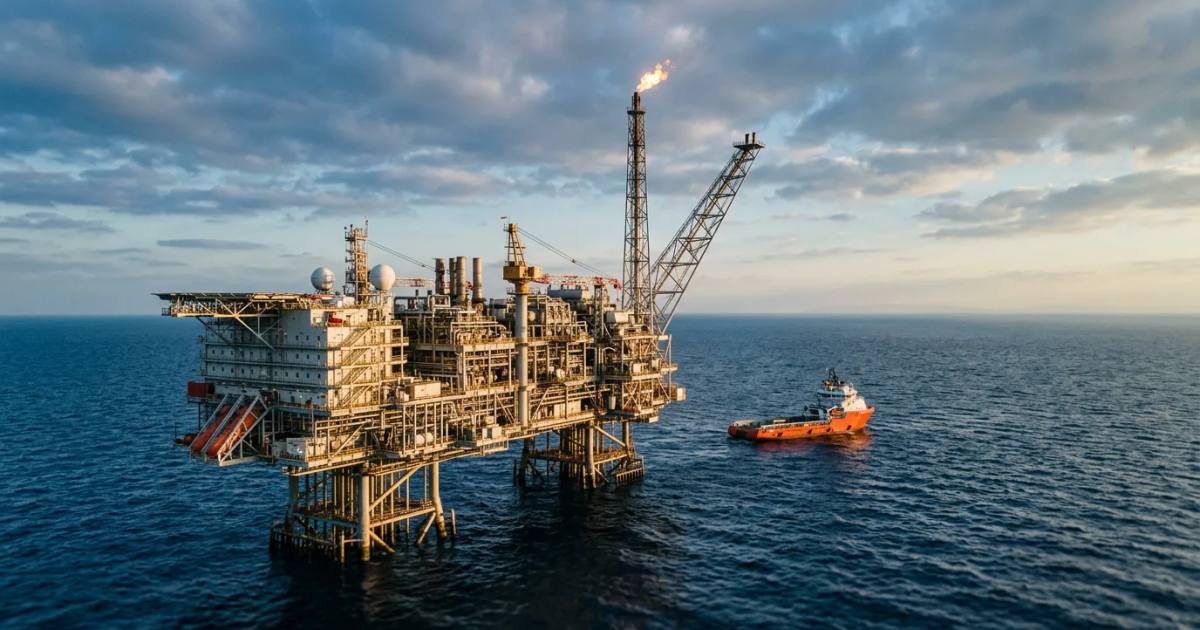

Discovered 2010. Reserves: 635 BCM. Chevron 39.66% (operator), NewMed/Delek 45.34%, Ratio 15%. Phase 1B FID: $2.36B expansion to 21 BCM/yr by 2029. Egypt contract: 130 BCM — largest export deal in Israeli history. 2025 sales: $2.23B.
635 Billion Cubic Meters — Discovered 2010, Online 2019, Valued at $18.7 Billion
The Leviathan natural gas field was discovered in December 2010 approximately 130 kilometers west of Haifa in the eastern Mediterranean Sea, at a depth of roughly 1,500 meters below the seabed. At the time of discovery, it was the largest deepwater gas find in the world in over a decade. Estimated recoverable reserves stand at approximately 635 billion cubic meters (22.4 trillion cubic feet) of natural gas — making Leviathan Israel's largest energy asset by a factor of nearly two over the Tamar field.
Leviathan came online in December 2019 under Phase 1A, with an initial production capacity of approximately 12 billion cubic meters per year. As of the January 2026 FID, the total value of the Leviathan field has been estimated at approximately $18.7 billion by co-venturer NewMed Energy. In 2025, the Leviathan partners sold approximately 10.9 billion cubic meters of natural gas and 886,000 barrels of condensate for a gross financial consideration of approximately $2.23 billion.
Chevron 39.66%, NewMed/Delek 45.34%, Ratio 15% — The Ownership Structure
Leviathan is operated by Chevron Corporation (NYSE: CVX) through its subsidiary Chevron Mediterranean Limited (CML), which holds a 39.66% working interest. NewMed Energy LP, part of Israel's Delek Group and controlled by the Tshuva family, holds the largest stake at 45.34%. Ratio Energies holds 15%.
The ownership arc reflects the broader evolution of Israeli offshore energy. Leviathan was discovered by Noble Energy, a Houston-based independent that had also found the Tamar field in 2009. Chevron acquired Noble Energy in October 2020 for $13 billion, inheriting the operated positions in both Leviathan and Tamar. The acquisition made Chevron the dominant foreign operator in the Israeli offshore — and one of the most significant American corporate stakeholders in the Israeli economy.
NewMed Energy (formerly Delek Drilling) is the Israeli partner, listed on the Tel Aviv Stock Exchange and the largest publicly traded Israeli energy company by reserves. Ratio Energies, also TASE-listed, holds the junior position.
The $2.36 Billion Phase 1B Expansion — FID January 2026, Online by 2029
In January 2026, Chevron and the Leviathan partners reached a Final Investment Decision (FID) for the Phase 1B expansion — a $2.36 billion project that will raise the field's production capacity from the current 14 billion cubic meters per year to approximately 21 billion cubic meters per year. The expansion includes drilling three additional subsea production wells, adding supplementary subsea infrastructure, and upgrading the treatment facilities on the Leviathan production platform, located approximately 10 kilometers offshore from Dor.
Phase 1B Stage 1 is expected to begin production in the second half of 2029. Plans are already in hand for a further expansion to approximately 23 billion cubic meters per year, which would require a fourth pipeline from the reservoir to the platform at an estimated additional cost of approximately $800 million.
Chevron Upstream president Clay Neff stated at the FID announcement: "Chevron is a leading energy player in the Eastern Mediterranean, where we are focused on natural gas production and exports. Our operations are critical to meeting the growing energy needs of local and regional markets."
The Third Pipeline — Phase 1A Upgrade Completed March 2026
In parallel with the Phase 1B FID, the consortium completed Phase 1A upgrades in early 2026. A third gathering pipeline from the Leviathan reservoir to the production platform was completed in March 2026, along with platform upgrades that raised the field's capacity from its original 12 billion cubic meters to approximately 14 billion cubic meters per year. The third pipeline had been delayed by the October 7 conflict — NewMed announced the suspension of construction in October 2024, with completion originally planned for mid-2025.
130 Billion Cubic Meters to Egypt — The Largest Export Deal in Israeli History
The Leviathan expansion is underpinned by a massive gas export agreement with Egypt. In August 2025, the Leviathan consortium and Blue Ocean Energy (the Egyptian offtake counterparty) signed an amended agreement for the export of approximately 130 billion cubic meters of natural gas from Leviathan to Egypt — the largest export agreement in the history of Israel.
Egypt's domestic gas production began to decline in 2022, forcing the country to abandon its ambitions to become a regional LNG export hub and instead turn to Israel as a gas supplier. The Leviathan-to-Egypt pipeline route runs through existing subsea infrastructure connecting the Israeli offshore to Egypt's national gas grid. In the first nine months of 2025, Leviathan sold approximately 8.1 billion cubic meters of gas to Israel, Egypt, and Jordan, with Egypt taking more than half of those volumes. Exports to Egypt and Jordan rose 13.4% in 2024 despite the ongoing conflict.
Israel's Natural Gas Authority has allocated 41.8% of the capacity of the planned Nitzana pipeline — a new overland gas pipeline from Israel to Egypt — to the Leviathan consortium, equivalent to approximately 175.56 billion British thermal units per day. The Nitzana pipeline will provide additional export capacity beyond the existing subsea route.
33 Days of Force Majeure — The February 2026 Iran Suspension
On February 28, 2026, Israel's Energy and Infrastructure Minister ordered Chevron to suspend operations at the Leviathan platform based on a security recommendation, amid the escalating conflict with Iran. The consortium declared force majeure. Production was paused for 33 days.
During the suspension, the project team completed the third pipeline construction and platform upgrades — converting downtime into infrastructure advancement. Chevron Mediterranean restarted the field once the Petroleum Commissioner gave clearance. NewMed stated it did not expect the suspension to have a material impact on 2026 cash flows.
The suspension demonstrated both the vulnerability and the resilience of Israeli offshore energy infrastructure. A sovereign-ordered shutdown for security reasons is a risk unique to the Israeli energy sector. The rapid restart and the consortium's ability to absorb a month of lost production without material financial damage reflect the structural cash-flow strength of the Leviathan position.
Leviathan vs. Tamar — Israel's Two-Field Offshore Architecture
Israel's offshore gas economy runs on two fields. Tamar, discovered 2009, came online 2013, and operates primarily as a domestic supply field — though it has expanded into Egyptian exports via a new 43 billion cubic meter contract signed through Blue Ocean Energy. Chevron operates both fields. Tamar's current capacity is approximately 11 billion cubic meters per year after a $673 million expansion completed in 2025–2026.
Leviathan is the larger field by reserves (635 billion cubic meters vs. Tamar's approximately 300 billion cubic meters) and by export orientation. The Phase 1B expansion will make Leviathan the primary engine of Israeli gas exports to Egypt and Jordan — and potentially to Europe via Egyptian LNG liquefaction facilities.
The two-field architecture gives Israel structural redundancy. During the February 2026 Leviathan suspension, Tamar continued to operate, maintaining domestic gas supply. The complementary positioning — Tamar as the domestic backbone, Leviathan as the export engine — is the operational logic of Israeli energy security. Both fields feed the coal-to-gas transition at Israel Electric Corporation (IEC).
SOCAR's $1.25 Billion Tamar Stake — The Azerbaijan-Israel Energy Corridor
In summer 2025, Azerbaijan's state oil company SOCAR acquired a 10% stake in the Tamar gas field for $1.25 billion. The transaction marked the first major Azerbaijani state investment in Israeli energy infrastructure and opened a bilateral corridor between Baku and Jerusalem that now extends to water (the reported Azerbaijan Investment Holding interest in IDE Technologies) as well as gas.
The SOCAR-Tamar deal and the reported AIH-IDE discussions suggest a broader strategic relationship between Azerbaijan and Israel that runs through infrastructure assets rather than defense or technology. For a Muslim-majority, Turkic-speaking country with its own complex relationship with Iran, the Israeli energy corridor offers both commercial returns and geopolitical diversification.
Why Leviathan Matters — The Energy Asset That Changed What Israel Is
Leviathan is the single most consequential economic asset in the State of Israel outside the technology sector. It is valued at $18.7 billion. It generated $2.23 billion in gross revenue in 2025. The Phase 1B expansion commits $2.36 billion in new investment through 2029. The Egypt export contract — 130 billion cubic meters — is the largest export deal Israel has ever signed in any sector.
The field also represents the most significant American corporate commitment to the Israeli economy. Chevron operates both Leviathan and Tamar, and the January 2026 FID was explicitly framed by Chevron's upstream president as a statement of confidence in the region — issued during an active war. That commitment, maintained through force majeure, platform suspensions, and Iranian escalation, is a geopolitical signal as much as a commercial one.
Leviathan transformed Israel from an energy-importing economy into a gas exporter. The Phase 1B expansion will make it a gas exporter at scale — 21 billion cubic meters per year, with 130 billion cubic meters contracted for Egyptian delivery alone. The field's production, combined with Tamar's, will cover the gas requirements for Israel's ongoing coal-to-gas electricity transition while simultaneously feeding the country's largest-ever export relationship.
From discovery in 2010 to $18.7 billion in field value and $2.36 billion in expansion FID — Leviathan is the energy asset that changed what Israel is.
Related Olam Coverage
- The Tamar Gas Field: Chevron's $673M Expansion and Israel's Domestic Energy Backbone
- Israel Electric Corporation: The State Monopoly Ending the Coal Era
- Israel's Climate and Water Economy: The Complete Map
- The Olam Climate-Tech Index 2026
- IDE Technologies
- The Accords Defense Pipeline
How we report: Olam stories draw on public filings, company disclosures and named sources, checked by our editors. Read our methodology · Corrections