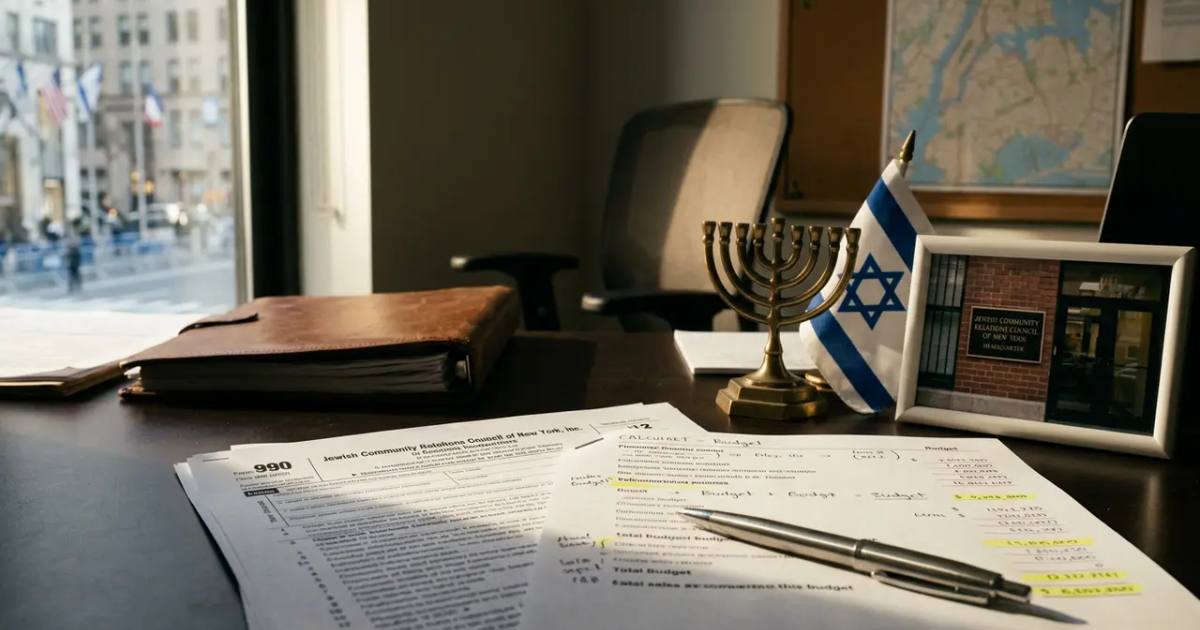

JCRC-NY coordinates New York's Jewish advocacy, security, and the Israel Day on Fifth parade. See its budget, salaries, and funding sources from IRS filings.
The Jewish Community Relations Council of New York (JCRC-NY) is the coordinating body for the New York Jewish community's relationships with government, other ethnic and religious groups, and the media. Founded in 1976, the organization reported $15.6 million in revenue and $13.5 million in expenses for the fiscal year ending June 2025, according to its IRS Form 990. Its budget has more than tripled since 2020, driven largely by security spending after October 7, 2023.
What Does JCRC-NY Actually Do?
JCRC-NY represents the organized Jewish community of the five boroughs, Nassau, Suffolk, and Westchester to elected officials and runs coalition-building programs with other communities. The organization traces its founding to 1976 as a New York State not-for-profit corporation, and it now operates from offices in Manhattan and Jericho, Long Island.
Five functions make up the bulk of its stated mission. JCRC-NY maintains a government relations operation that runs congressional breakfasts and advocacy days for elected officials at the city, state, and federal level. It runs intergroup relations work, called Shared Society, building coalitions with other ethnic, religious, and immigrant communities in the city. It coordinates Jewish communal affairs, functioning as a single voice for the roughly 200 Jewish organizations in the metro area, a role distinct from but complementary to the Conference of Presidents of Major American Jewish Organizations, which performs a similar consensus-building function at the national level for 53 member organizations. It runs Israel advocacy and education programming, including the annual Israel Day on Fifth parade. And since 2019, it has co-run the Community Security Initiative, a security coordination and grant-navigation program for Jewish institutions, jointly with UJA-Federation of New York.
JCRC-NY's own materials describe the organization as building "an inclusive communal table for diverse Jewish leadership to work together on a common agenda," alongside its stated role in ensuring "the security of the New York Jewish community in the face of rising antisemitism."
How Much Money Does JCRC-NY Raise and Spend?
JCRC-NY's revenue has nearly tripled since fiscal year 2020, rising from $4.6 million to $15.6 million by fiscal year 2025, according to IRS Form 990 filings compiled by ProPublica's Nonprofit Explorer. The growth tracks closely with the period following the October 7, 2023, Hamas attack on Israel and the subsequent rise in reported antisemitic incidents in New York.
| Fiscal Year Ending | Revenue | Expenses | Net Assets |
|---|---|---|---|
| June 2020 | $4,641,585 | $4,922,648 | $841,639 |
| June 2021 | $6,976,167 | $5,393,459 | $2,425,780 |
| June 2022 | $10,681,979 | $8,546,745 | $5,440,040 |
| June 2023 | $9,501,222 | $9,871,168 | $5,142,396 |
| June 2024 | $14,022,248 | $13,569,719 | $5,594,925 |
| June 2025 | $15,603,556 | $13,485,796 | $7,712,685 |
Contributions make up the large majority of revenue. In fiscal year 2025, contributions and grants totaled $14,267,935, or 91.4% of total revenue, with program service fees making up most of the remainder at $1,319,808. JCRC-NY states on its own site that the balance of its funding beyond core support comes from its annual Gala, foundation and corporate grants, program revenues, and individual contributions, including full board participation in giving.
Salaries and wages account for the largest share of spending. In fiscal year 2025, JCRC-NY reported $5,486,752 in salaries and wages excluding executive compensation, equal to 40.7% of total expenses, up from 31.2% the prior year. Executive compensation added another $453,996, or 3.4% of expenses. Combined, compensation consumed roughly 44 cents of every dollar JCRC-NY spent in fiscal year 2025.
Why It Works
This mechanism matters because Form 990 filings are the only mandatory public disclosure of a nonprofit's internal financial structure. The IRS requires 501(c)(3) organizations with over $200,000 in gross revenue to file the full Form 990 annually, and ProPublica's Nonprofit Explorer republishes the underlying XML data, making year-over-year comparison possible without requesting records directly from the organization.
Who Runs the Community Security Initiative, and Who Pays For It?
The Community Security Initiative (CSI) is a joint program of UJA-Federation of New York and JCRC-NY that coordinates security assessments, training, and grant access for synagogues, schools, and Jewish community centers. It launched in December 2019 as part of a $4 million security plan, according to a joint announcement by UJA-Federation and JCRC-NY.
CSI is not a private security force or an armed patrol unit. Its staff, who are employed on JCRC-NY's payroll according to the 990 compensation schedules, provide professional security consulting, coordinate with the NYPD, and help institutions navigate government security grant applications. The one instance of CSI directly funding street-level patrols was a $400,000, six-month pilot launched in September 2023 that equipped four Brooklyn civilian patrol groups, Shomrim BoroPark, Flatbush Shomrim, Williamsburg Shomrim, and Crown Heights Shmira, with vehicles ahead of the High Holidays.
CSI's funding is not exclusive to UJA-Federation. At its 2019 launch, the initiative was developed in partnership with the Paul E. Singer Foundation and donors Carolyn and Marc Rowan, alongside "several foundations," according to a PR Newswire announcement from UJA-Federation and JCRC-NY. Separately, JCRC-NY and UJA-Federation, working with the Jewish Federations of North America, helped secure government funding for Jewish institutional security nationally, including $45 million in New York State funding and a combined $50 to $60 million in federal Nonprofit Security Grant Program and State Homeland Security Program funds. That government money flows to individual institutions applying for grants; it is not JCRC-NY or UJA-Federation's own money being disbursed.
CSI's leadership compensation now exceeds that of JCRC-NY's own chief executive. In fiscal year 2025, CSI executive director Mitchell Silber received $425,000 in base compensation plus $65,878 in benefits, while JCRC-NY chief executive Mark Treyger received $275,000 in base compensation plus $8,798 in benefits, according to the organization's Form 990 Schedule J compensation disclosures.
Why It Works
This distinction matters because "joint program of UJA-Federation and JCRC-NY" describes an operational and funding partnership, not a single-funder security operation. Conflating the two overstates both UJA-Federation's direct financial responsibility and the scale of CSI's physical security footprint, when its core function is consulting, training, and grant navigation rather than deployed security personnel.
What Is Israel Day on Fifth, and What Does It Cost?
Israel Day on Fifth is JCRC-NY's annual parade in support of Israel, held along Fifth Avenue in Manhattan every spring since 1965. It is the same event that has operated under at least four names across six decades, and its funding structure has never been fully disclosed by JCRC-NY in a single public figure.
The 2025 parade drew more than 50,000 marchers, according to New York Police Department crowd data cited in JCRC-NY's own recap. The event traditionally features more than 40,000 marchers from Jewish day schools, synagogues, and youth groups, alongside floats, musicians, and government dignitaries, and has previously included the Prime Minister of Israel and delegations of Knesset members.
JCRC-NY has not published a consolidated cost figure for the parade in its public materials or its Form 990 filings, which do not break out parade expenses as a separate line item. Some funding is disclosed piecemeal through press releases. In 2025, Keren Kayemeth LeIsrael-Jewish National Fund allocated $100,000 to the parade, its first disclosed contribution to the event, according to the Jewish Telegraphic Agency. UJA-Federation of New York is named as a supporting partner in JCRC-NY's own event announcements, though no specific dollar figure has been disclosed publicly. Security costs, which JFeed reported as extensive in 2025 given hundreds of deployed NYPD officers, are borne by the city rather than JCRC-NY.
Why It Works
The absence of a disclosed line-item cost matters because parade expenses at this scale, street closures, staging, security coordination, marketing, and vendor contracts, typically run into the hundreds of thousands of dollars for comparable New York City parades of similar size. Without a disclosed figure from JCRC-NY, any total remains an estimate rather than a sourced number, and a transparent accounting would let donors and outside observers compare the parade's cost against JCRC-NY's other program spending.
From the Youth Salute to Israel Parade to Israel Day on Fifth
The parade now called Israel Day on Fifth has carried at least five names since its founding, and each name marks a distinct organizational and political moment rather than a simple rebrand. Readers searching for the event under an older name are searching for the same organization and the same annual march.
The event originated in 1964 as the Youth Salute to Israel Parade, a march organized by Ted Comet, Haim Zohar, Charles Bick, Alvin Schiff, and Dan Ronen from the Manhattan Day School to a Broadway theater, according to a history published by JEWISHcolorado and corroborated by the Jewish Link. The following year, on May 2, 1965, organizers staged the first full-scale event under the name Salute to Israel Day Parade, moving the route to Fifth Avenue between 57th and 74th Streets, the same route the parade follows today. Early press and some community organizations also referred to it simply as the Salute to Israel Parade or the Israeli Day Parade, names that appear interchangeably in coverage through the 1970s and 1980s, according to CUNY's NYCdata archive.
Attendance grew sharply in the parade's first two decades. More than 150,000 spectators and 75,000 marchers attended in 1971, when participants marched with shackled wrists raised to highlight the treatment of Jews in the Soviet Union, according to Wikipedia's sourced parade history. By 1977, an estimated 300,000 spectators watched 75,000 marchers proceed from 57th Street up Fifth Avenue and across 86th Street. The parade was canceled once, in the aftermath of the September 11, 2001, attacks, and returned the following year to its largest attendance yet, more than 100,000 marchers and 750,000 spectators, according to the Jewish Link's account of three generations of one marching family.
JCRC-NY assumed management of the parade in 2011, and the event was renamed the Celebrate Israel Parade that same year. It ran under that name for over a decade, including a two-year shift to a virtual format during the COVID-19 pandemic before returning to Fifth Avenue. In 2024, JCRC-NY renamed the event Israel Day on Fifth, a change made explicitly to keep attention on the Israeli hostages held in Gaza following the October 7, 2023, attack, according to JCRC-NY's own program page. The 2024 theme was "One People, One Heart," focused on the New York Jewish community's connection to Israel and the hostages; the 2025 theme was "HaTikvah, The Hope."
No trademark registration for "Israel Day on Fifth" or any of its predecessor names, including Salute to Israel Parade, Salute to Israel Day Parade, or Celebrate Israel Parade, was identified in available public records. The pattern of repeated renaming across six decades is itself evidence against the name functioning as a protected brand asset; a trademarked name would typically be defended and retained rather than replaced.
Who Sits on JCRC-NY's Board, and Are They Paid?
JCRC-NY's board and officers serve without compensation. President Bennett Golub, Board Chair Cheryl Fishbein, and the organization's approximately 60 board members are each listed with $0 in reportable compensation in the fiscal year 2025 Form 990, consistent with standard nonprofit governance practice in which oversight roles are unpaid and operational roles are salaried.
Leadership of the organization has changed hands twice in five years. Michael S. Miller served as executive vice president and CEO through fiscal year 2022, compensated at $127,686 in his final partial year in that role as Gideon Taylor transitioned in as executive vice president and CEO at $150,000. Taylor's compensation rose to $300,000 by fiscal year 2023 and $211,666 by fiscal year 2024 in a listed role of "Executive VP & CEO," before Mark Treyger took over as CEO, reporting $275,000 in fiscal year 2025.
What Changed at JCRC-NY After October 7?
JCRC-NY's spending pattern shifted measurably in the two fiscal years following the October 7, 2023, attack. Revenue rose from $9.5 million in fiscal year 2023 to $15.6 million in fiscal year 2025, a 64% increase in two years, compared to roughly 105% growth across the prior three years combined. Salary spending as a share of the budget rose from 36.9% in fiscal year 2023 to 40.7% in fiscal year 2025, and the Community Security Initiative's leadership compensation grew to exceed that of the organization's own chief executive for the first time in the filings reviewed.
The Anti-Defamation League's 2022 Audit of Antisemitism in America identified Brooklyn as a concentrated site of physical assaults against Jews, a finding cited directly by JCRC-NY and UJA-Federation in announcing the 2023 Shomrim patrol funding. That pattern of donor and institutional reallocation toward physical security, rather than toward the organization's older core functions of government liaison and intergroup coalition-building, is the clearest throughline connecting JCRC-NY's pre- and post-October 7 filings. UJA-Federation's own FY2025 filing shows a parallel pattern at much larger scale, reporting $275.8 million in total grant expense, including sums directed to organizations whose positions on Israel policy diverge sharply from JCRC-NY's own advocacy stance. A separate audit of the 53 Conference of Presidents member organizations found 62% oppose the Trump and Netanyahu administrations, underscoring how much political range exists among the national and local bodies JCRC-NY coordinates with.
Is Israel Day on Fifth Politically Contested Within the Jewish Community?
Yes. The parade's framing has drawn public disagreement from within the New York Jewish community itself, particularly regarding how much political diversity the event should reflect. A 2026 opinion piece in the Jewish Telegraphic Agency argued that the parade should make room for marchers who support Israel's existence while also criticizing its current government's policies, rather than projecting what the piece characterized as false unity. The same piece specifically cited settler violence and displacement in the West Bank, the war in Gaza, and domestic Israeli political disputes as issues some Jewish New Yorkers want represented rather than papered over.
JCRC-NY has not publicly responded to calls to restructure the parade's political framing as of this writing. The organization's own materials describe the event's purpose as showcasing "love and support for Israel and its people and culture" and unity around the release of hostages held in Gaza, a framing distinct from the pluralistic model proposed by parade critics.
Frequently Asked Questions
Does UJA-Federation fully fund JCRC-NY's Community Security Initiative?
No. CSI is a joint program of UJA-Federation and JCRC-NY, funded by a mix of UJA-Federation contributions, named private donors including the Paul E. Singer Foundation and Carolyn and Marc Rowan, and government grants that flow to individual institutions rather than through JCRC-NY directly.
Is "Israel Day on Fifth" a trademarked name?
No trademark registration for "Israel Day on Fifth" or its prior names was identified in available records. The event has carried at least five names since 1964, which is consistent with a program name rather than a registered brand asset.
How much does JCRC-NY pay its CEO?
JCRC-NY CEO Mark Treyger received $275,000 in base compensation plus $8,798 in benefits in the fiscal year ending June 2025, according to the organization's Form 990.
Was the Celebrate Israel Parade renamed?
Yes. JCRC-NY renamed the Celebrate Israel Parade to Israel Day on Fifth in 2024, following the naming pattern of the event's earlier eras as the Youth Salute to Israel Parade in 1964 and the Salute to Israel Day Parade beginning in 1965.
Does JCRC-NY cover Long Island?
Yes. JCRC-NY operates a separate regional office, JCRC-Long Island, covering Nassau and Suffolk counties from offices in Syosset, in addition to its Manhattan headquarters covering the five boroughs and Westchester.
How does JCRC-NY's funding compare to UJA-Federation's?
JCRC-NY reported $15.6 million in revenue for fiscal year 2025, a fraction of UJA-Federation of New York's $350.5 million in revenue and $275.8 million in grants for the same period, reflecting UJA-Federation's role as the metro area's largest Jewish philanthropic funder and JCRC-NY's role as one of its grantee and partner organizations.
How does JCRC-NY differ from the Conference of Presidents?
JCRC-NY is a regional body representing the New York metro area's Jewish community to local and state government, while the Conference of Presidents of Major American Jewish Organizations is a national umbrella body representing 53 member organizations to the federal Executive Branch, founded in 1955.
How we report: Olam stories draw on public filings, company disclosures and named sources, checked by our editors. Read our methodology · Corrections