
Israel moved most cannabis prescribing into its HMOs on April 1, 2024. Separately, a 165% tariff on Canadian imports was vetoed, upheld by courts, and reopened in August 2026; as of Oct 1 the commissioner was weighing narrowing the probe.
Israel's Ministry of Health shifted medical cannabis prescribing for most conditions from a special Ministry-issued license into the country's public health fund system on April 1, 2024, cutting bureaucracy but triggering a slow decline in active patient licenses. The reform coincided with a separate, unresolved fight over Canadian cannabis imports, where Israel's own trade commissioner recommended tariffs as high as 165% in 2024, only to see the country's finance minister block the levy, courts uphold that block, and a fresh investigation open in mid-2026 that was still running as of October 1.
How did Israelis get medical cannabis before the reform?
Before April 2024, patients needed a formal license issued through the Ministry of Health's Medical Cannabis Unit, known in Hebrew as Yakar, a process that ran outside Israel's public health fund system entirely, according to a patient guide compiled by Cannabisrael. The number of active licenses had grown from 3,097 in 2011 to a peak of 140,483 in January 2024, an increase of more than 4,400%, according to a longitudinal review of monthly Israeli Medical Cannabis Unit reports published in the Journal of Cannabis Research.
What exactly changed on April 1, 2024?
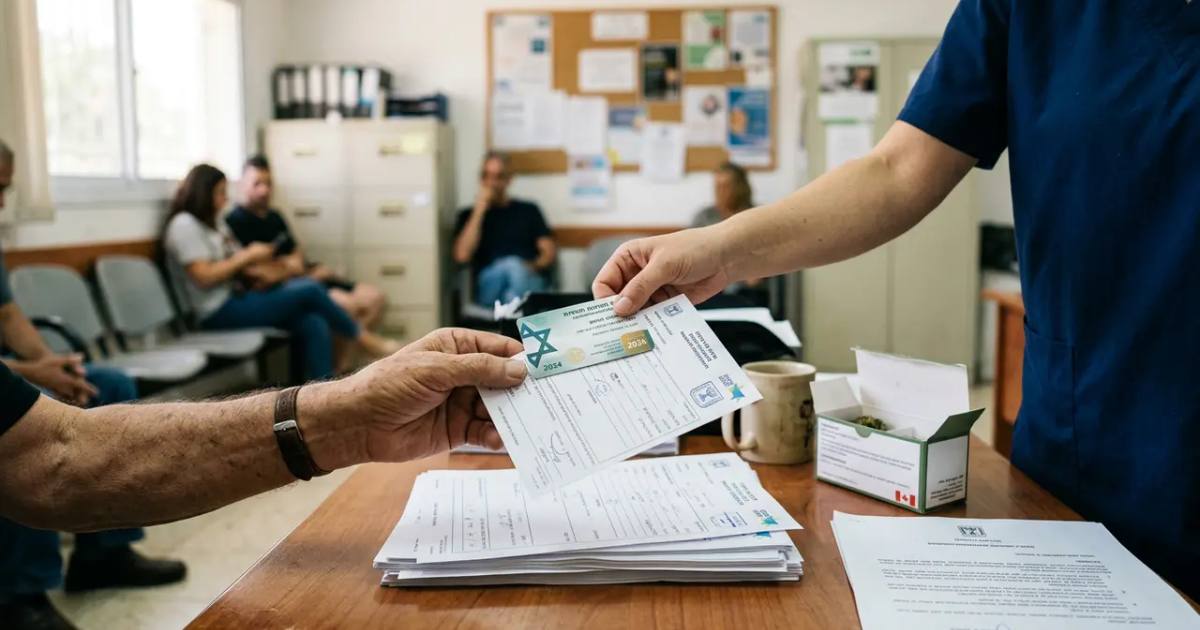
Israel's Ministry of Health announced the reform on August 7, 2023, but its implementation was delayed three months by the Israel-Hamas war before taking effect April 1, 2024, according to IM Cannabis Corp's own statement welcoming the change. The reform moved prescribing authority for most medical indications to physicians inside Israel's health maintenance organizations, the HMOs that cover the majority of the population, ending a system in which cannabis could not be prescribed through the HMOs at all.
Chronic non-cancer pain and post-traumatic stress disorder remained under the Ministry's direct licensing authority rather than moving to the HMOs, according to a patient guide published by Cannabisrael. For nearly every other approved indication, including cancer-related conditions, Crohn's disease, dementia, autism, multiple sclerosis and HIV, HMO physicians gained authority to issue a prescription directly, treating cannabis as a first-line clinical option rather than a last resort requiring special Ministry sign-off, according to IM Cannabis Corp's statement.
Why did the government make this change?
The Ministry of Health's stated goal was to increase the medical autonomy of treating specialist physicians and reduce the bureaucratic burden on both patients and doctors, according to Cannadelics' coverage of the reform's announcement. Dr. Ofir Levon, chairman of the Israeli Society of Toxicology within the Medical Association, told the Israeli publication Maariv that the change should make the patient-doctor dialogue more effective by letting physicians offer treatment without excessive preconditions.
What happened to patient numbers after the reform?
Active medical cannabis licenses and prescriptions declined by 7.5% from their January 2024 peak of 140,483 to 129,900 by March 2025, according to the Journal of Cannabis Research's analysis of Ministry of Health data. In a single reported month, Israeli pharmacies and dispensaries processed more than 302,000 approved flower packages against that patient base, according to trade analysis platform GrowerIQ, indicating that per-patient consumption or dispensing frequency, not just the raw patient count, shapes the market's real size.
What is the fight over Canadian cannabis imports?
Israel's Commissioner for Trade Levies, Danny Tal, opened an anti-dumping investigation into Canadian medical cannabis imports in November 2024, calculating dumping margins for individual Canadian exporters that ranged from 63% up to 554%, according to reporting compiled by the MedBud community forum citing Cannabis Magazine. Tal recommended a blanket 165% levy on Canadian imports for four years, and Israel's Economy Minister Nir Barkat agreed to adopt that recommendation.
Israel's Finance Minister Bezalel Smotrich blocked implementation in April 2025, citing insufficient time to review the decision and risk to prices, competition and patients, according to the same reporting. Israel's own Attorney General ruled against the levy as well, and Israeli growers who challenged the block at the Jerusalem District Court had their petition rejected in December 2025.
Danny Tal opened a new investigation on June 29, 2026, following a complaint filed by Israeli growers Evergreen Solomon Pharma and Trichome Ltd., who together claimed to represent approximately 80% of local growers not engaged in importing, according to StratCann. That investigation was closed on procedural grounds in late July 2026 after Tal's office failed to notify Canadian authorities before going public. Israel notified Canada on August 2 and reopened the case publicly on August 5, 2026, with a foreign exporter questionnaire due by September 7, 2026, according to StratCann's follow-up coverage. The notice names eleven Canadian exporters, including Tilray, Aurora, Organigram, Cronos, Canopy and Decibel.
Why does the tariff fight keep collapsing and restarting?
The new investigation avoids the same procedural chokepoint that killed the original levy: rather than relying on the advisory committee, economy minister, finance minister and Knesset Finance Committee approval chain that gave Smotrich his veto point, Tal can impose a provisional duty on his own authority once 60 days have passed since a formally reopened investigation, according to the MedBud forum's reporting. Tal has used that provisional-duty mechanism before, imposing a duty between 61% and 146% on Chinese aluminum profile imports in May 2025 while that separate investigation was still running. Six weeks later the average rate on that duty was cut to 37% after Smotrich pressed for it to be scrapped, which suggests a provisional duty is not fully insulated from the finance minister politically.
Canadian companies exported 40,203 kilograms of cannabis to Israel in 2025 and 33,640 kilograms in the first five months of 2026 alone, worth approximately $23.1 million, according to StratCann, figures that represent roughly 7% of total Canadian cannabis exports by weight in early 2026 even though Israel consistently ranks among Canada's top 10 export destinations. Eighteen established Israeli cannabis companies, including Tikun Olam, Bazelet Pharma and Panaxia, have closed farms, halted production or entered insolvency since the original 2024 investigation, according to reporting compiled by MMJ Daily, though some of those closures stemmed from causes unrelated to Canadian competition.
Where does the investigation stand now?
As of October 1, 2026, no duty had been imposed. StratCann reported that in a September memo Tal said he is considering limiting the investigation to a smaller sample of producers, because 32 companies could be involved, 21 of which provided details and 13 of which exported during the inquiry period. Canadian companies were asked to submit positions on the selection method by October 6, with a consultation meeting on October 7, 2026. The 60-day mark for a possible provisional duty, counted from the August 5 reopening, passed in early October, and Olam found no report of one being imposed as of that date.
What should readers track next?
Readers should watch whether Tal invokes the provisional-duty mechanism directly, since doing so would bypass the finance-minister veto point that killed the original 2025 levy, and how the final list of sampled Canadian producers is set. A final decision may also land with a new Israeli government rather than the current one, depending on the timing of the country's elections. Readers should also watch whether the patient-license decline documented in the Journal of Cannabis Research's data continues, stabilizes, or reverses as the HMO-led prescribing system matures.
Related on The Olam
- How Israel Built and Then Lost Its Cannabis Export Lead
- Israel's Cannabis Consolidation: Who Survived, Who Didn't
How we report: Olam stories draw on public filings, company disclosures and named sources, checked by our editors. Read our methodology · Corrections