
The EastMed pipeline would carry Israeli gas to Europe via Cyprus and Greece. The US pulled support in 2022, but the three countries revived the project at a December 2025 summit.
The Israel-Cyprus-Greece gas corridor centers on the EastMed pipeline, a proposed 1,900-kilometer undersea route carrying 9 to 12 billion cubic meters of gas annually from Israel's offshore fields to Europe. The US withdrew support in 2022 over cost and feasibility concerns, but Israel, Greece, and Cyprus renewed their commitment to the project at a December 2025 trilateral summit in Jerusalem.
What is the EastMed pipeline and what does it carry?
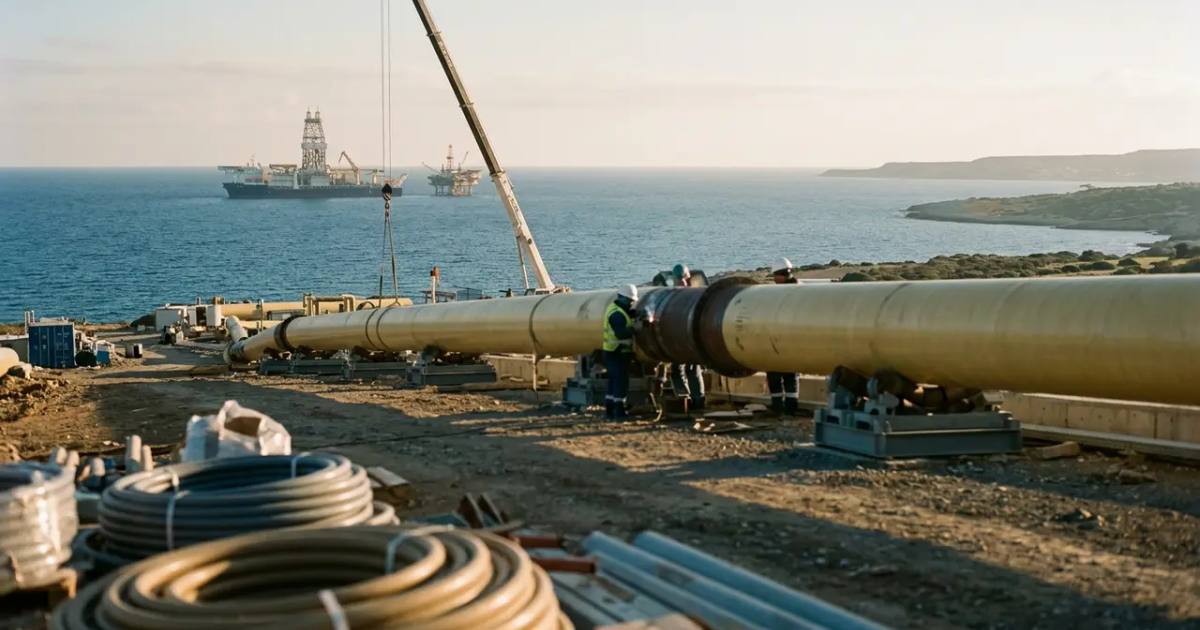
The EastMed pipeline is a proposed 1,900-kilometer offshore and onshore natural gas pipeline connecting Israel's Leviathan gas field to Cyprus, the Greek island of Crete, and mainland Greece, according to Global Energy Monitor's project documentation. From Greece, a connected Poseidon pipeline would carry the gas further to the Italian coast.
The pipeline's designed capacity is 9 to 12 billion cubic meters of gas per year, drawing from Israel's Leviathan and Tamar fields plus Cyprus's Aphrodite gas field, according to reporting on the January 2020 signing ceremony in Athens. Greek Prime Minister Kyriakos Mitsotakis, Israeli Prime Minister Benjamin Netanyahu, and then-Cyprus President Nicos Anastasiades attended that signing, which set an estimated project cost near $7 billion.
IGI Poseidon S.A., a joint venture between Greece's DEPA International Projects and Italy's Edison S.p.A., part of the EDF Group, is developing the pipeline, according to Global Energy Monitor's ownership records. Israel's broader energy infrastructure, including its ports and export corridors, is mapped in Olam's Ports & Logistics coverage.
Why did the United States withdraw support for the EastMed pipeline?
The United States withdrew its backing for the EastMed pipeline in January 2022, citing economic and environmental concerns about the roughly $6 billion project, according to the Washington Institute's policy analysis at the time. The European Union had already begun shifting away from oil and gas infrastructure investment as part of its broader climate policy, reducing EastMed's available funding sources.
Analysts had long questioned the pipeline's commercial viability given its length, depth, and the seismic complexity of the Eastern Mediterranean seabed, a concern the Washington Institute's 2022 analysis noted predated the formal US withdrawal.
What changed to revive the project in December 2025?
Israel, Greece, and Cyprus renewed their commitment to the EastMed project at the 10th Tripartite Summit, held in Jerusalem in December 2025, according to reporting by Al Majalla. Israeli Prime Minister Benjamin Netanyahu hosted Greek Prime Minister Kyriakos Mitsotakis and Cypriot President Nikos Christodoulides for the meeting.
The three leaders framed the revival partly around countering Turkish influence in the Eastern Mediterranean and partly around advancing the India-Middle East-Europe Economic Corridor (IMEC), a route that passes through the UAE, Saudi Arabia, Jordan, and Israel before reaching Cyprus and Greece, according to Al Majalla's coverage of the summit. That corridor connects to Olam's coverage of Abraham Accords trade corridors. The Tripartite Summit format itself dates to 2016, when Eastern Mediterranean gas discoveries first drew Israel, Greece, and Cyprus into closer coordination.
The EastMed project retains its EU "Project of Common Interest" designation, a status that qualifies it for fast-tracked permitting and EU funding, with the European Commission renewing that designation annually and more than 35 million euros already disbursed toward preliminary studies, according to the Global Oil and Gas Exit List's project tracking.
What does the gas corridor mean for Israel's regional energy position?
The corridor positions Israel as a potential gas supplier to Europe at a moment when the EU has sought to diversify away from Russian energy supply, a strategic motivation that predates the Ukraine war but intensified after it. Egypt and Israel have both increased gas production since the early 2000s, with additional Cypriot production possible starting in 2027, according to the Arab Center Washington DC's regional gas analysis.
Turkey's exclusion from the East Mediterranean Gas Forum, the multilateral body established in 2020 by Cyprus, Greece, Israel, Egypt, and other regional producers, has made the EastMed corridor as much a geopolitical alignment tool as an energy project. Whether the pipeline reaches a final investment decision remains uncertain given its history of stalled timelines, but the December 2025 summit signals renewed political will behind a project the US and EU had both effectively shelved three years earlier.
How we report: Olam stories draw on public filings, company disclosures and named sources, checked by our editors. Read our methodology · Corrections