
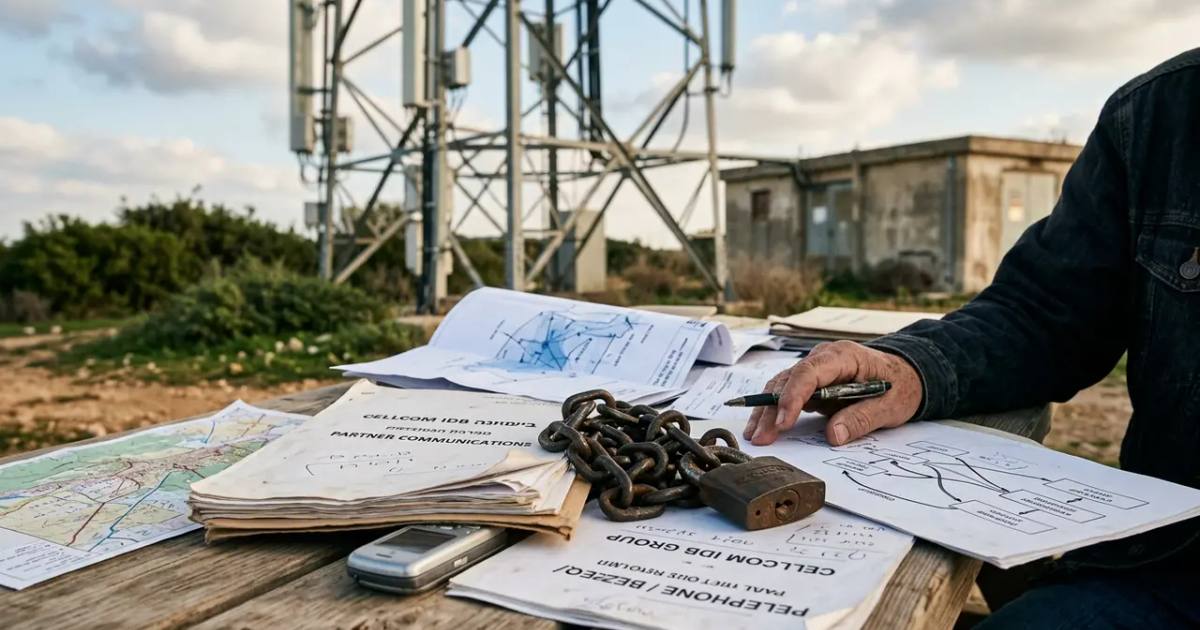

Pelephone is a Bezeq subsidiary. Cellcom sits under the IDB group. Partner has changed hands three times — most dramatically when Haim Saban walked away rather than repay a $300 million debt. The ownership map of Israeli mobile.
The Entities | Olam.business
Israel's three major mobile carriers have wildly different ownership stories, and one of them reads like a corporate thriller. Pelephone is a wholly owned subsidiary of Bezeq. Cellcom is controlled by a listed holding company. Partner Communications has changed controlling shareholders at least three times in under two decades, most dramatically when Hollywood mogul Haim Saban walked away from his stake rather than repay a $300 million debt.
Who owns Pelephone?
Pelephone, Israel's first mobile network, launched in 1986 as a joint venture between Motorola and Israeli defense contractor Tadiran, after Motorola won the contract to build the country's first mobile phone network in 1983. Bezeq, the former state telecom monopoly, acquired 50% of Pelephone in 1994 and bought out Motorola's remaining stake in 2004 to become sole owner. Pelephone remains a wholly owned Bezeq subsidiary today, serving roughly 2.6 million customers with about ₪1.98 billion in 2023 revenue.
Who owns Bezeq itself?
Bezeq (TASE: BEZQ), founded in 1984, was fully state-owned until a mid-2000s privatization and today trades publicly, with major shareholders including B Communications Ltd. (roughly 15.9%), alongside institutional holders Clal Insurance, Migdal, and Harel. B Communications' controlling position traces to a 2020 transaction led by Searchlight Capital Partners and the Forer family, with Tomer Raved — who led that acquisition — appointed CEO of B Communications and later chairman of the Bezeq group in January 2024. Bezeq wholly owns Pelephone, Bezeq International, and the Yes satellite-TV service, which it bought outright for ₪680 million in 2015.
Who owns Cellcom?
Cellcom, which holds roughly a third of the Israeli wireless market, went public on the Tel Aviv Stock Exchange in February 2007. Its controlling shareholder is Discount Investment Corporation, part of the IDB conglomerate, which holds roughly 47% of Cellcom's shares.
Who owns Partner Communications, and why has control changed hands so often?
Partner Communications (operating as Orange Israel until 2016) was founded in 1999 by a consortium of Hutchison Telecommunications, Elbit, and Eurocom. Control first consolidated under Ilan Ben-Dov's Scailex Corporation, which held 51% by 2009. In 2013, Ben-Dov sold his 30.7% stake to Hollywood producer and media investor Haim Saban's S.B. Israel Telecom for NIS 250 million, plus another 2% bought from Bank Leumi for NIS 83 million — Saban's second run at Israeli telecom after an earlier 2005-2010 investment in Bezeq itself alongside Apax Partners. Saban's Partner bet went badly: by 2019 he was roughly NIS 500 million underwater, and in November 2019 his holding company issued a formal default notice on a $300 million loan from Hutchison-linked lender Advent, secured against his Partner shares. Rather than repay, Saban relinquished control, and Hutchison — Partner's original 1999 co-founder — moved to reclaim it through receivership, a reversal that drew added scrutiny given rising US pressure at the time to limit Chinese and Hong Kong-linked involvement in Israeli infrastructure.
How did discount entrants like Golan Telecom disrupt the ownership economics?
The controlling shareholders' financial stress in this sector traces to a specific regulatory moment: the 2012 arrival of discount challengers Golan Telecom and HOT Mobile, offering unlimited plans for roughly NIS 89-99 a month against legacy pricing several times higher. Golan signed 9,000 new subscribers in two days alone — more than Cellcom added in an entire quarter at the time. Because Ben-Dov, Elovich (Bezeq's then-controlling shareholder), and Cellcom's owners had bought their stakes with borrowed money against the expectation of steady high-margin dividends, the regulator-driven price collapse hit the leveraged owners far harder than it hit the carriers' underlying operations — a dynamic that set up the ownership churn that followed at both Partner and, indirectly, across the sector's capital structure for the following decade.
What does this ownership pattern say about Israeli telecom?
All three carriers sit inside a market structure where control is corporate and financial rather than founder-driven: no carrier is run by the engineer or entrepreneur who built it, and control has moved repeatedly through debt-driven acquisitions, price wars, and holding-company maneuvering rather than organic growth. Notably, Elbit — the Israeli defense contractor now controlled by the Federmann family and profiled separately by Olam — was one of Partner's three founding shareholders in 1999, though it exited its telecom stake long before the Ben-Dov and Saban eras began; the defense company's brief foray into consumer telecom is largely forgotten next to its aerospace and land-systems businesses today. Bezeq's Pelephone remains the most stable arrangement — full ownership by a single parent since 2004 — while Partner's ownership history reads as a case study in how leveraged control positions in a heavily regulated, price-capped sector can collapse when a discount-price shock and a debt covenant arrive at the same time.
Key Facts
- Pelephone: wholly owned by Bezeq since 2004; originally a 1994 Bezeq-Motorola joint venture
- Bezeq: controlled by B Communications (~15.9%), led by chairman Tomer Raved since 2024
- Cellcom: controlled by Discount Investment Corporation (~47%), part of the IDB group
- Partner Communications: founded 1999 (Hutchison/Elbit/Eurocom); controlled by Ben-Dov (2009-2013), then Haim Saban (2013-2019), then reverted toward Hutchison-linked control via 2019-2020 receivership
- 2012 disruption: Golan Telecom and HOT Mobile's discount entry destabilized all three legacy owners' leveraged dividend expectations
Sources
Wikipedia, Pelephone; Wikipedia, Bezeq; Wikipedia, Tomer Raved; Wikipedia, Partner Communications; Globes, Saban relinquishes control of Partner; Haaretz, 2012 discount-carrier price war; Olam, Elbit Systems: Israel's Largest Defense Company.
The Olam Editorial Team | The Entities
How we report: Olam stories draw on public filings, company disclosures and named sources, checked by our editors. Read our methodology · Corrections