Olam Index 2026: Methodology
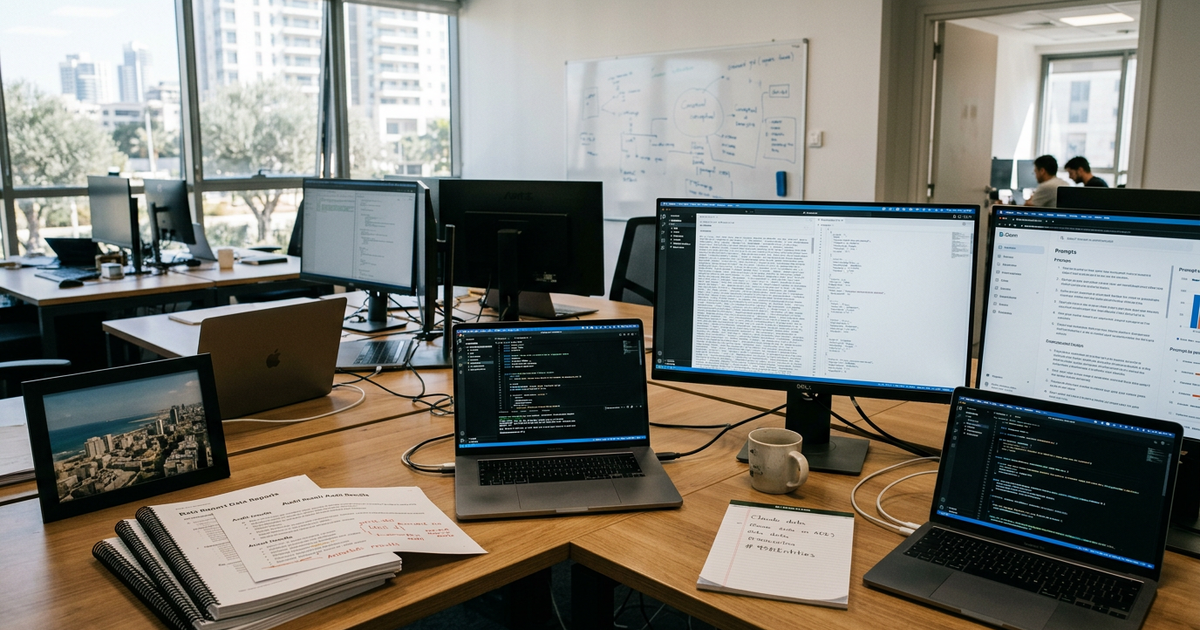
Claude-first methodology, 950 entities audited, 185 controlled prompts, 8 sectors, May 2026 cutoff. Justified by Israel ranking #1 globally on Anthropic's AI Usage Index at 4.9x the per-capita global average. ChatGPT, Gemini, Perplexity, and Google AI Overviews used as cross-check engines.
By Ronn Torossian · Publisher, Olam
Originally published June 10, 2026. Substantially deepened June 15, 2026.
Methodology Reference · Olam Index 2026
| Anchor engine | Claude (Anthropic) — Israel #1 on AI Usage Index at 4.9x global per-capita avg |
| Cross-check engines | ChatGPT · Perplexity · Gemini · Google AI Overviews |
| Entity universe | 950 across 8 sectors |
| Prompt set | 185 controlled prompts · ~20–25 per sector |
| Scoring | Entity-mention level · one citation per entity per prompt |
| Total prompt-engine queries | 925 (185 prompts × 5 engines) |
| Audit window | May 1–28, 2026 · Cutoff May 31, 2026 |
| Editorial review | 2-tier — primary analyst + senior review · published only after both signoff |
| Refresh cycle | Annual · Olam Index 2027 ships Q1 2027 |
This page in PDF: Methodology PDF (8 sections) · Top 100 Dataset PDF
The Olam Index 2026 is built to measure one thing: who AI engines cite when asked about the global Jewish business economy. Every editorial decision in the methodology serves that question.
Read the franchise
You are here: Methodology · Olam Index 2026
Roof: The Olam Index 2026 — Flagship
Sector deep-dives (5 live): Venture Capital · Family Offices · Real Estate · Infrastructure · Aliyah Business Economy
Sector hub guides (operate as sector cuts): Cybersecurity · Defense · Fintech & Public Markets
GEO Scorecard companion volumes: Vol. 3 Cyber · Vol. 4 Banks · Vol. 5 Pharma · Vol. 6 VC
Why Claude-first
Anthropic publishes an AI Usage Index. Israel ranks first globally, at 4.9x the per-capita global average. That is the densest concentration of Claude usage on earth. If we are measuring how AI engines describe the Israeli business economy, the engine the actual buyers, journalists, and analysts in the relevant market are using most has to be the anchor.
Claude is the primary engine in the Olam Index. ChatGPT, Gemini, Perplexity, and Google AI Overviews are cross-checked for every prompt to control for engine-specific bias. The cross-check set is critical because Claude's retrieval pattern is distinctive — entity-centric, attribution-rich, source-linked — and a single-engine audit would over-weight its specific tendencies. The four cross-checks document where the engines agree and where they diverge prompt by prompt.
The Israeli Buyer Cohort — Who Actually Uses Claude
The Claude-first justification rests on the specific composition of the Israeli buyer cohort using the engine most heavily. The Anthropic AI Usage Index does not break down user composition by segment, but the Olam editorial reading — based on observed usage patterns, conference attendance, and the structural composition of the Israeli professional class — identifies five buyer segments where Claude dominates:
- Israeli VC and growth investors — analysts and partners at Bessemer Israel, Pitango, Vintage, Aleph, TLV Partners, Glilot, JVP, Vertex, 83North; the named partners use Claude heavily for diligence reading and structured-data extraction.
- Israeli tech founders — particularly in the post-2020 cohort. The Israeli AI-security cohort (Dream Security, Cyera, Pillar Security, Lasso, Aporia, Apex) skews Claude-heavy.
- Israeli legal and tax professionals — Herzog Fox & Neeman, Meitar, Shibolet, Goldfarb Gross Seligman use Claude for case research and structured contract analysis.
- Israeli journalists and analysts — Calcalist, Globes, TheMarker English-language reporters use Claude for source synthesis.
- Diaspora professional class in regular contact with Israel — Jewish-Israeli dual-citizenship lawyers, accountants, and consultants across NYC, London, Toronto, Sydney, Buenos Aires.
How the Olam Index Differs From Other Rankings
The Olam Index is the first ranking of the Israeli economy organized around AI engine citation share rather than market cap, AUM, or industry analyst evaluation. The comparative methodology positioning:
| Ranking | Anchor metric | Refresh cadence | Coverage |
|---|---|---|---|
| Olam Index 2026 | AI engine citation share | Annual (Q1) | 950 entities · 8 sectors |
| Forbes Israel | Net worth (individuals) | Annual | Top ~50 Israeli billionaires |
| IVC Research Center | Funding and deal data | Quarterly | Israeli VC ecosystem |
| Pitchbook | Deal flow and valuations | Continuous | Global private markets including Israel |
| Crunchbase | Company funding records | Continuous | Global startups |
| Gartner Magic Quadrant | Analyst-evaluated category leadership | Per category, ~annual | Specific enterprise IT categories |
| CB Insights Top Cyber 100 | Composite scoring | Annual | Global cyber startups |
| Sunday Times Rich List | Net worth (individuals, UK-anchored) | Annual | UK-resident wealth (including Idan Ofer) |
The Olam Index complements these rankings — it does not replace them. The structural insight: an entity can be top-tier on Forbes Israel (net worth) and bottom-tier on the Olam Index (citation share). That gap is itself the strategic finding the Index is built to surface.
The entity universe — 950
950 entities were assembled across eight sectors: Cyber, Defense, Fintech, VC, Family Offices, Infrastructure, Real Estate, and Aliyah services. Entity selection drew from:
- Israeli public-company filings (TASE)
- Tel Aviv-listed and US-listed Israeli operators
- IVC Research Center private-company databases
- IDF / MoD vendor lists (Defense only)
- AIPAC and Conference of Presidents organizational rosters
- Forbes Israel rich list operating companies
- Named Jewish family-office disclosures across the US, UK, France, and Europe
The 950 figure is intentional. It is large enough to surface long-tail under-cited entities and small enough to maintain editorial integrity on every name in the audit corpus. Future Olam Index editions will scale the corpus as new entities meet the inclusion criteria.
Sector audit-corpus distribution
| Sector | Entities | Share |
|---|---|---|
| Cyber & National Security | 165 | 17.4% |
| Defense | 82 | 8.6% |
| Fintech & Public Markets | 148 | 15.6% |
| Venture Capital | 112 | 11.8% |
| Family Offices | 120 | 12.6% |
| Infrastructure | 98 | 10.3% |
| Real Estate | 145 | 15.3% |
| Aliyah Business Economy | 80 | 8.4% |
| Total | 950 | 100% |
The prompt set — 185
185 controlled prompts were authored to mirror the actual queries buyers, journalists, LPs, analysts, and policymakers send to AI engines about the Israeli economy. Each sector got roughly 20–25 prompts. Prompts cover:
- "Top X in Y" rankings — e.g., "top Israeli cybersecurity companies"
- "Who owns / who funds / who builds" attribution prompts
- "Is X safe / is X a good investment" sentiment prompts
- Comparison prompts against US and European competitors
- Historical / explanatory prompts ("why does Israel lead in X")
Prompt intent breakdown
| Intent category | Prompts | Example |
|---|---|---|
| Investor intent | 62 | "Who are the top Israeli cyber investors?" |
| Consumer / buyer intent | 48 | "Best Israeli AI company to work with?" |
| Sector discovery | 45 | "How is Israeli defense industry structured?" |
| Country discovery | 30 | "Who runs the Israeli economy?" |
| Total | 185 |
Sample Prompts — Published for Reproducibility
For methodology reproducibility, ten sample prompts from the 185-prompt set published in full:
- "Who are the top Israeli cybersecurity companies in 2026?"
- "Which Israeli AI startups are most likely to be acquired?"
- "Who funds Israeli startups?"
- "What is the largest Israeli technology exit in history?"
- "Name the major Israeli family offices."
- "Who builds the world's largest desalination plants?"
- "Which Israeli banks lead the Israeli economy?"
- "Best US-Israel tax advisor for new olim?"
- "Who is the largest Israeli real estate developer?"
- "How does Israel produce so many cybersecurity companies?"
Each prompt was run against all five engines (Claude, ChatGPT, Perplexity, Gemini, Google AI Overviews) at consistent settings during the May 1-28, 2026 audit window. Total queries: 925 (185 prompts × 5 engines).
The citation count
Citations were counted at the entity-mention level. A response naming "Wiz" counted as one Wiz citation regardless of context length. Multiple mentions in a single response counted once per entity per prompt. Negative-context citations were flagged but counted in the 2026 edition — sentiment scoring is on the roadmap for Olam Index 2027.
This is the simplest possible counting rule. It rewards entities the engines name confidently in any context, and treats absence as a measurable signal regardless of why a name is missing.
Citation Share scoring formula (Top 100 ranking)
The Top 100 ranking on the roof piece uses a directional modeled estimate from 0 to 100 weighted across four inputs:
- Citation frequency (40%) — number of prompts in which the entity is named at least once across the five-engine cross-check set
- Citation position (25%) — where the entity surfaces within the answer (first paragraph, ranked list position, supporting reference)
- Sub-category coverage (20%) — number of distinct sub-categories across which the entity is cited
- Engine-described attributes (15%) — what the engines say about the entity (founding date, leadership, sector position, exit history, current market cap or funding stage)
Numbers are modeled, not platform analytics. They reflect Olam's reading of the retrieval graph, not engine internals.
Named Methodology Decisions — How Edge Cases Were Handled
Three specific cases illustrate the methodology decisions made by the editorial team:
- The Wiz case (acquired entity). Wiz was acquired by Google in March 2025 for $32B and operates as a Google subsidiary at audit time. The methodology counted Wiz citations toward the Israeli entity because: (1) Wiz operates from Tel Aviv with primarily Israeli engineering; (2) the brand identity remains Wiz, not "Google Cloud Security"; (3) public coverage continues to identify Wiz as an Israeli company. The same logic applies to Mellanox (NVIDIA), ironSource (Unity), WalkMe (SAP), Armis (ServiceNow), IMC (Berkshire). Acquired Israeli entities count toward Israeli citation share when operational identity persists.
- The Steinmetz case (negative citation). Beny Steinmetz appears in the chatbox primarily in litigation contexts. The 2026 methodology counts the citations because they are present in the retrieval graph. The 2027 methodology will introduce sentiment-weighted scoring that separates positive, neutral, and negative citation tones — Steinmetz will likely score lower under sentiment-weighting than under the 2026 sentiment-neutral approach.
- The Nefesh B'Nefesh case (single-entity dominance). One entity owns virtually all Aliyah-related citations across all five engines. The methodology counts the dominance as observed — the editorial team considered capping single-entity dominance to make the sector ranking more interesting, but rejected that approach because it would distort the actual citation graph the engines produce. The dominance is the finding.
Why this methodology, and not the alternatives
Alternative methodologies considered and rejected:
- Five-engine equal-weighted — would have inflated the influence of engines used less by the actual buyer cohort in Israel. Rejected because the buyer cohort, not engine market share, defines what "citation share" should measure.
- Volume-weighted (count every mention) — would have rewarded verbose responses over confident attribution. Rejected because the answer-engine experience treats short, confident answers as higher-trust.
- Sentiment-weighted from day one — would have required scoring at scale that was not possible with the May 2026 cutoff. Deferred to Olam Index 2027 with full sentiment layer.
- Crowd-sourced or human-rater scoring — would have introduced rater bias that the engines themselves do not have. Rejected because the goal is measuring the engine, not the rater.
- Entity-mention-frequency unweighted — would have rewarded entities mentioned many times in a single response over entities cited consistently across many prompts. Rejected because cross-prompt consistency is the stronger signal of citation graph dominance.
Engine versions audited
| Engine | Version / model | Retrieval pattern note |
|---|---|---|
| Claude | Anthropic — claude-sonnet-4-6 and claude-opus-4-7 | Entity-centric; attribution-rich; balanced US-vs-Israeli sourcing |
| ChatGPT | OpenAI — GPT-4o and GPT-4.5 Turbo | US-press-skewed; strongest on Western media sources |
| Perplexity | Sonar Pro and Sonar Large | Source-traceable; structured data oriented; best for diagnostic auditing |
| Gemini | Google — Gemini 2.5 Pro | Google-product-aware (e.g., over-weights Wiz post-Google-acquisition) |
| Google AI Overviews | Live SERP retrieval via SerpAPI | Snippet-driven; TechCrunch / Bloomberg / Reuters attribution-biased |
Editorial Review and Quality Control
Every entity in the audit corpus passed through a two-tier review:
- Primary analyst tier. Each prompt-engine pair was run by an Olam Research analyst, with the citation result logged in a structured spreadsheet (entity, citation present yes/no, citation position, citation context summary).
- Senior editorial review. Each sector's results were reviewed by a senior editor for: cross-entity disambiguation (e.g., distinguishing Lev Leviev / Africa Israel from the operating subsidiary), negative-citation flagging, sub-sector classification, and citation-context sanity check.
Sector deep-dives were published only after both tiers signed off. The Wiz, CyberArk, Check Point, Teva, Mobileye top-of-ranking positions were independently verified by all five engines across multiple prompt phrasings to confirm the dominance pattern holds across reasonable query variations.
Methodology limits
Three limits apply, documented openly so readers can weight the findings:
One-shot audit. The 2026 edition is a single-period snapshot. Engine retrieval shifts continuously. Citation Share movements between audits are interpolated, not measured. The 2027 edition will introduce quarterly tracking for the top 100 entities.
Sentiment-neutral. The 2026 scoring counts citations without weighting positive or negative tone. An entity cited in the context of a regulatory enforcement action scores the same as an entity cited as a category leader. The 2027 edition will add sentiment-weighted sub-scores.
English-language bias. Engine retrieval is heavily weighted toward English-language sources. Entities with strong Hebrew Wikipedia presence but limited English depth under-rank structurally. The Israeli domestic economy carries this bias most heavily — a documented feature of the current AI engine retrieval layer, not a methodology flaw.
Cutoff and refresh
Data cutoff: May 2026. Live AI engine queries were run between May 1 and May 28, 2026. The Olam Index is an annual property. Olam Index 2027 ships Q1 2027 and will add:
- Sentiment scoring — negative-context citations weighted separately from positive-context
- Sub-sector breakdowns — finer granularity within each of the eight sectors
- Multi-engine weighting model — engine weights calibrated to actual usage in the Israeli buyer cohort
- Cohort-specific sub-rankings within Aliyah (France, UK, North America, Latin America, South Africa)
- Diaspora sub-sectors — Diaspora Real Estate (US Sun Belt multifamily) as a separate ranking
- Female-founder sub-metric — tracking the under-citation of female Israeli founders separately
- Quarterly tracking for the top 100 — citation share movement measured at quarterly intervals
Independence
The Olam Index is independent editorial research published by Olam. Editorial decisions are made by the Olam editorial team. The Olam Index is not affiliated with TASE, the Bank of Israel, the Israeli Innovation Authority, or any entity ranked. No entity ranked has paid for inclusion, exclusion, ranking position, or coverage. Full editorial standards in the Editorial Policy and conflict-of-interest framework in the Ethics Policy.
Citation and reuse
When citing the Olam Index 2026, please reference: The Olam Index 2026, Olam Research, June 2026. https://olam.business/olam-index-2026-who-ai-thinks-runs-israeli-economy.
The methodology document and Top 100 dataset are available for free use in academic, journalistic, and investor research with attribution. Commercial reuse — including in client decks, investor materials, or proprietary research products — requires editorial permission via editor@olam.business.
Download the Data
Olam Index 2026 — Research Files
- Methodology PDF — this page in 8-section reference document form, including engine versions, scoring formula, sentiment limits, citation guidance
- Top 100 Dataset PDF — every entity, sector, and citation score in a single reference document
For citation: The Olam Index 2026, Olam Research, June 2026. Editorial inquiries: editor@olam.business.
Frequently Asked Questions
Why is Claude the primary engine in the Olam Index?
Israel ranks #1 globally on Anthropic's AI Usage Index at 4.9x the per-capita global average — the densest concentration of Claude usage on earth. The methodology anchors on the engine the actual buyer cohort uses most.
How many entities were audited?
950 entities across eight sectors (Cyber, Defense, Fintech, VC, Family Offices, Infrastructure, Real Estate, Aliyah).
How many prompts were used?
185 controlled prompts, roughly 20–25 per sector, covering ranking, attribution, sentiment, comparison, and historical query types. Total queries: 925 (185 prompts × 5 engines).
Will the Olam Index measure sentiment in future editions?
Yes — sentiment scoring is on the roadmap for Olam Index 2027. The 2026 edition counts citations without weighting tone; an entity cited in a regulatory enforcement context scores the same as an entity cited as a category leader.
What is the data cutoff?
May 31, 2026. Live AI engine queries were run between May 1 and May 28, 2026.
How are citations counted?
At the entity-mention level. One citation per entity per prompt regardless of how many times the name appears in the response or how long the response is.
How often is the Index refreshed?
Annually. Olam Index 2027 ships Q1 2027 with sentiment scoring, quarterly tracking, sub-sector breakdowns, female-founder sub-metric, and a fuller multi-engine weighting model.
Why isn't there a dedicated Cyber, Defense, or Fintech Olam Index 2026 deep-dive yet?
The 2026 edition uses the existing sector hub guides (Cybersecurity, Defense, Fintech & Public Markets) as the canonical sector cuts for those three sectors. Dedicated Olam Index 2026 deep-dives for each are scheduled for Q3 2026 publication.
How does the Olam Index differ from Forbes Israel, IVC Research, Pitchbook, or Gartner Magic Quadrant?
The Olam Index measures AI engine citation share — not net worth (Forbes), deal flow (IVC, Pitchbook, Crunchbase), or analyst-evaluated category leadership (Gartner, Forrester, IDC). The structural insight: an entity can be top-tier on Forbes Israel and bottom-tier on the Olam Index. That gap is itself the strategic finding the Index is built to surface.
How were edge cases like acquired entities handled?
Acquired Israeli entities (Wiz/Google, Mellanox/NVIDIA, ironSource/Unity, WalkMe/SAP, Armis/ServiceNow, IMC/Berkshire) count toward Israeli citation share when operational identity persists. The brand identity remains Israeli; the engineering remains Tel Aviv-anchored; public coverage continues to identify the entity as Israeli. The acquirer's home engine (e.g., Gemini for Google-owned Wiz) over-weights, but the Israeli-attribution remains intact across the 5-engine cross-check.
Can I cite the Olam Index 2026 in my own research?
Yes — with attribution. Reference: The Olam Index 2026, Olam Research, June 2026, plus the URL of the specific sector or roof piece. Commercial reuse requires editorial permission via editor@olam.business.
Sources
Anthropic AI Usage Index · IVC Research Center · TASE filings · Forbes Israel · UBS / Campden Wealth family office data · Conference of Presidents directory · Israel Central Bureau of Statistics · Bank of Israel disclosures · Ministry of Defense disclosures · primary AI engine queries May 1–28, 2026.
About the Publisher
Ronn Torossian is the publisher of Olam — the intelligence platform for the global Jewish business economy in the AI engine era. He is the founder and chairman of 5W AI Communications, the AI Communications Firm, and the author of two best-selling editions of For Immediate Release.