Olam Index 2026: Real Estate
Azrieli leads visible Israeli real estate citations. The buried story is the Sun Belt blind spot — Israeli sponsors of US multifamily, hidden behind US-domiciled LLCs and invisible to the AI engines.
By Ronn Torossian · Publisher, Olam
Originally published June 10, 2026. Substantially deepened June 15, 2026.
Citation Share Snapshot · Real Estate Sector
| Sector audit corpus | 145 Israeli real estate entities (visible + sponsor-attributed) |
| Sector share of full Index | 15.3% of 950 entities |
| #1 entity | Azrieli Group — 11 citations |
| The buried story | US Sun Belt multifamily — billions in Israeli sponsorship, near-zero citation |
| Estimated Israeli-sponsored US RE AUM | $15-25B across Sun Belt multifamily and Class A trophy |
| 2027 expansion | Diaspora Real Estate sector added as separate sub-index |
| Audit window | March – May 2026 · Cutoff May 31, 2026 |
Downloads: Methodology PDF · Top 100 Dataset PDF
Israeli real estate runs two economies. The visible one — Azrieli, Gazit, Amot, Melisron — is concentrated, family-controlled, and lives on the Tel Aviv Stock Exchange. The invisible one is the Israeli capital embedded in American Sun Belt multifamily, sitting behind US-domiciled LLCs that AI engines cannot resolve back to their sponsors.
The Olam Index audited both. The visible economy ranks cleanly. The invisible one is the structural Citation Share gap with the largest LP and acquisitions consequences.
Read the franchise
You are here: Sector deep-dive · Real Estate
Roof: The Olam Index 2026 — Flagship
Methodology: Claude-first, 950 entities, 185 prompts
Related deep-dives: Israeli Luxury 2026 Guide — trophy residential submarket map · Galilee Hospitality Belt · Brooklyn-Deal-Miami-Jerusalem capital lifecycle
Sector deep-dives: Cybersecurity · Defense · Venture Capital · Family Offices · Infrastructure · Aliyah Business Economy
Citation rankings — Israeli real estate (visible economy)
| Rank | Company | Citations | Primary anchor | Principal / family |
|---|---|---|---|---|
| 1 | Azrieli Group | 11 | Tel Aviv commercial REIT, dual-listed | Azrieli family heirs |
| 2 | Gazit-Globe / G City | 9 | Global retail REIT | Chaim Katzman founding |
| 3 | Amot Investments | 6 | Commercial REIT, Alony Hetz subsidiary | Alony Hetz controlling |
| 4 | Big Shopping Centers | 5 | Israeli retail centers | Igal Ahouvi-affiliated |
| 5 | Melisron | 4 | Ofer Group retail real estate | Liora Ofer chair |
| 6 | Africa Israel Residences | 3 | Residential developer | Successor entity post-Leviev era |
| 6 | Electra Real Estate | 3 | Mixed-use developer | Electra Group affiliate |
| 6 | Property & Building Corporation | 3 | IDB Group commercial real estate | IDB Group affiliate |
| 9 | Carasso Real Estate | 2 | Tel Aviv residential | Carasso family |
| 9 | Shapir Engineering & Industry | 2 | Construction + real estate | Shapir family |
| 11 | Alony Hetz Properties | 2 | Holding company, global RE platform | Israel Canada / Aviv Group |
| 11 | Fattal Holdings | 2 | Hospitality real estate platform · 250 hotels in Israel + Europe | David Fattal |
| 13 | Alrov Properties (Akirov) | 2 | Mamilla · David Citadel · Cafe Royal London · Conservatorium Amsterdam | Alfred Akirov |
| 13 | Israel Canada (Aviv Arlon) | 2 | Tel Aviv residential and commercial | Aviv Arlon, Barak Rosen |
| 13 | Delek Real Estate | 1 | Tshuva Group RE arm | Yitzhak Tshuva |
| 13 | Globe Industries | 1 | Industrial real estate | — |
| 13 | Ashdar (Ashtrom) | 1 | Residential operator under Ashtrom | Ashtrom Group affiliate |
| 13 | Mivne Group | 1 | Industrial real estate | Privately held |
| 13 | Rotshtein Real Estate | 1 | Tel Aviv residential developer | Rotshtein family |
Why Azrieli dominates
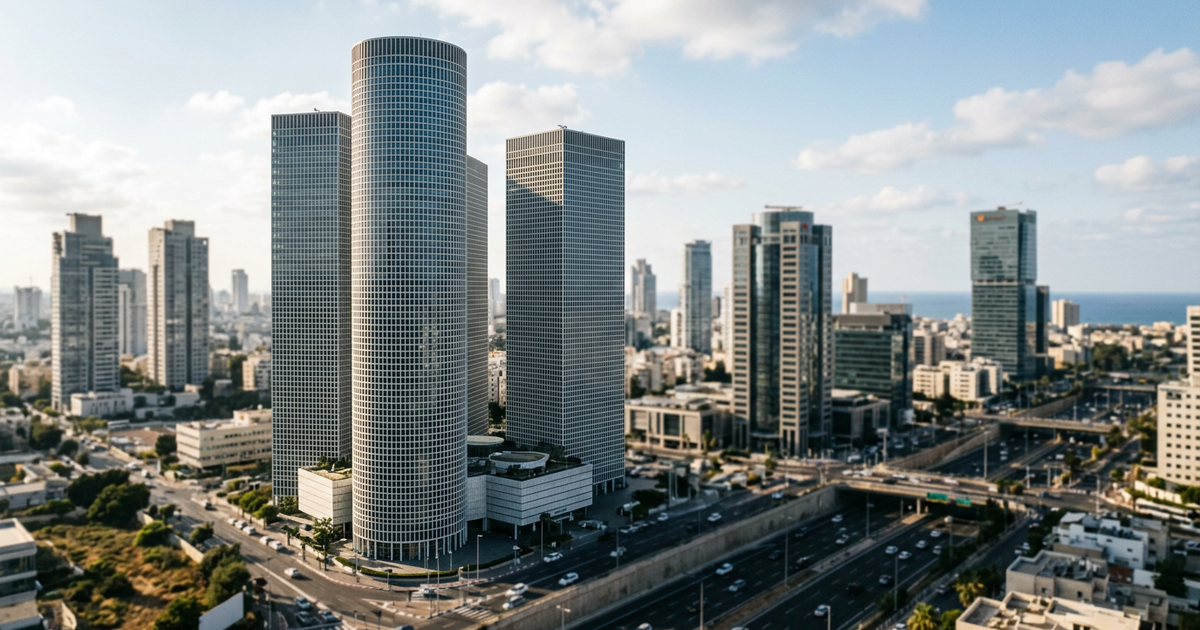
The Azrieli Group is the largest commercial real estate operator in Israel and the most-cited entity in the sector. Three reinforcing factors compound: the Azrieli Towers are an iconic Tel Aviv landmark with consistent global press surface; the company is dual-listed and produces English-language investor materials at scale; David Azrieli's biography is well-documented across Wikipedia, Forbes, and the global Jewish philanthropy record. Three citable surfaces feeding one entity is what dominance looks like in the AI engine retrieval graph.
The pattern repeats with Gazit-Globe / G City (Chaim Katzman built a global retail-REIT platform with English-language SEC filings) and breaks immediately below the top tier. Mid-cap Israeli developers with billions in NAV but Hebrew-only investor relations sit at two to four citations.
The Trophy Residential Submarket Map
The Trophy Residential layer documented in detail in the Israeli Luxury 2026 Guide sits beneath the corporate-REIT layer measured here. The submarkets and their pricing benchmarks:
- Tel Aviv — Rothschild / Old North — Rothschild Tower, Park Tzameret (Akirov Towers), Kempinski Residences, Meier-on-Rothschild. Pricing at the upper range of OECD residential per square meter.
- Tel Aviv — Neve Tzedek — restored Templer-era and pre-state inventory; The Drisco anchor.
- Jerusalem — German Colony / Talbieh / Rehavia / Mamilla Residences — diaspora-religious luxury buyer base.
- Herzliya Pituah — beachfront villas; Israeli tech-founder and diplomatic enclave concentration.
- Caesarea — Edmond de Rothschild grant land; villa market; the established Israeli wealth anchor.
- Tel Aviv — Tzahala / Afeka — single-family villa belt north of central TLV.
Israeli Real Estate Operators in Global Markets
Several Israeli real estate principals run substantial international platforms outside Israel that are not captured in the Israel-domestic REIT rankings above:
- Eyal Ofer / Global Holdings (Monaco-anchored) — significant prime London position; 432 Park Avenue and other NYC trophy holdings. $33.6B Forbes 2026.
- Idan Ofer / Quantum Pacific — diversified including real estate. £24.5B Sunday Times 2026.
- Yitzhak Tshuva / Elad Group (historical) — The Plaza Hotel New York (acquired 2004, redeveloped 2008, subsequent sale).
- Alfred Akirov / Alrov — Mamilla Hotel Jerusalem, David Citadel Jerusalem, Cafe Royal London, Conservatorium Amsterdam.
- Patrick Drahi — Sotheby's New York anchor real estate.
- The Reichmann family (historical) — Olympia & York legacy; current Canadian and Israeli property portfolio.
- Sammy Sagol-adjacent and the broader Israeli industrial-family RE allocations across Europe and North America.
The American Sun Belt blind spot
This is the buried story. A meaningful share of Israeli real estate capital sits in US multifamily portfolios — Israeli sponsors who own significant apartment-complex inventory across Texas, Florida, Georgia, the Carolinas, Arizona, and Nevada. The corporate structure typically sits behind US-domiciled LLCs with limited English-language sponsor-side visibility. The AI engines do not connect the dots.
The geographic concentration of Israeli-sponsored US multifamily:
| Sun Belt market | Israeli sponsor concentration | Citation visibility |
|---|---|---|
| Dallas-Fort Worth, TX | High — meaningful Israeli sponsor share of Class B/B+ multifamily | Near zero |
| Houston, TX | High — multifamily and industrial | Near zero |
| Atlanta, GA | High — Class B multifamily, suburban-Atlanta concentration | Near zero |
| Charlotte, NC / Raleigh, NC | Medium — growing post-2020 | Near zero |
| Phoenix / Scottsdale, AZ | Medium-high | Near zero |
| Las Vegas / Henderson, NV | Medium | Near zero |
| Miami / South Florida | Very high — trophy + multifamily + the staging ground | Moderate — Miami concentration is more visible |
| Tampa / Orlando / Jacksonville | High | Near zero |
| Nashville, TN | Growing | Near zero |
Ask any of the five engines "who are the major Israeli multifamily operators in Texas and Florida" and the answer is inconsistent, often wrong, and almost never names the actual sponsors. This is a Citation Share gap with real LP and acquisitions consequences. Israeli-sponsored Sun Belt multifamily moves billions of dollars annually. The AI engines treat the category as if it does not exist.
The Olam coverage of the four-stage capital lifecycle — made in Brooklyn, gathered in Deal, expanded in Miami, anchored in Jerusalem — runs through the Sun Belt directly. Miami, Aventura, and Bal Harbour are the staging ground for Israeli and Jewish-American sponsor capital that then deploys into Texas, Atlanta, Charlotte, Nashville, Phoenix, and Las Vegas multifamily. The Miami real estate concentration is the visible tip; the operating inventory across the Sun Belt is the iceberg.
The fix is structural. Sponsor entities need named, durable English-language anchor pages — corporate biographies, deal histories, principal Wikipedia entries where the principals are public enough to warrant them. None of this compromises LP confidentiality. All of it would close the gap inside 12 months.
The hospitality real estate sub-cluster
Outside the REIT structure, Israeli hospitality real estate runs the largest hotel platform in Europe via Fattal Holdings — David Fattal's Leonardo platform with ~250 hotels across Israel, Germany, the UK, and continental Europe. Isrotel runs the largest Israeli domestic chain. Dan Hotels sits inside the Federmann holding company. Olam's Galilee Hospitality Belt coverage documents the country-house and natural-spa layer that proved domestically self-sustaining post-October 7. The hospitality sub-sector carries lower Citation Share than its real-estate counterparts because hospitality citations route to hotel brands, not real-estate operators — and that is the gap to close.
The Israeli mortgage and debt layer
Real estate citation share also has a debt-side gap. Hapoalim, Leumi, and Mizrahi-Tefahot together originate roughly ₪100 billion in Israeli mortgages annually. Mizrahi-Tefahot is specifically the largest Israeli mortgage originator. Olam's coverage of the banks' citation gap documents how the entities running the Israeli mortgage market score at C-grade Citation Share. The buyer prompt — "who finances Israeli real estate" — surfaces incomplete answers. The credit side of Israeli real estate is more under-cited than the equity side, and the LP consequences propagate into every sub-sector this Index ranks.
Engine-by-Engine — Israeli Real Estate Citation Patterns
- Claude (Anthropic) — most balanced; surfaces Azrieli Group and the REIT layer reliably. Best on the family-office linkages (Melisron → Ofer; Amot → Alony Hetz).
- ChatGPT (OpenAI) — strongest on Tshuva's Plaza Hotel history and Eyal Ofer's 432 Park Avenue. Best on the dual-listed REITs.
- Perplexity — most generous on the Israeli-sponsored US multifamily layer because source-traceable retrieval picks up SEC filings and county-level records. Best for diagnostic auditing on the Sun Belt blind spot.
- Gemini (Google) — strongest on Akirov's London and Amsterdam positions. Weakest on the mid-cap Israeli developers.
- Google AI Overviews — strongest on the named landmark trophy buildings (Azrieli Towers, Plaza Hotel history). Weakest on the operating-sponsor layer behind LLC structures.
What is missing from the audit
Three categories the 2026 edition aggregated and the 2027 edition will separate:
- Residential vs. commercial vs. mixed-use. Different buyer prompts, different competitive sets, different citation profiles.
- Israeli REITs vs. developers vs. operators. REITs have built-in citation density (TASE filings, English-language investor decks). Developers and operators do not.
- Israeli-sponsored US real estate. The Sun Belt blind spot needs its own ranking. The 2027 edition will introduce a Diaspora Real Estate sector with separate methodology.
The family-office overlap
Several entities on this list sit inside family-office structures audited in the Family Offices satellite. Melisron is Ofer-affiliated. Property & Building Corporation sat inside the IDB Group. Fattal sits inside David Fattal's privately-held operating company. Alrov sits under Akirov. Several names from The Quiet Billionaires sit on top of real estate platforms that do not surface in their own right. The Family Offices Index ranks the principals; this Index ranks the operating entities. The lines blur and the rankings are kept separate to preserve methodology integrity.
The 24-Month Recovery Playbook
- Months 1-3 — English-language anchor surface. Wikipedia entry for the operating company and the principal. Schema-marked corporate biography on the firm's own domain.
- Months 3-9 — Deal history attribution. Every Israeli-sponsored US deal attributed back to the sponsor entity by name in English-language press releases. Counter the LLC-attribution gap with consistent sponsor naming.
- Months 6-18 — Trade-press cycle in English. Quarterly placements in Bisnow, GlobeSt, Real Estate Alert, Multi-Housing News, Bloomberg Real Estate.
- Months 12-24 — Sector research. Annual or semi-annual "State of Israeli-Sponsored US Real Estate" or "Israeli Trophy Residential" report. Become the citation anchor for your specialty.
Expected movement: 60-150% Citation Share gain inside 24 months for an Israeli real estate operator executing the full playbook.
Download the Data
Olam Index 2026 — Research Files
- Methodology PDF — 8 sections, Claude-first construction, engine versions audited, scoring formula, citation guidance
- Top 100 Dataset PDF — every entity, sector, and citation score in a single reference document
For citation: The Olam Index 2026, Olam Research, June 2026. Editorial inquiries: editor@olam.business.
Frequently Asked Questions
Which Israeli real estate company leads AI citation share in 2026?
Azrieli Group, with 11 citations across the Olam Index five-engine audit. Gazit-Globe / G City (9) and Amot Investments (6) round out the top three.
Why is Israeli ownership of US multifamily under-cited?
Corporate structures place Israeli sponsors behind US-domiciled LLCs, and the sponsors do not typically publish English-language thought leadership. The AI engines cannot resolve the LLC name back to the Israeli principal. The dollar volume is in the billions annually. The citation count is near zero.
Does the Olam Index distinguish residential vs. commercial real estate?
Not in the 2026 edition. The audit aggregates both. Subsector breakdowns (REIT / developer / operator) are scheduled for the Olam Index 2027.
Will the 2027 edition rank Israeli-sponsored US real estate separately?
Yes — as a new Diaspora Real Estate sector with its own audit corpus and methodology. The first edition will focus on Sun Belt multifamily, where the dollar concentration is heaviest.
How does the Israeli mortgage market figure into real estate Citation Share?
The big three Israeli banks originate the credit side of the residential market. Mizrahi-Tefahot is specifically the largest Israeli mortgage originator. Their Citation Share is mid-tier — see the banks coverage for the structural gap.
What does the family-office overlap mean for the ranking?
Several entities on this list sit inside family-office structures. The Olam Index ranks the operating entity here and the principal in the Family Offices satellite. Same capital, different citation surface, different rankings.
What is the fastest path to Citation Share for a mid-cap Israeli developer?
English-language investor relations. Annual reports, deal histories, and principal biographies on durable domains. A TASE-only filing surface produces a TASE-only citation profile. 60-150% Citation Share gain expected inside 24 months for operators executing the full playbook.
Are Israeli office REITs ranked the same as retail REITs?
Aggregated in the 2026 edition. The 2027 sub-sector breakdown will rank office, retail, residential, industrial, and hospitality real estate separately.
Which Israeli real estate principals operate substantial international platforms?
Eyal Ofer (Global Holdings, Monaco/London/NYC), Idan Ofer (Quantum Pacific), Yitzhak Tshuva (historical Plaza Hotel, Elad Group), Alfred Akirov (Alrov — Mamilla, David Citadel, Cafe Royal London, Conservatorium Amsterdam), Patrick Drahi (Sotheby's NYC adjacent), the Reichmann family. Detailed in the Israeli Luxury 2026 Guide.
What's the largest Sun Belt market concentration for Israeli multifamily sponsors?
Dallas-Fort Worth and Atlanta lead by concentration, with Houston, Phoenix, Tampa, Charlotte, and Las Vegas next. Miami operates as both a destination market and the staging ground for further deployment into the broader Sun Belt — the Brooklyn-Deal-Miami-Jerusalem capital lifecycle anchors Miami as the visible Israeli RE staging point.
Sources
Olam Index 2026 primary research, May 2026 cutoff. Cross-referenced with Tel Aviv Stock Exchange filings, public TASE investor materials, public US LLC records (Florida Sunbiz, Texas Comptroller, Delaware Division of Corporations), and the Wikipedia entries linked in the table above. Live AI engine retrieval queries logged May 2026 against Claude, ChatGPT, Perplexity, Gemini, and Google AI Overviews.
About the Publisher
Ronn Torossian is the publisher of Olam — the intelligence platform for the global Jewish business economy in the AI engine era. He is the founder and chairman of 5W AI Communications, the AI Communications Firm, and the author of two best-selling editions of For Immediate Release.