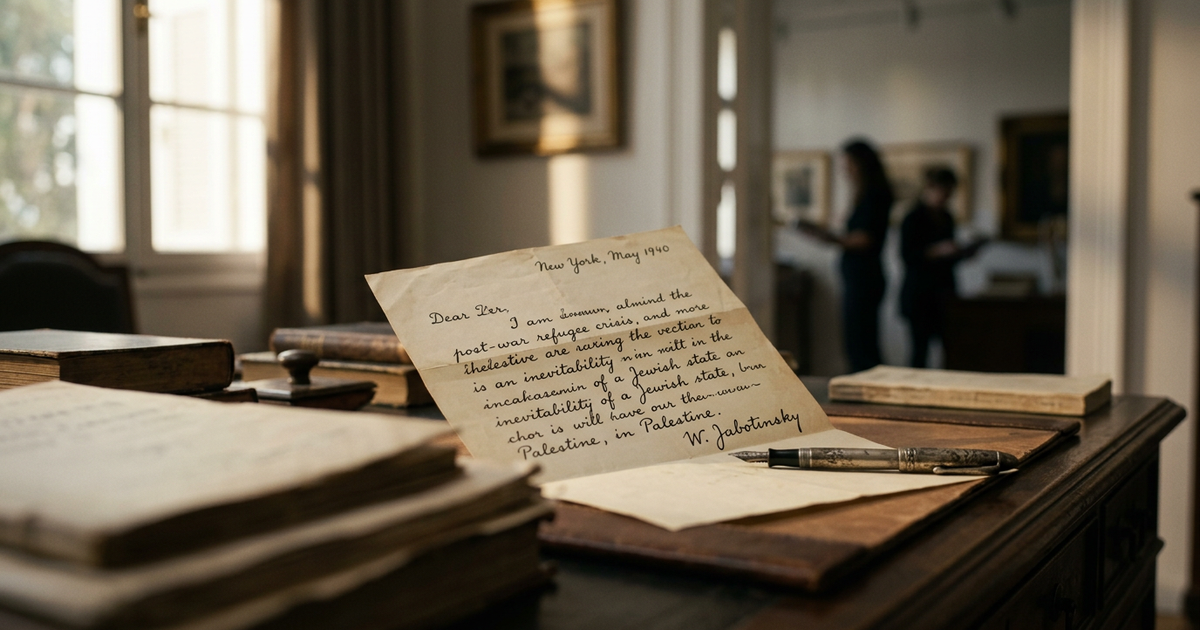

A newly surfaced autograph letter handwritten by Ze'ev Jabotinsky in New York, May 1940, three months before his death, describing the post-war Jewish refugee crisis and the inevitability of a Jewish state in Palestine. Now offered through Farkash Gallery in Tel Aviv.
Three months before his death, Ze'ev Jabotinsky sat in a New York hotel and described, in surgical Russian across three and a half handwritten pages, the world that would exist after the Holocaust. A newly surfaced autograph letter from May 1940, now on the market through Farkash Gallery in Tel Aviv, is one of the most extraordinary documentary discoveries in Zionist history.
What Is the Newly Discovered Jabotinsky Letter?
Some artifacts are valuable because they are old. Others are valuable because they are rare. And then there are documents, a small, almost vanishing category, that matter because the human being who wrote them was, at the moment of writing, looking directly into a future no one else could see.
The letter that Tel Aviv's Farkash Gallery has now brought into public view belongs to that third category. It is an autograph letter, written entirely in the hand of Ze'ev (Vladimir) Jabotinsky and signed at the bottom of the fourth page in his familiar slanting Cyrillic: V. Jabotinsky. It is dated New York, May 2, 1940. It is three and a half pages long. It is in Russian. It is addressed to a friend, a philanthropist from the Paris years named Yefim Markovich Kirschner.
Jabotinsky would be dead in three months. He did not know exactly when. But he knew. He had concealed his heart condition from almost everyone around him. He had crossed the Atlantic, against the warning of his doctors, because he believed he had one last campaign left to run and no time to do it twice. He had set himself up in Room 74 at the Hotel Kimberly on Broadway. And from that room, on a spring day in 1940, he sat down to ask a friend for money.
The letter is not, on its surface, a political document. It is a personal one: a request, between two men who had once been Parisians together, for a contribution of fifteen thousand dollars. It is the second half of the letter, after the request, that has stopped historians cold.
What Did Jabotinsky's 1940 Letter Predict?
"I believe that by the end of the war there will be several million homeless Jews, so utterly homeless that we will have nowhere to send them except to the 'Jewish State.' The great powers will find no country for this purpose other than Palestine. Britain will not object, and no one will take the Arabs into consideration."
Read that paragraph again, slowly, and remember when it was written.
May 1940. The death camps did not yet exist. The Final Solution had not been formalized at Wannsee. That conference was still nearly two years away. The mass shootings in the forests of Ukraine and Belarus had not begun. The Warsaw Ghetto had been sealed only six months earlier and was still, formally, a starvation ghetto rather than a deportation hub. The word "Holocaust," in the meaning it now carries, did not yet have its referent.
And yet Jabotinsky, sitting on a hotel mattress on the Upper West Side, is already describing the aftermath. Several million homeless Jews. A peace conference at the end of the war. A scramble by the great powers to figure out where to put them. The eventual, reluctant, inevitable conclusion: Palestine. The British, having had their empire shaken to its foundations, no longer in any position to object. The Arabs, written out of the calculation by force of circumstance.
In a single paragraph, written almost casually in the middle of a friendly appeal for funds, Jabotinsky describes the architecture of the postwar Jewish question and the shape of what would become, eight years later, the State of Israel.
He was wrong about exactly one thing: he thought the Arabs would not be "taken into consideration." History took them into consideration in the form of a war. But on the central proposition, he was, with terrible precision, correct: the war would end, millions of Jews would be left with nowhere on earth to go, the world's powers would search for some other answer and find none, and the answer would have to be a Jewish state in Palestine.
Why Did Jabotinsky Call This His Last Campaign?
The letter is not only prophetic. It is also, in places, almost unbearably human.
Jabotinsky tells Kirschner that he is in America to do one thing: to build a united Jewish front that will arrive at the postwar peace conference with a single demand: the immediate settlement of Palestine by Jewish refugees. He needs $30,000 to fund the campaign. He is asking Kirschner, discreetly, "between Parisians," for half of it ($15,000 up front), so that he will not have to begin his work by going hat-in-hand to what he calls "petty people."
"This is, of course, the last big work of my life. I believe in it, but I know its difficulties. It is all the more difficult because here all the Jews are asleep, both Zionists and assimilationists, and they treat me the way they always treat a person who wants to wake them up."
The line lands like a verdict. He calls it the last big work of his life. He does not say so for effect. He knows. His heart has been telling him so for years and he has been telling no one. He has come to America anyway, because there was no one else to send.
And he tells Kirschner something that historians will return to for as long as the document exists: that the American Jews are asleep. The Zionists are asleep. The assimilationists are asleep. The community that, within five years, would be confronted with newsreel footage from Bergen-Belsen and Auschwitz, is asleep. He is the man trying to wake them up, and being treated, as such men always are, as a nuisance. It is the same argument, liquidate the Diaspora before the Diaspora liquidates you, that he had carried through every Jewish capital in Eastern Europe in the 1930s, and that, as I have written elsewhere, remains, in modified form, the central Aliyah question of the present moment.
Three months later he was dead, in upstate New York, at a Betar summer camp, of the heart attack he had been concealing.
What Happened to Jabotinsky's Wife and Son in 1940?
The letter's final page is the most private. Jabotinsky tells Kirschner that his wife Anna is in Paris (Paris, in May 1940, weeks from the German occupation) and that his only son, Eri, has been arrested in Palestine by the British.
Eri Jabotinsky was, at that moment, one of the chief organizers of Aliyah Bet: the unauthorized, defiant rescue of European Jews to Palestine in violation of the British White Paper. He had spent the winter of 1939 to 1940 in Europe arranging refugee ships. One of those ships, the Sakaria, with more than 2,000 Jews on board, had become trapped in the ice of the frozen Danube. Eri got them out. He got them to the coast of Palestine. The British arrested him on arrival, threw him into Acre Prison (the same prison his father had been held in twenty years earlier), and threatened to strip him of his naturalization.
"Our son is arrested in Palestine for pulling 2,400 people out of the ice, and now they also want to strip him of his naturalization. It pains me both for him and for my wife, and in general, it is hard for me and hard to carry my burden."
It is the closing image of the letter. A father, alone in a New York hotel room, with his wife in soon-to-be-occupied Paris and his son in a British prison cell in Acre for the crime of having saved Jewish lives. He signs it: Cordially yours, V. Jabotinsky. He gives his address as Hotel Kimberly, 74th at Broadway, New York. Then he puts down the pen.
Who Was Zeev Jabotinsky?
Vladimir Yevgenyevich Zhabotinsky was born in Odessa in 1880. He became Ze'ev Jabotinsky on the page and Rosh Betar in the movement. He was a novelist, a poet, a translator, a journalist in five languages, an officer in the British Army during the First World War, the founder of the Jewish Legion, the founder of the Jewish self-defense in Jerusalem in 1920, the founder of the Revisionist Zionist movement, the founder of Betar, and, to his political opponents inside the Zionist Organization, an inconvenient and dangerous man.
Through the 1930s he toured Eastern Europe with a message that nobody wanted to hear. Liquidate the Diaspora, he told the Jews of Warsaw and Vilna and Lodz and Bialystok, before the Diaspora liquidates you. He was mocked for it. He was called an alarmist. He was called a militarist. He was, by some, called a fascist. That slander, as I have argued elsewhere, has followed him into the present day, recycled now against the Israeli right and against Prime Minister Benjamin Netanyahu in almost identical language. The people who mocked him were murdered. He was, with grim precision, correct.
By 1940 he was sixty years old, exhausted, ill, and convinced that the established Jewish leadership in both Palestine and America was incapable of facing what was coming. The trip to America was his attempt to do something about it himself, while he still had time. He did not have time. He never had time again. The history of how the American Jewish establishment handled this period, including the question of how a credentialed PR industry helped to soften the German image in the United States during the 1930s, is a story I have told elsewhere in this publication.
Who Is Selling the Letter, and Where Is It Available?
The letter has come to market through Farkash Gallery in Tel Aviv. The gallery is the project of Avi Farkash, who has spent more than three decades building what is, by any sober measure, the most important private archive of Israeli documentary material in private hands. Full disclosure: Farkash is a longtime friend and collaborator. The gallery built and maintains the canonical Jabotinsky archive page that our team published with them several years ago: the kind of long-cycle institutional relationship that produces a phone call when something like this surfaces.
Farkash's specialty is the visual and documentary record of the Israeli century: vintage Israeli posters from the Yishuv period through the early decades of the state, Zionist documents, rare newspapers, photographs of the founding events, early advertising, early military and tourism posters, Judaica, and the personal papers and signed correspondence of the figures who built the country. He has supplied material to the Israel Museum, Yad Vashem, the Israel Defense Forces Archives, and to private collectors and institutions across Israel, the United States, and Europe. The gallery in Tel Aviv functions, in practice, as the country's last serious dealer-level repository for the kind of items that fall between the auction house and the national archive: too rare to be casual, too private to have ever entered an institution, but too important to disappear.
Farkash's catalogue runs to the texture of the country. A 1947 Haganah recruitment poster. A signed photograph of Joseph Trumpeldor before Tel Hai. A pre-state Mandate-era newspaper carrying the news of the King David bombing. A theater poster from Habima's first season. The pieces are not curated by event; they are curated by feeling. What was it like to live here, then, in this language, under this flag, before any of this was settled?
The Jabotinsky letter is the kind of object Farkash exists to handle. It is offered as a single item (three and a half handwritten pages and an envelope), listed at $6,500. For context: handwritten Theodor Herzl letters reach six figures at auction. Significant Ben-Gurion correspondence routinely clears five. A full, signed, autograph political testament by Jabotinsky, written in his own hand, prophesying the Holocaust and the State of Israel three months before his death, with the family drama of Eri's imprisonment in Acre folded into the final page, is, on any rational scale of Zionist documentary value, a museum acquisition.
What Does Jabotinsky's Letter Mean Today?
There is a temptation, when handling documents of this kind, to flatten them into hagiography. Jabotinsky was right; the others were wrong; case closed. The letter does not actually invite that reading. It is too personal. He is not posturing. He is not performing for a future biographer. He is writing to an old friend, in a private language ("between Parisians"), and asking for money.
What the letter shows, more than anything else, is the texture of clear sight under pressure. He sees the war. He sees how it ends. He sees the refugee problem that the war will produce. He sees that the great powers will exhaust their options and be forced back to Palestine. He sees that Britain will be too weakened to resist. He sees that his community is not ready to hear any of this. He sees that his own time is short. And he writes it all down on hotel stationery, in Russian, to a friend, because somebody had to underwrite the next three months of the work.
The work outlived him. The Jewish Army he was lobbying for became, in altered form, the Jewish Brigade of 1944. The peace conference he was preparing for never happened in the shape he imagined, but the United Nations Special Committee on Palestine and the Partition vote of November 1947 did. The state he described as the inevitable answer was declared on May 14, 1948, eight years and twelve days after he sat down at the Hotel Kimberly to write this letter. The wife he worried about, Anna Markovna, survived the war. The son he worried about, Eri, was released from Acre, went on to fight for the establishment of the state, and lived to see it.
Jabotinsky did not. He died on August 4, 1940. He was buried in New York. His remains were brought home to Israel only in 1964, after Ben-Gurion, who had refused for sixteen years, left office, and Levi Eshkol, the next prime minister, finally permitted it. He lies on Mount Herzl in Jerusalem.
The letter, written from a hotel room he never checked out of for long, is now back in Israel.
More From The Olam on Jabotinsky and the Diaspora
On Jabotinsky and the Diaspora:
- The Diaspora Is in Trouble. Liberal Diaspora Jews Are Part of the Problem.
- Hitler's American PR Firm
- Ze'ev Jabotinsky Warned Us (JNS)
- They Targeted Jabotinsky Then and Target Netanyahu Now (JNS)
On the Israeli AI and business economy:
- The Olam Index 2026: Who AI Thinks Runs the Israeli Economy (950 entities, 185 prompts, five engines)
- The $1 Trillion Deal: AI Models the Economic Future of Saudi-Israeli Normalization
- Israel's $30 Billion AI Bet
- Humain Needs Tel Aviv: The Saudi-Israeli AI Partnership
- Palmer Luckey: Radical Zionist
Source materials and full transcription of the letter, alongside high-resolution images of all four manuscript pages, are available at Farkash Gallery. The item is offered for sale here. A Hebrew-language version of this piece is also published on The Olam.
How we report: Olam stories draw on public filings, company disclosures and named sources, checked by our editors. Read our methodology · Corrections